AI-Generated Free Tools: When Utility Becomes Scaled Content Abuse
Use a 12-point launch gate and a matched-query test to decide whether an AI-assisted tool library creates distinct utility or thin indexable templates.
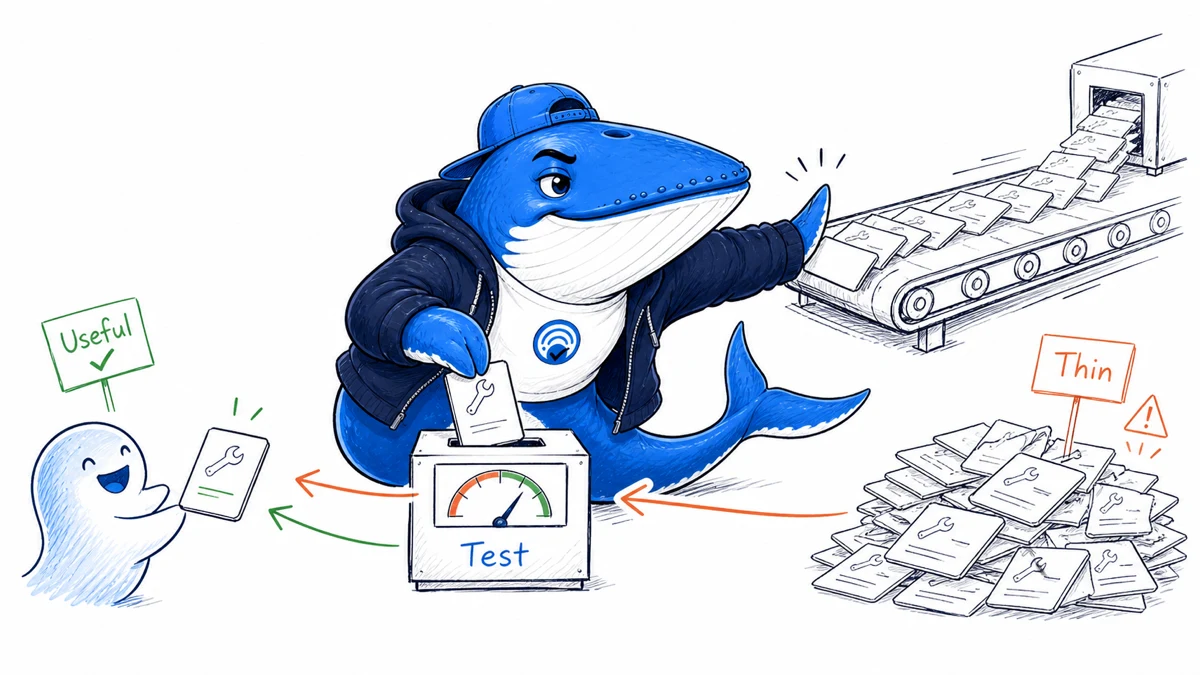
A large library of AI-assisted tools can be useful, but scale is not evidence of value. Publish an indexable tool page only when it performs a distinct reader job, validates inputs, produces a useful result, explains its limits, and receives ongoing human ownership. Consolidate, revise, or noindex pages that differ mainly by keyword or decoration.
Google does not prohibit appropriate use of generative AI. Its guidance warns that producing many pages without adding value may violate the scaled content abuse policy, regardless of whether the pages were written by people, automation, or both. The key distinction is not “AI or no AI.” It is whether the library exists to help users or primarily to manufacture search entry pages.
Count useful decisions, not URLs
A percentage calculator, redirect mapper, robots tester, and title preview solve different problems. One calculator cloned into hundreds of city, industry, or keyword pages may not. The strongest tool has a clear input, a defensible transformation, an output the reader can act on, and guidance for cases where the calculation does not apply.
Before building a library, inventory the intended tools in a table. Give each one a reader, decision, unique logic, required data, expected output, failure states, owner, and update trigger. If two rows have the same logic and outcome, consider one flexible tool with useful presets instead of separate indexable pages.
Run the 12-point launch gate
| Check | Pass condition | Possible action |
|---|---|---|
| Reader job | One real task or decision is explicit. | Rewrite the brief. |
| Distinct logic | The computation or workflow differs materially. | Merge duplicate variants. |
| Inputs | Fields are necessary, labeled, and validated. | Remove decorative inputs. |
| Output | The result changes what the user can do. | Revise or do not publish. |
| Boundary | Assumptions and unsupported cases are visible. | Add limits and stop rules. |
| Examples | Examples demonstrate use without pretending to be evidence. | Add verified scenarios. |
| Alternatives | The page says when another method is better. | Add comparison guidance. |
| Template risk | The main content is not a near-duplicate shell. | Consolidate variants. |
| Indexing | The page merits a standalone search result. | Noindex utility states. |
| QA | Edge cases, accessibility, and mobile use are tested. | Hold release. |
| Ownership | A named owner can correct logic and copy. | Do not launch orphaned tools. |
| Maintenance | A date or product change triggers review. | Record the contract. |
Recognize four common library patterns
Pass: a set of tools uses different inputs and mechanisms for different decisions. Each page includes a native interface, accessible result, worked example, limitations, and relevant documentation.
Revise: the tool is useful, but the page is a generic introduction wrapped around an embed or opaque result. Improve validation, explain the method, add a reproducible example, and show when the output should not be used.
Consolidate: fifty pages change only an occupation, city, platform, or adjective while running the same calculation. Use one tool with meaningful controls, and create supporting pages only where the underlying decision truly differs.
Noindex or do not publish: the page returns generic generated text, has no stable method, exists only for a long-tail phrase, or cannot be maintained. Utility for an existing user does not automatically make a state worthy of indexing.
Do not confuse technical eligibility with editorial value
A page can be crawlable, canonical, fast, and valid while still being unhelpful. Conversely, a genuinely useful tool can fail discovery because its output is available only after client-side actions, its instructions are hidden, or internal links do not reach it. Technical and editorial gates must both pass.
Google’s AI-search optimization guidance says normal search foundations apply and does not require special AI markup or an llms.txt file. Adding schema does not repair a thin tool. Structured data must accurately describe visible content, and it does not guarantee inclusion.
Make the output inspectable
If the tool calculates a score, show the components and units. If it transforms text, keep the input and output available for comparison. If it calls an AI model, disclose the model surface, date, variable behavior, data handling, and what a user must verify. Do not present generated recommendations as deterministic facts.
Store progress locally when possible and say so. For bring-your-own-key tools, keep keys in the user’s browser, avoid logging them, and document the external provider request. A privacy statement is part of the interface, not footer decoration.
Release a small representative set first
- Choose three to five tools that serve clearly different jobs.
- Test them with real inputs, invalid inputs, mobile layouts, keyboard navigation, and assistive technology.
- Observe whether readers complete the task, return, save a result, or reach the intended next step.
- Review indexed pages for template repetition and unsupported promises.
- Expand only when the next tool contributes distinct logic or evidence.
Page count should be an output of useful coverage, not a production target. Use the site’s current tools as a quality baseline: native, usable without an iframe, bounded, and explained. For the surrounding article, follow the evidence-led publishing guide so generated claims never bypass sourcing.
Google’s generative UI changes the free-tool decision
Update, September 9, 2026: Google says Search can now generate interactive tools and simulations for some learning questions. The company describes generative UI as globally available in English in AI Mode and beginning to roll out in AI Overviews. Its example generates a pH visualization; it also documents quiz creation in both surfaces.
This is a capability announcement, not evidence that independent calculators have lost a fixed percentage of traffic. A Reddit discussion helped surface the change, but its “90%” traffic claim did not link to a study and some commenters could not reproduce the same result. We are not using that number.
The product change does raise the quality bar. A page whose entire value is a basic one-shot calculation is easier for a search surface to satisfy directly. A tool with persistent state, specialist data, batch inputs, exports, collaboration, reproducible methods or a consequential workflow still gives the user something a generated inline widget may not.
| Tool value | Weak page | Stronger independent utility | Evidence to collect |
|---|---|---|---|
| Calculation | One formula with generic explanatory copy | Validated assumptions, ranges, scenarios and inspectable formulas | Completion, correction and export events |
| Data | Repackages public constants | Fresh first-party, licensed or user-supplied data with provenance | Dataset version, coverage and error reports |
| Workflow | Returns one isolated result | Batching, saved state, handoffs, comparison and downloadable records | Repeat use and task-completion paths |
| Decision | Produces an unexplained score | Shows evidence, uncertainty, alternatives and a stopping rule | Inputs reviewed and decisions changed |
| Trust | Opaque model output | Named owner, tested edge cases, corrections and privacy boundary | Version log, failure cases and support record |
Run a matched query test before consolidating tools
- Select 20 queries that currently lead to a specific tool page. Freeze country, language, device, account state and search surface.
- Record whether Search shows a standard result, direct answer, generated UI, quiz, simulation or no special treatment.
- Save the result state and the exact date. Do not infer a global rollout from one account.
- Compare Search Console impressions and clicks for the same page and query set over matched periods.
- Measure on-site task completion, exports, saves and return use separately from search clicks.
- Improve or consolidate a page because its reader job is weak, not because one screenshot predicted a traffic collapse.
Download the 20-query observation ledger. Its rows are marked EXAMPLE-REMOVE; it is a test fixture, not measured SearchEngineAnswer results.
Primary documentation
Keep learning
Continue this topic
Next in this topic
Robots.txt Is 200 but Unreachable to Google: A Network Diagnostic
Earlier in this topic
Seasonal SEO After the Event: Keep, Update, Redirect, or Remove?
SEO
Ask a question or join the discussion