Bing AI-Guided Image Search: What 8 Desktop Queries Showed
In one US-English desktop run, Bing grouped seven of eight image queries. See the exact labels, source-panel behavior, negative case, and study limits.
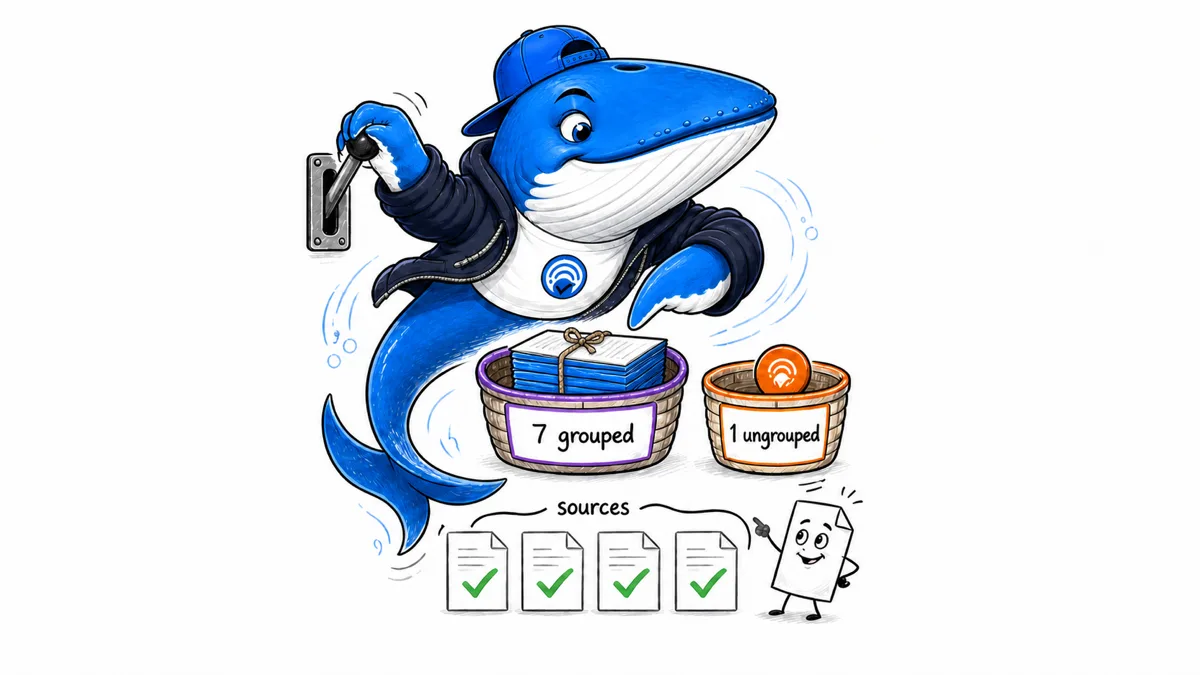
Observed August 31, 2026: Bing’s optional AI-guided image-search view grouped seven of eight queries in one signed-out, US-English desktop session. The grouped runs exposed 43 visible labels, while 21 visible summary cards carried a “4 Sources” badge. One product-color query loaded ordinary image results without the guided layer.
This is a small interface observation, not a ranking study. It shows how Bing organized this particular sample and where a publisher audit should look next. It does not establish a selection formula, traffic effect, persistent market behavior, or new image-SEO requirement.
What changed since the original protocol
Microsoft announced the experience in May 2026 as an optional “New Version” for US desktop users. Its example showed images organized into categories with generated descriptions and source links. The original version of this page therefore published a test protocol and stayed out of the search index until results existed.
We have now completed the first bounded run. Before opening the new experience, we confirmed that the conventional image-results page exposed the “New Version” switch. We then ran eight fixed queries on the guided route and recorded the visible group headings and source-badge cards. The evidence supports a narrow results article, not a broad performance claim.
Method and environment
The observation used Bing Images on a 1280×720 desktop viewport, signed out, with mkt=en-US, cc=US, and setlang=en-US in the URL. All eight queries were captured on August 31, 2026. The market and language parameters were explicit; the underlying IP location was not independently verified.
The query set was intentionally heterogeneous rather than statistically representative. It covered Bing’s announcement example, an artist, a how-to, an educational diagram, an ambiguous entity, design inspiration, a product attribute, and a current-event map. Each query was run once. We coded three visible layers separately:
| Layer | Recorded evidence | What the count does not prove |
|---|---|---|
| Guided result | Whether a generated grouping layer appeared | That the same layer appears for every user or rerun |
| Group label | Every visible heading that named a cluster | That each heading had a complete summary card in view |
| Source badge | Visible cards labeled “4 Sources” | That every linked source was unique, accurate, or an image owner |
We did not score every image thumbnail or click every destination. One source badge;the main “2026 Solar Eclipse Path Map” card;was opened for a deeper source-panel check. The downloadable row-level file preserves the queries, labels, counts, environment, stable observation URLs, and notes.
The coding rule deliberately follows what was rendered, not what the interface might load after more scrolling or interaction. That keeps the observation reproducible and prevents unseen cards from being converted into assumed evidence.
Results at a glance
Seven of eight queries produced visible AI-guided content, an in-sample rate of 87.5%. The seven grouped runs contained 43 visible headings in total. Twenty-one visible cards showed a “4 Sources” badge. Those numbers have different denominators and should not be collapsed into a single coverage metric.
| Query | Guided? | Visible labels | Visible “4 Sources” cards | Most useful observation |
|---|---|---|---|---|
| Highest Mountains in Washington | Yes | 5 | 5 | Named five individual peaks |
| Picasso | Yes | 3 | 3 | Grouped by movements or medium |
| espresso brewing methods | Yes | 5 | 5 | Grouped mainly by equipment |
| human heart diagram | Yes | 9 | 1 | Many anatomy-specific headings |
| jaguar | Yes | 7 | 1 | Every visible label meant the car brand |
| living room paint ideas | Yes | 5 | 5 | Grouped by palette families |
| Sony WH-1000XM6 colors | No | 0 | 0 | Ordinary image results appeared |
| 2026 solar eclipse path map | Yes | 9 | 1 | The inspected source panel named four destinations |
| Total | 7 of 8 | 43 | 21 | One session; one run per query |
The grouped experience was not restricted to broad inspiration searches. It also appeared for educational diagrams and a date-specific map query. Conversely, the specific headphone-color query did not receive the guided layer in this run. That contrast is useful as an observation, but eight queries cannot identify the feature’s triggering logic.
Labels revealed different organizing strategies
The headings did more than subdivide a generic image grid. Their organizing rule shifted with intent. “Highest Mountains in Washington” became five named peaks: Mount Rainier, Mount Adams, Mount Baker, Glacier Peak, and Mount Olympus. “living room paint ideas” became five palette families: Neutral Tones, Bold Colors, Pastel Shades, Earthy Hues, and Dark Colors.
For “espresso brewing methods,” the view used equipment labels;Espresso Machine, Moka Pot, Aeropress, French Press, and Keurig. That is a meaningful reframing: a publisher may write about techniques while the interface clusters around devices. For “human heart diagram,” the labels moved from orientation to anatomy, including anterior, posterior, cross-section, arteries, veins, chambers, valves, and a 3D illustration.
The practical lesson is to record the label before evaluating representation. A page can be relevant to the typed query yet absent from a narrower generated category. That absence does not by itself show an indexing problem.
The “jaguar” query exposed an ambiguity risk
All seven visible headings for the ambiguous query “jaguar” referred to vehicles: Jaguar Cars, F-Type, XJ, E-Pace, I-Pace, XK120, and F-Pace. No animal-oriented heading appeared in the captured guided layer.
This does not mean Bing always interprets the word as a car brand. It records one deterministic-looking presentation in one environment. Still, it demonstrates why ambiguity deserves its own test class. A publisher covering the animal could be technically indexed and visually relevant while the generated navigation commits to a different entity.
When auditing an ambiguous subject, save the complete heading set rather than checking only whether one thumbnail appears. Then rerun with disambiguating terms, such as “jaguar animal,” and compare the source pages and destinations. That produces a testable entity-resolution note instead of an unsupported claim about visibility.
What the inspected source panel showed
The main summary card for “2026 solar eclipse path map” displayed a “4 Sources” badge. Opening it exposed four linked destinations: Timeanddate.com’s August 12 eclipse map, the NASA Eclipse Web Site map, the National Solar Observatory map, and a NASA Scientific Visualization Studio page.
| Displayed source | Organization | What was verified |
|---|---|---|
| August 12, 2026 eclipse map | Timeanddate.com | The destination was listed in the opened panel |
| SEsearch map | NASA Eclipse Web Site | The destination was listed in the opened panel |
| Eclipse Map 2026 | National Solar Observatory | The destination was listed in the opened panel |
| 2026 eclipse visualization | NASA SVS | The destination was listed in the opened panel |
The test verified panel membership, not the factual accuracy of every generated sentence or the ownership of every displayed image. It also revealed a separation that matters to publishers: summary sources are a distinct surface from the landing pages attached to individual image thumbnails. A summary source is not automatically an image owner, and a citation in one layer should not be reported as image attribution in another.
What publishers can;and cannot;infer
The sample supports three modest conclusions. First, guided grouping appeared across several intent types. Second, the generated organizing dimension varied by query. Third, the source panel can surface recognizable primary or specialist destinations, but that panel is separate from thumbnail attribution.
It does not show that a particular schema field, caption style, file format, or page template caused inclusion. Microsoft did not disclose such a rule in the announcement, and this test made no controlled page changes. It also measured no impressions, clicks, referrals, conversions, or conventional image-ranking positions.
Publishers should therefore keep established foundations: crawlable landing pages, stable image URLs, accurate alternative text, visible captions where useful, clear ownership and licensing information, sensible dimensions, and consistency between the image and surrounding copy. The technical SEO launch checklist helps verify those basics. Treat any change as an experiment using the small SEO experiment method, not as an “AI grouping” shortcut.
A repeatable publisher audit
- Lock the environment. Record date, country and language parameters, viewport, signed-in state, SafeSearch setting, browser, and whether the New Version is enabled.
- Predefine the query set. Mix broad, specific, ambiguous, brand, product, diagram, current-event, and publisher-owned queries.
- Code the layers separately. Record whether guided content appears, then transcribe labels, summary badges, image thumbnails, and destination URLs in separate fields.
- Open source panels selectively. Save every listed destination and distinguish a summary citation from an image landing page.
- Preserve negative cases. An ungrouped query is evidence; do not silently replace it with a query that produces the desired interface.
- Rerun without merging observations. A later capture is a new row set. Compare it with the earlier run instead of overwriting history.
For a publisher-owned image, add the visible thumbnail crop, apparent host, clicked destination, final redirect, canonical URL, and whether the page identifies the creator or license. Those fields are necessary before reporting attribution quality.
Limitations
- Small purposive sample: eight queries are useful for interface inspection, not prevalence estimates for Bing Images.
- One run per query: the test does not measure day-to-day, account-level, device-level, or geographic variation.
- Parameter, not IP, verification: US market and English were set in the URL; network geolocation was not independently audited.
- Viewport-dependent counts: “visible” means present in the captured desktop page state. Lazy-loaded or interaction-dependent cards may exist beyond it.
- One deeply inspected panel: all 21 visible badges were counted, but only the eclipse panel’s destinations were transcribed.
- No destination census: individual image landing pages, duplicates, redirects, canonical ownership, and licensing were not fully audited.
- No performance outcome: the study cannot connect grouping to impressions, traffic, revenue, or ranking.
- Interface instability: labels, sources, and availability can change after the capture date.
Download the observation data
Download the eight-query observation CSV. It contains one row per query, the test environment, guided-content flag, visible label count, visible source-badge count, exact label transcription, stable observation URL, and a boundary note.
The file excludes cookies, account data, request headers, browser storage, and transient session identifiers. The URLs retain only the query and explicit market/language parameters needed to reproduce the route.
Publisher implication
Image-search guidance changes the importance of context around the asset
In the eight desktop queries, the useful unit was not the image alone. The visible result also depended on the surrounding topic, source and destination.
- Publish an original, high-quality image that answers a real visual need.
- Keep the caption and nearby explanation specific to what the image shows.
- Make the destination page valuable even when a user arrives for the image first.
My takeaway: I would optimize the image and its explanatory page together. Decorative volume is not a substitute for a useful visual source.
Update and source note
Updated August 31, 2026: this page replaced a preregistered protocol with the completed first observation, row-level data, exact environment, negative case, inspected source-panel example, and limitations. Editorial standards for evidence, corrections, and material updates are described in our editorial policy.
Keep learning
Continue this topic
Next in this topic
Cloudflare Crawl-to-Referral Ratios: A Defensible Audit Method
Earlier in this topic
Kagi AI-On vs AI-Off: A Reproducible Search Test Protocol
Research
Ask a question or join the discussion