Google Package Tracking: Run a 30-Field Maintenance Audit
Separate the closed new-partner intake from existing-integration work, then audit latency, status fields, privacy, display accuracy and incident ownership.
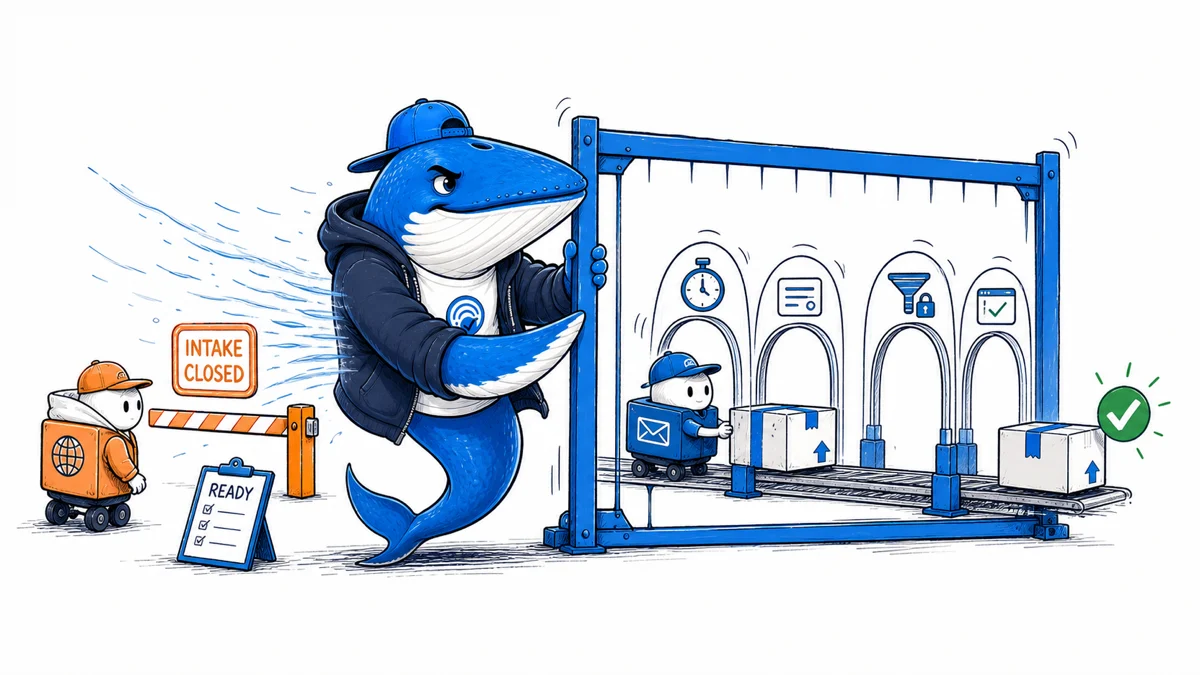
Direct answer: Google’s package-tracking Early Adopters Program is no longer accepting new partners. The current documentation still describes the Search feature and its API contract for participating carriers. That makes the practical job an integration-maintenance audit for existing partners, not an application guide for prospective carriers.
Google last updated the page on July 14, 2026. Existing partners should verify availability, average and 95th-percentile response time, required status fields, privacy filtering and display accuracy. Prospective partners should record readiness without treating the old interest form as an open route. The downloadable 30-field maintenance ledger separates those two states.
The documented change is intake closure, not feature retirement
The current Google Search package-tracking documentation, retrieved August 29, 2026, says the Early Adopters Program is no longer accepting new partners. It also says package tracking remains available in languages and countries where Google Search is available and continues to document the integration contract.
That wording does not establish that every existing carrier still participates, that the feature appears for every eligible query, or that Google has retired package tracking. The Search documentation update log describes an intake change and newly recommended fields. Preserve that boundary in roadmaps, support articles and internal tickets.
| Question | Current documented state | Safe action |
|---|---|---|
| Does Google document a package-tracking Search feature? | Yes | Use the live page as the contract source |
| Can a new carrier join the Early Adopters Program? | No; intake is closed | Do not promise an application path |
| Are operational requirements still documented? | Yes | Existing partners can audit their integration |
| Does structured data alone activate the feature? | Google does not document that route | Do not present markup as a substitute for partnership |
Confirm partner state before allocating integration work
Ask the carrier’s named Google contact and internal integration owner whether the company is an existing participant. Preserve the answer, date and evidence reference. A live Search result is useful observation, but it is not a complete partner record because appearance can vary and may disappear during an incident.
If the company is not an existing partner, stop implementation work that assumes access. Keep a privacy-safe readiness record for a future program, but do not build against an undocumented onboarding path. Google’s 2019 announcement is historical evidence that the program once invited applications, not proof that its interest form remains open.
Measure the latency contract with the correct percentiles
Google expects almost no API downtime and requires responses within 700 milliseconds on average, with the 95th percentile not exceeding 1,000 milliseconds. The page warns that package information may stop displaying when the API fails those requirements. Monitor both the average and p95; one does not substitute for the other.
Define the time window, endpoint, region, request class and sample count. Exclude neither timeouts nor errors from a performance denominator simply because they lack a response duration. Record how synthetic checks differ from production requests and who decides whether to hold a release.
| Control | Evidence | Decision boundary |
|---|---|---|
| Availability | Success, timeout and error counts for a declared window | A high success rate does not prove displayed data is accurate |
| Average latency | Mean across the full declared request sample | Keep errors and sampling rules visible |
| p95 latency | 95th-percentile method, value and denominator | Do not infer p95 from an average |
| Display check | Privacy-safe comparison between source status and visible Search result | One query is an observation, not a global availability test |
Validate the required status field and its time
The required response information is CurrentStatus, including the date and time that status became valid and any error state. Test schema validity and meaning. A timestamp that records API response time instead of status-effective time can make a technically complete payload misleading.
Compare the returned status with the carrier’s source of truth using a safe test shipment or authorized synthetic record. Record timezone handling, daylight-saving assumptions, status mapping and unknown values. Do not put a customer’s tracking number or delivery address in the public ledger.
Check every recommended field as a separate contract
Google recommends delivered and promised dates, tracking number and URL, regional support phone numbers, transit events, creation and pickup dates, timestamp and location events, and whether rescheduling is available. Recommended does not mean optional to your customer experience. Decide which fields the integration promises and test each one.
| Field group | Validation | Failure to catch |
|---|---|---|
| Dates and times | Format, timezone, chronology and source value | A delivered date before pickup or an ambiguous local time |
| Tracking URL | HTTPS response, stable destination and authorized shipment context | Redirect loops, expired domains or leaked identifiers |
| Transit events | Order, status mapping and privacy-safe location granularity | Duplicate or reversed events |
| Rescheduling | Eligibility, displayed state and downstream action | An enabled control when the carrier cannot accept the request |
Treat privacy exclusion as a release blocker
Google says not to send personal data or geographical information about the package recipient or sender. This is an explicit API boundary. Test payload fixtures for names, street addresses, email addresses, phone numbers, account IDs and precise recipient or sender coordinates before release.
Keep privacy logs and raw responses inside the carrier’s controlled environment. The public checklist should record only pass, fail, owner and evidence reference. If a fixture contains realistic-looking personal data, replace it with unmistakably synthetic values and keep it out of production telemetry.
Reconcile API truth with the visible Search result
An API can be available while its data is stale. A Search result can be absent while the endpoint is healthy. Test the control planes separately: origin shipment state, API payload, Google-facing delivery, and visible result. Use a correlation key internally, but never publish a live tracking number.
For each sampled case, record the expected status, payload status, observed display and observation time. Classify mismatch types rather than collapsing them into “broken”: missing feature, stale status, wrong mapping, timestamp drift, privacy failure or display difference.
Give incidents an owner and a stopping rule
Name owners for API availability, payload accuracy, privacy, Google partner coordination and customer support. Define thresholds that hold a release or trigger an incident. Google’s documented limits are necessary controls, but an organization may choose stricter internal thresholds to protect status accuracy.
Preserve incident start and end times, affected regions, sample counts, payload changes and remediation. A temporal overlap between a deployment and a missing Search feature suggests a hypothesis; it does not prove the deployment caused Google’s display change.
Use the 30-field maintenance ledger
The CSV’s unit of analysis is one audit window for one existing integration or readiness review. It records partner state, performance, schema, privacy, display reconciliation, ownership and next review. Example rows use EXAMPLE-REMOVE and do not represent a SearchEngineAnswer carrier test.
Store dashboards, payload samples and partner correspondence in restricted systems. Put only safe evidence references in the ledger. The technical SEO launch checklist can cover the carrier-owned tracking page, while this ledger remains specific to Google’s partner API contract.
Prospective partners should maintain readiness without claiming access
A non-participant can still improve its own tracking pages, stable HTTPS URLs, customer-support routes, accessibility, response performance and privacy controls. Those are useful customer-facing investments. They do not create Google package-tracking eligibility while the program is closed.
Review the live Google documentation before every roadmap decision. If intake reopens or the feature is replaced, evaluate the new terms from scratch. Until then, retire application instructions that point to the 2019 interest form and keep existing-partner maintenance separate from future readiness.
Update note: This page was materially rebuilt on August 29, 2026 around Google’s July 14 intake change. It is a maintenance method, not evidence that SearchEngineAnswer operates a carrier integration or that a prospective partner can obtain access.
Keep learning
Continue this topic
Next in this topic
Cloudflare AI Bot Defaults: Search, Agent and Training Audit
Earlier in this topic
DuckDuckGo Expanded Result Previews: What Publishers Can Verify
SEO
Ask a question or join the discussion