Building SearchEngineAnswer.com from zero: 7 Google indexing lessons
SearchEngineAnswer moved from a private WordPress build to 12,216 Google impressions. Seven lessons explain what changed, what did not, and how to measure a new site without confusing property growth with page success.
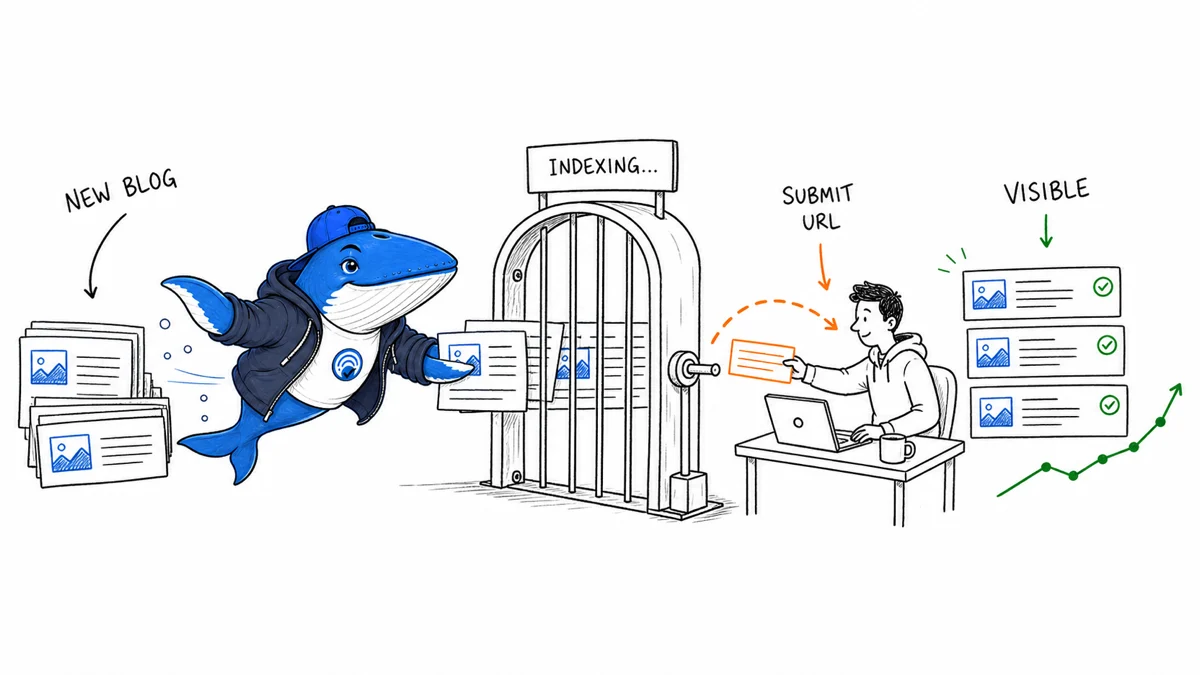
SearchEngineAnswer moved from a private WordPress build to 12,216 Google Search impressions in the available history from August 8 to September 29, 2026. The exact article you are reading received only 20 impressions and no clicks during that same window.
That difference is the main lesson. A growing property can contain pages that still have not proved demand, relevance, or click appeal. This case study explains how I separate those questions, what changed during the build, and which decisions the evidence justified.
The lesson in one sentence
Measure a new publication as a sequence of gates: public eligibility, discovery, indexing, search appearance, click, and useful reader action. Passing one gate does not prove the next.
- Eligible: the page is public and crawlable.
- Discovered: Google knows the URL exists.
- Indexed: Google can consider the canonical page for results.
- Shown: Search Console records an impression for a query.
- Clicked: the result earns a visit from Google Search.
- Useful: the visit produces a declared reader outcome, such as reading another article, using a tool, saving a checklist, or subscribing.
The interactive build timeline
Open any date to see the observed state, the change I made, and the conclusion I refused to draw. The timeline works without JavaScript and can be operated with a keyboard.
The case-study post existed before public launch
The WordPress publication timestamp for this post is July 15. By August 5, the wider site still had its search visibility setting closed.
Boundary: a WordPress publication date did not establish public crawl eligibility.
The editorial and technical foundation was rebuilt
The site had nine pre-launch articles and
blog_publicwas set to0. I rebuilt the taxonomy, templates, policies, editorial workflow, and Sonar visual system.Boundary: a finished publishing system did not establish crawling, indexing, rankings, or traffic.
The public indexing gate opened
blog_publicreturned1. The production site became eligible for public inspection and crawling.Boundary: eligibility did not prove that Google had discovered or indexed every URL.
The first Search Console baseline appeared
Search Console reported 18 clicks, 276 impressions, a 6.5% click-through rate, and an average position of 57.4 for data from August 8 to August 12.
Boundary: five days of mixed queries could not establish durable acquisition.
Property growth and page performance split apart
The property reached 67 clicks and 5,406 impressions through September 9. This exact article had six impressions and no clicks.
Boundary: a stronger property total did not prove that this page had earned demand.
The low-value review changed the publishing system
I audited 242 posts. The recovery plan consolidated 64 thin or overlapping URLs into stronger destinations, selected 45 durable pages for deeper rebuilds, reduced 447 tags to 33 reusable topics, and cut guide-format assignments from 133 to nine.
Boundary: those changes describe the editorial system. They do not prove an AdSense approval or a Google ranking improvement.
The site reached 12,216 impressions while this article remained at zero clicks
The property recorded 108 clicks and 12,216 impressions through September 29. The exact-page report showed 20 impressions, no clicks, and an average position of 22.6. I reframed the article around the indexing lessons supported by that split.
Boundary: the title and lesson structure are editorial hypotheses. The next page-level review will test whether they improve qualified visibility.
The fresh Search Console evidence
I captured both reports again on October 3 with Search type set to Web (text) and the three-month control selected. The available history ran from August 8 to September 29. The first report has no page filter. The second uses an exact filter for this article.
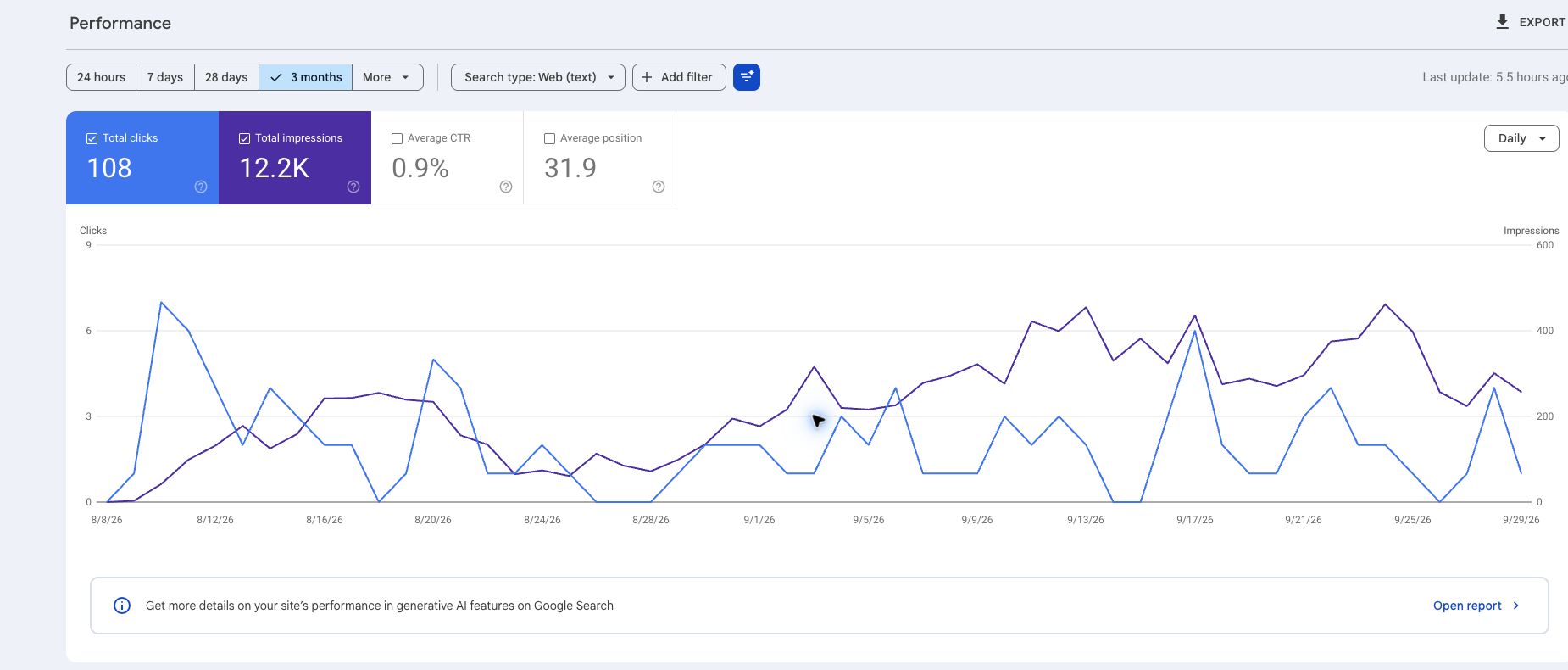
| Available window | Clicks | Impressions | CTR | Average position |
|---|---|---|---|---|
| August 8 to August 12 | 18 | 276 | 6.5% | 57.4 |
| August 8 to September 9 | 67 | 5,406 | 1.2% | 40.8 |
| August 8 to September 29 | 108 | 12,216 | 0.9% | 31.9 |
The property added 90 clicks and 11,940 impressions after the five-day baseline. CTR fell by 5.6 percentage points while the aggregate average position improved numerically by 25.5 positions. Those changes occurred as the site added pages and appeared for a broader mix of queries. They are not a controlled ranking experiment.
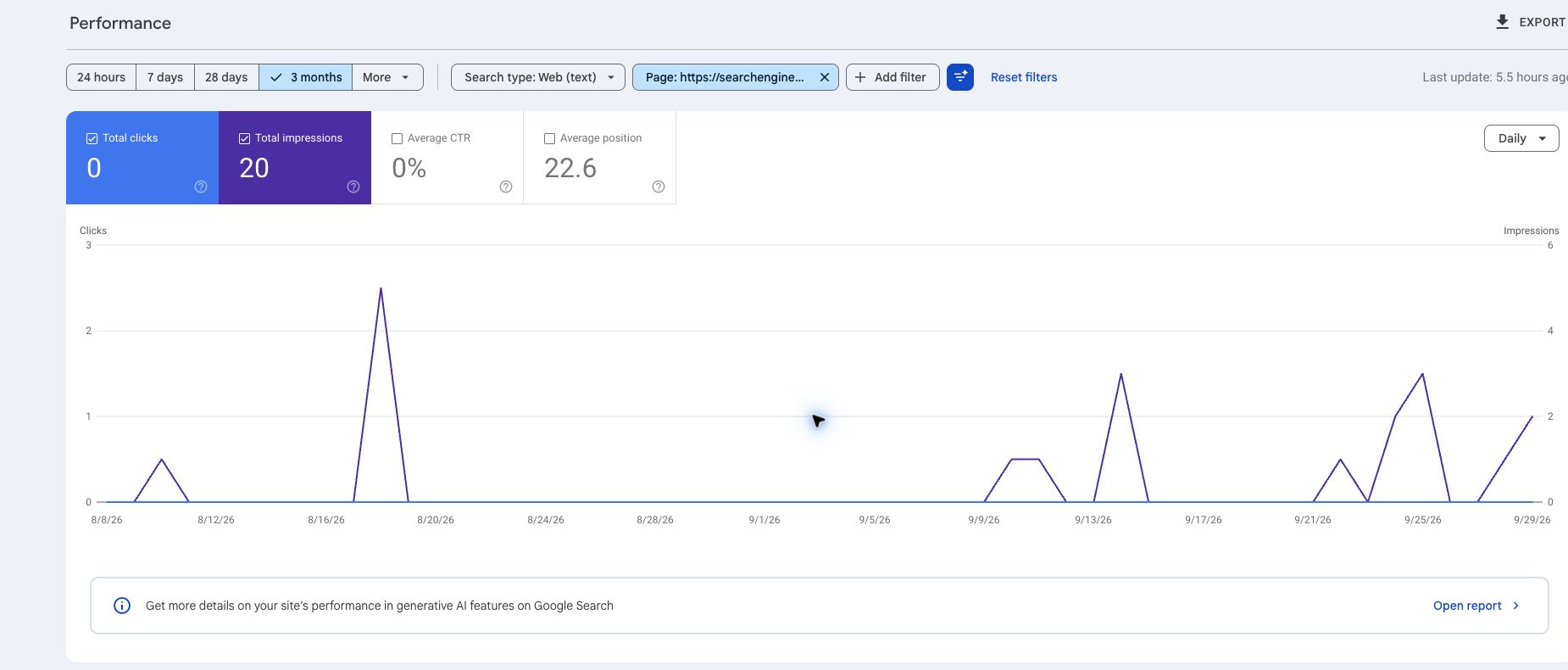
| Available window | Clicks | Impressions | CTR | Average position |
|---|---|---|---|---|
| August 8 to September 9 | 0 | 6 | 0% | 10 |
| August 8 to September 29 | 0 | 20 | 0% | 22.6 |
The page gained 14 impressions after September 9, but it still had no clicks. The later average position was 12.6 positions worse. With only 20 impressions across a changing query mix, neither average is stable enough to support a ranking claim.
Seven Google indexing lessons from the build
1. Publication and crawl eligibility are separate states
A post can carry a publication date while the site remains private to search engines. The article existed in WordPress before the public indexing gate opened. My first launch check is therefore not the post status alone. I verify the public URL, robots rules, index directive, canonical, sitemap presence, and a crawlable internal link.
2. Property totals and page totals answer different questions
The property report shows whether the publication is earning wider visibility. The exact-page report shows whether one URL is contributing to that result. SearchEngineAnswer’s property grew, but this article did not earn a Search click. Reporting only the sitewide total would turn a true number into a misleading page claim.
3. CTR can fall while reach expands
The first 276 impressions produced a 6.5% CTR. The cumulative 12,216 impressions produced a 0.9% CTR. The later report includes far more pages and queries, including weak or exploratory matches. A lower aggregate CTR can therefore accompany broader discovery. I investigate the page and query rows before treating the decline as a snippet problem.
4. Average position is a mixture, not one ranking
The property average moved from 57.4 to 31.9, while this page moved from 10 to 22.6. Neither number tracks one fixed keyword. Search Console averages positions across the impressions included by the report. New queries, new pages, geography, device, and search-feature changes can alter the mixture. I use average position to find questions, then inspect the underlying dimensions.
5. Query data can reframe the reader’s job without providing the answer
The page-level table exposed two query rows: Google indexing recovery case study with five impressions and search engine indexed with two. Those rows explain seven of the page’s 20 impressions. Search Console did not expose the other 13, so I left them unknown.
The visible terms suggested that readers needed a practical indexing lesson rather than a headline built around the property’s impression count. I changed the article structure and title to match that job. This is an editorial test, not proof that Google will reward the change.
6. An indexing request is a nudge, not a guarantee
For priority pages, I use URL Inspection after checking the canonical URL, sitemap, internal links, and public response. Google’s recrawl documentation says crawling can take from a few days to a few weeks and that a request does not guarantee inclusion. I record the request date as one event in the timeline, not as a success state.
7. Fix the publishing system before increasing output
The low-value review showed that page-by-page expansion was not enough. The site had too many short announcements, guide labels, and narrow tags. Consolidating overlapping URLs, reducing the taxonomy, and rebuilding durable pages changed the publication system. That work created clearer ownership and stronger update paths, but it still needs to be judged through later crawl, page, query, and reader-outcome data.
A repeatable measurement checklist for a new site
- Freeze the reporting window. Record the dates, Search type, filters, time zone, and last-update time.
- Capture the property baseline. Save clicks, impressions, CTR, position, pages, queries, countries, devices, and search appearances.
- Filter priority pages exactly. Do not assign property totals to an article, tool, or landing page.
- Record the indexing ladder. Keep the publication date, sitemap state, internal-link state, inspection result, request date when used, first impression, and first click.
- Preserve missing data as missing. Do not reverse-engineer hidden queries from totals.
- Separate discovery from satisfaction. An impression proves appearance under Search Console’s rules. It does not prove a useful visit.
- Connect search data to reader outcomes. Track qualified visits, next-page reading, tool use, checklist progress, subscriptions, or another declared action when measurement is trustworthy.
- Set the next decision before waiting. Name the evidence that would make you retain, revise, consolidate, or retire the page.
What I will measure next
I will review this exact URL after October 31 with the same Web (text) scope. The decision fields are simple: relevant impressions, the first qualified click, visible query mix, average position with its sample size, and useful actions after the visit. I will keep the lesson structure if those signals become clearer. If the page remains too small to evaluate, I will improve its internal path and reassess whether its reader job overlaps another guide.
The broader publication review will continue to separate name-aligned demand from non-branded discovery. The property can grow while individual pages fail. That is not a contradiction. That’s why measurement has to stay at both levels.
Continue with the evidence-led publishing guide, use the small SEO experiment method for bounded tests, and review the technical checks to run before launch.
Primary sources and first-party evidence
- My SearchEngineAnswer Google Search Console Performance reports for the property and exact case-study URL, captured October 3, 2026, with data through September 29.
- My earlier property and exact-page Search Console capture from September 12, 2026, with data through September 9.
- My first SearchEngineAnswer Search Console Performance and Insights reports, captured August 14, 2026, with data through August 12.
- My production WordPress state and article publication record for post 32, checked October 3, 2026.
- Google Search Central: How Google Search works.
- Google Search Central: Ask Google to recrawl your URLs.
- Google Search Console: Performance reports.
Keep learning
Continue this topic
Next in this topic
How to run small SEO experiments without overclaiming
Research
Ask a question or join the discussion