
An extraction study requires source quotes before keeping relationship claims
A preprint tests source-backed relationship extraction across 61 software vendors. Matching a quote does not establish current adoption or endorsement.
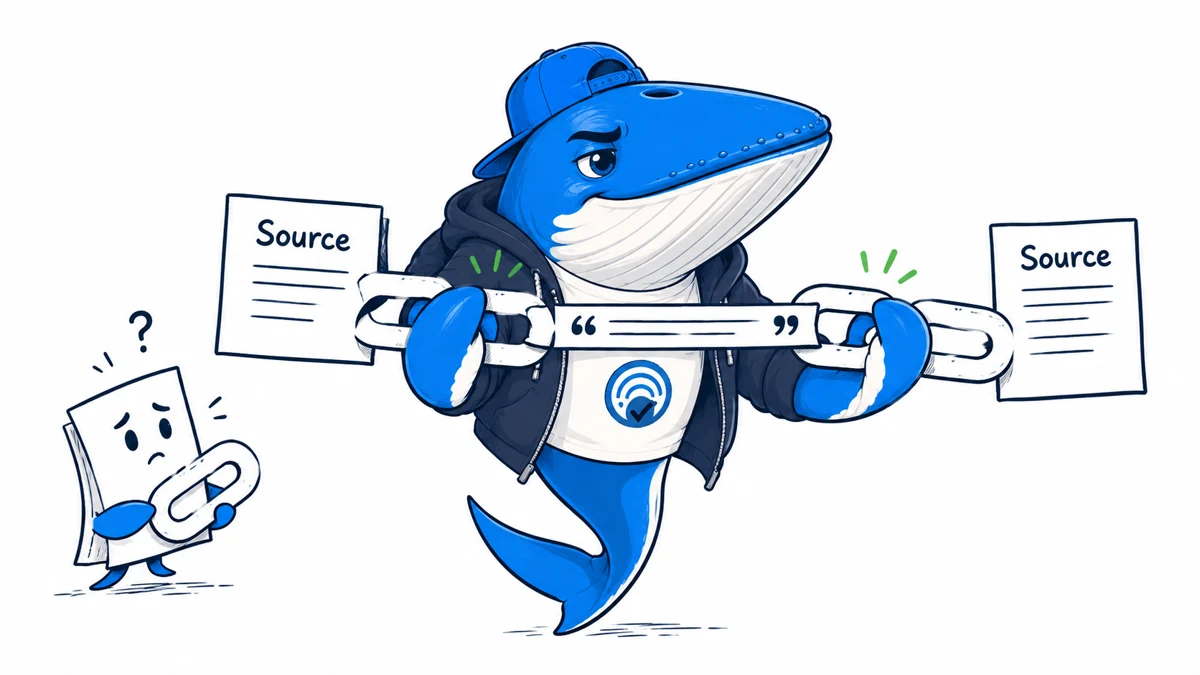
A research assistant can copy a company name accurately and still invent the relationship around it. A logo beside a product, a testimonial without clear attribution, or a list of event sponsors can become a false customer claim when extraction skips the surrounding context.
A preprint submitted on October 23 addresses that failure by requiring source quotations for retained relationship claims. Juan Felipe Duran, Arthur Tobler and Martin Vallières study a healthcare-software corpus covering 61 vendors. The subject is evidence extraction, not clinical decision-making.
Verify the connection as well as the names
The published pipeline first proposes candidate relationships, then checks the quoted text, entity references, and meaning before storing accepted relations with provenance. Its evaluation reference is model-assisted and only partly human-reviewed. That limits how confidently we can generalize its scores.
Consider a fictional vendor page headed “Partners and customers” with two organizations below it. An extractor proposes that both are customers. Even if every name is spelled correctly, the heading leaves the relationship unresolved. A matching text span is a starting point; the reviewer still needs wording that establishes which organization uses which product.
| Check | Useful evidence | Reason to stop |
|---|---|---|
| Identity | The page identifies both organizations unambiguously | A shortened name could refer to another entity |
| Relationship | A passage explicitly connects the organization to product use | The page establishes sponsorship, investment or membership instead |
| Time | The claim has a date or current confirmation appropriate to the task | An old statement is being presented as present adoption |
A quote preserves a statement, not its present truth
The authors explicitly distinguish what a page stated from whether the relationship remains current or the named organization endorsed the product. The paper also notes incomplete entity resolution. A second spelling of an organization can therefore remain a separate entry unless reconciliation catches it.
For an editorial workflow, keep the proposed sentence beside the original URL, retrieval date, and passage. When a heading supplies part of the meaning, preserve that heading too. If the evidence remains ambiguous, narrow the sentence to what the page actually establishes or leave the relationship out. Do not fill the gap with a more confident paraphrase.
Review the reference labels before repeating an accuracy claim
The page-level evaluation key covers relationships already proposed by the extractor. It cannot reveal every relationship the extractor missed. The separate curated reference has its own omissions, and all vendors come from one partner catalog. These are material limits for a method intended to find evidence scattered across the web.
SearchEngineAnswer reviewed the paper and opened its linked repository. We did not execute the pipeline or independently label its data. The example above is illustrative, not a result from the study.
The citation failure map separates retrieval and claim-support errors in a finished answer. The evidence-led publishing workflow applies that discipline to editorial decisions. For structured extraction, make the relationship itself the claim under review, then preserve the source that supports it.
Keep learning
Ask a question or join the discussion