Google Research Cut Retrieval Fan-Out Time 12× to 20×
Google researchers report that Retrieve-for-Train generated ten retrieval directions 12× to 20× faster in fashion and music benchmarks, while the diffusion model traded some recall for greater diversity.
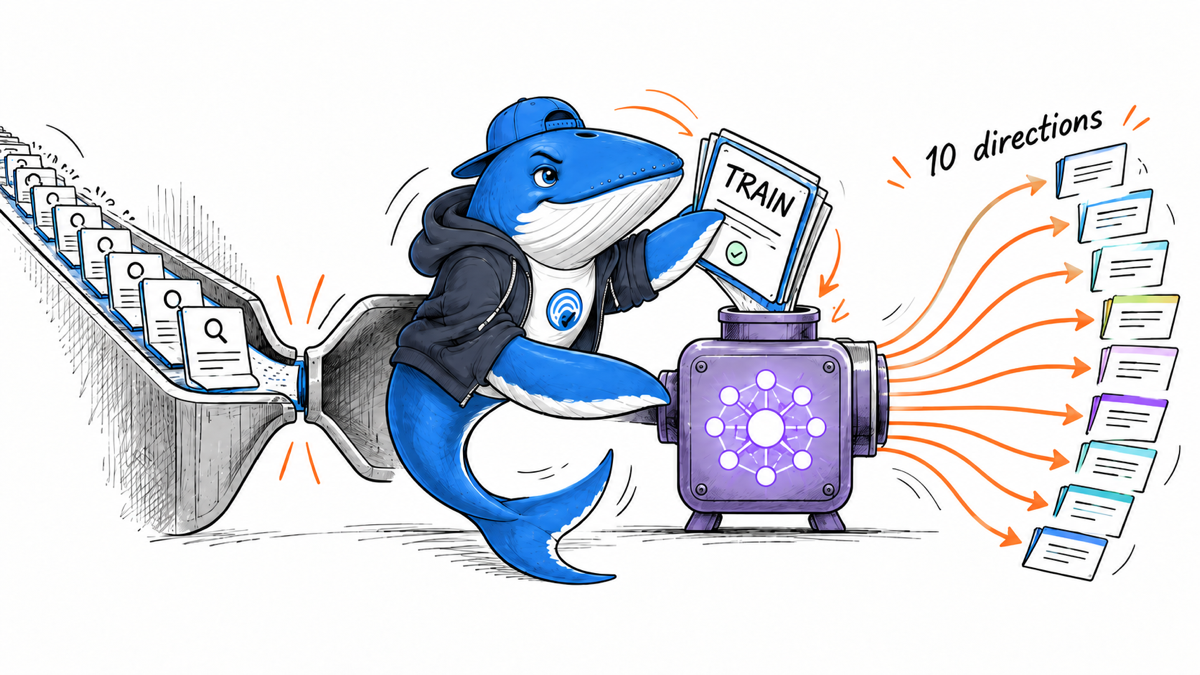
Direct answer: Google researchers report that Retrieve-for-Train generated ten retrieval directions 12× to 20× faster than its autoregressive planner in fashion and music benchmarks. The speed came from training a compact diffusion retriever on result sets produced by a slower, reward-optimized language model. The diffusion model was faster and often more diverse, but it did not beat the planner on every quality measure.
A broad request creates a set problem, not only a ranking problem
Suppose someone asks for equipment for a rainy family camping trip. Ten searches about waterproof tents can each be relevant. Together, however, they form a poor plan because they neglect sleeping systems, safe cooking, lighting, clothing and the needs of children.
This is the problem addressed by Google Research’s Retrieve-for-Train work. A complex request may need several retrieval directions, and the quality of the whole set matters. A direction that looks good alone can still waste a limited retrieval budget if it duplicates nine others.
The paper calls this fan-out retrieval. Instead of asking only whether each item is relevant, it asks whether the generated set is grounded in the request, aligned with the user’s goal and diverse enough to explore useful alternatives.
The expensive planner becomes training data
The method is easier to understand as a transfer of work from live inference to offline training.
1. Train a set planner
A 4B-parameter language model learns through reinforcement learning to produce ten directions that score well as a group. The default reward weights groundedness at 0.6, diversity at 0.2 and alignment at 0.2.
2. Compile its behavior
The frozen planner generates 128 target sets for each training query at a temperature of 0.9. These synthetic examples capture the slower model’s learned fan-out policy.
3. Serve a smaller retriever
A 53.9M-parameter diffusion model learns to map a request directly to a set of embeddings. At inference it generates the ten directions in parallel, then retrieves their nearest neighbors.
The researchers describe this as RL-compiled diffusion. It is not simply a smaller language model generating shorter text. The live component produces a set in embedding space, using a 256-step stochastic differential equation solver in the reported configuration.
Decode the 12× to 20× speed claim
The headline number is real within the experiment, but its scope is narrow. The timing covers the generation of ten fan-out directions. It does not measure a complete Google Search page, an AI answer, crawling, indexing or final response generation.
| Context batch size | Autoregressive planner | Diffusion retriever | Calculated speedup |
|---|---|---|---|
| 8 | 1.46 seconds | 0.07 seconds | 20.9× |
| 1,024 | Nearly 50 seconds | 4.21 seconds | About 11.9× |
The parallel structure matters. Autoregressive generation waits for one token after another, and its latency rises sharply as the context batch grows. The diffusion retriever works on the set representation together. That is the engineering value of the paper: a costly policy can be learned offline and then approximated by a serving model with much less serial work.
The paper identifies TPUv6e hardware for training, but it does not separately specify the hardware used for the latency plot. Treat the ratios as results for this implementation, not a universal benchmark for every production system.
The quality result is a trade, not a clean sweep
The weakly supervised collection retrieval test provides the clearest comparison between the reinforcement-learned planner and the compiled diffusion retriever. Higher recall and hit rate mean the generated set recovers more of the weak reference set. Higher Vendi score indicates more diversity.
| Model | Recall@5K | Hit@5K | Vendi diversity |
|---|---|---|---|
| Gemma R4T planner | 16.9 | 54.4 | 40.5 |
| Gemma diffusion | 15.0 | 54.1 | 46.2 |
| Qwen R4T planner | 20.9 | 64.6 | 27.5 |
| Qwen diffusion | 16.5 | 57.5 | 34.7 |
For Gemma, compilation raised the diversity score by 5.7 points while recall fell by 1.9 points. For Qwen, diversity rose by 7.2 points while recall fell by 4.4 points. The diffusion model therefore preserved much of the planner’s behavior and ran faster, but it shifted the balance toward diversity.
That distinction is more useful than a blanket claim that the smaller model was “better.” A shopping assistant that needs variety may accept the exchange. A high-recall research system may not.
Open-ended scores need a careful reading
The second evaluation has no single correct result set. The researchers created 43,874 broad queries and used Gemini 2.5 Flash to rate result sets on five-point scales. The fashion collection contained 21,888 candidates; the proprietary music collection contained 8,522 playlist embeddings.
| Method | Fashion | Music |
|---|---|---|
| No fan-out | 26.1 | 36.9 |
| Gemma zero-shot | 38.5 | 48.1 |
| Gemma R4T planner | 49.1 | 58.1 |
| Qwen zero-shot | 28.1 | 40.7 |
| Qwen R4T planner | 42.6 | 47.5 |
Against the same model’s zero-shot result, the R4T planner added 10.6 points for Gemma on fashion and 10.0 on music. The Qwen gains were 14.5 and 6.8 points. Those calculations support the paper’s claim that set-level reinforcement learning improved the planner.
The diffusion results in this experiment report diversity and alignment, but not groundedness, so the paper does not provide a comparable overall average for them. That missing value matters. It prevents a clean “diffusion wins on quality” conclusion.
The evaluation also relies on another model as judge. Gemini 2.5 Flash makes large-scale scoring practical, but it can import its own preferences and errors. The paper does not report a full human evaluation of the open-ended sets.
The failed rewards reveal why set optimization is difficult
The ablations are one of the most practical parts of the paper. Optimizing diversity alone could produce repeated or nonsensical text that spread embeddings apart without satisfying the request. Optimizing groundedness and alignment without diversity pushed the model toward near-paraphrases.
Both failures score well against an incomplete objective. One creates novelty without usefulness. The other creates relevance without coverage. The weighted reward works as a constraint system, not as a single definition of quality.
This is also a warning for AI visibility dashboards. A metric can be technically correct and still reward the wrong behavior. Counting source mentions may encourage volume. Counting unique prompts may favor noisy breadth. A useful measurement needs counterweights for support, distinct contribution and repeatability.
When moving work offline makes sense
| Operating condition | Likely fit for R4T-style compilation | Reason |
|---|---|---|
| Stable catalog and repeated task patterns | Strong | The offline planner can create many reusable examples, and serving savings recur. |
| Strict latency budget with a fixed output size | Strong | Parallel set generation directly addresses serial decoding cost. |
| Rapidly changing corpus or user intent | Uncertain | Training targets may age, and recompilation can become expensive. |
| Safety-critical or explanation-heavy retrieval | Needs additional controls | A nearest-neighbor embedding output is harder to inspect than explicit text directions. |
| Goal cannot be expressed as a reliable scalar reward | Weak | The planner can exploit gaps between the reward and the outcome people actually want. |
This decision table is an inference from the architecture and the paper’s stated limitations, not a production recommendation from Google. The authors specifically note the upfront reinforcement-learning cost, the difficulty of representing subjective properties as scalar rewards, the narrow architecture evaluation and the limited domains.
What publishers can take from the paper
Retrieve-for-Train is not an SEO ranking study, but it offers a useful model for complex-answer coverage. A page may be relevant and still add little if every other retrieved source supplies the same evidence. The stronger contribution is often a distinct, well-supported part of the decision.
- Map functions, not synonyms. For a complex topic, list the decisions, constraints, failure cases and evidence types a reader needs.
- Test the set. Look at whether ten retrieved sources cover different needs or repeat the same claim.
- Protect groundedness. A novel angle is not useful when it is unsupported.
- Measure stability. Repeat prompts and record dates before treating a small visibility movement as a trend.
The Google AI Mode SEO guide shows how to map fan-out without publishing one thin page per query variation. The AI visibility noise-floor protocol provides a way to separate real movement from normal answer variation.
The paper does not announce a Google Search deployment
The work was accepted at ICML 2026 and tested on fashion outfits and a proprietary music-playlist collection. The paper does not state that Retrieve-for-Train powers Google Search, AI Mode, Gemini, shopping results or another public product.
It also does not test web crawling, indexing, ranking signals, citations or publisher traffic. Calling the method “Google’s new search system” would go beyond the evidence. The defensible claim is narrower and still important: Google researchers demonstrated that a slower set planner can train a much smaller diffusion retriever to generate diverse fan-out directions faster, with a measurable quality trade-off.
The result worth remembering
Retrieve-for-Train turns a slow reasoning process into a fast learned retrieval policy. Its strongest contribution is not the largest speedup in isolation. It is the demonstration that set-level goals can be trained offline, compiled into a compact model and served quickly enough to make broader retrieval practical.
The unresolved question is whether the compiled model preserves the quality a particular application values. In this paper, speed and diversity improved while recall sometimes declined. That is not a footnote. It is the decision.
Primary sources
Keep learning
Continue this topic
Next in this topic
What 30,000 Reddit Answers Reveal About Which Voices Survive AI Search
Earlier in this topic
Q2D-Web Shows Why AI Citations Depend on First-Stage Retrieval
Research
Ask a question or join the discussion