ChatGPT Ads Context Hints: Test Conversation Matching
OpenAI says context hints guide ad matching but are not exact-match keywords and do not guarantee delivery. Diagnose eligibility, relevance, auction, and outcomes with a controlled ledger.
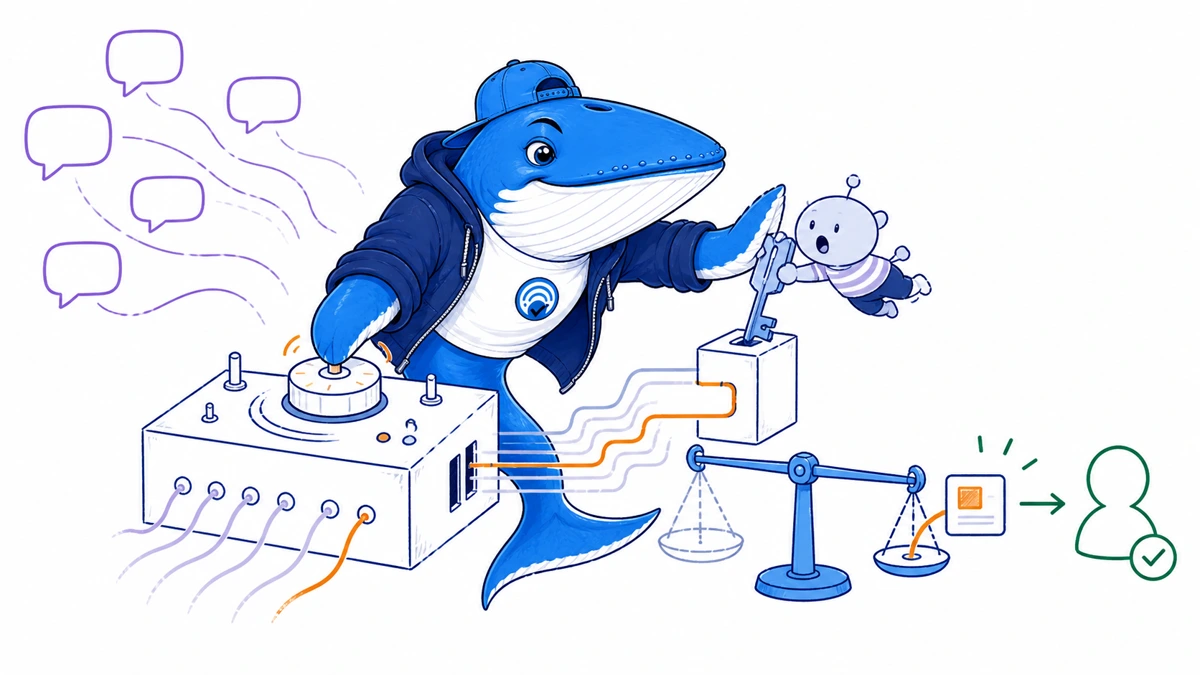
Direct answer: ChatGPT Ads context hints are not exact-match keywords. OpenAI says they describe conversations, topics, or keywords where an offer may be relevant, but they neither guarantee delivery nor identify the single reason an ad appeared. Diagnose them as one input inside a relevance-weighted auction, alongside conversation intent, the landing page, title, copy, creative, bid, eligibility, and—when enabled—selected broader ChatGPT signals.
The practical consequence is simple: a zero-impression hint is not automatically a targeting failure, and an impression does not prove an exact phrase matched. A useful test holds the offer, bid, creative, landing page, objective, and time window steady while changing one hint version.
What OpenAI says enters ad selection
OpenAI’s current advertiser guide places ads below ChatGPT responses and lists the advertiser name, favicon, title, copy, landing page, and image creative as parts of the ad unit. Selection and delivery consider several signals rather than a keyword table.
| Input | Documented role | Do not infer |
|---|---|---|
| Current conversation | Context and intent can inform expected relevance | The user’s exact prompt or private conversation can be reconstructed from reporting |
| Context hints | Guide matching toward relevant conversations, topics, or keywords | Exact-match behavior or guaranteed delivery |
| Landing page, title, and copy | Contribute to the relevance assessment | A strong hint can compensate for a mismatched destination |
| Broader ChatGPT signals | Selected signals may be considered when ads personalization is enabled | Which private signal caused an individual impression |
| Bid and objective | Define the auction and payment model at ad-group level | The highest bid always wins |
OpenAI describes the auction as relevance-weighted and second-price. That means a delivery diagnosis must preserve both competitive and relevance conditions. Editing every input at once may improve delivery, but it destroys the evidence needed to identify what mattered.
Separate Reach from Clicks before comparing results
ChatGPT Ads supports a Reach objective bought on CPM and a Clicks objective bought on CPC. The maximum bid is set at ad-group level. OpenAI recommends a starting maximum CPC of $3–$5 for Clicks campaigns, but that is a platform recommendation, not a market-clearing price or performance guarantee.
Do not put a Reach test and a Clicks test in one winner table. Their optimization targets and payment units differ. At minimum, report the objective, maximum bid, spend, impressions, clicks, conversions, CTR, average CPC, average CPM, dates, market, creative version, and landing-page version.
Use a four-layer delivery diagnostic
| Layer | Evidence to inspect | Stop condition |
|---|---|---|
| 1. Eligibility | Account, campaign, policy, review, dates, budget, landing-page access, and creative status | Do not blame the hint while the ad cannot serve |
| 2. Conversation relevance | Hint, offer, title, copy, destination, and controlled conversation fixture | Change one relevance input per paired test |
| 3. Auction | Objective, maximum bid, bid-strength guidance where available, market, and competing conditions | Do not equate eligibility with an auction win |
| 4. Delivery and outcome | Impressions, clicks, spend, conversions, UTMs, and backend outcomes | Do not call an impression a conversion result |
The order matters. If the campaign is pending review, there is no hint experiment. If eligibility passes but the ad never enters a competitive auction, a hint rewrite alone may not change delivery. If impressions arrive but the landing page fails, the problem is downstream of matching.
Build a paired context-hint test
- Choose one commercial reader job, such as comparing two solution categories, and write a neutral conversation fixture that represents it.
- Duplicate the ad group only when the platform workflow and budget allow a clean comparison.
- Keep the objective, maximum bid, market, schedule, landing page, title, copy, and creative unchanged.
- Change only context hint A to context hint B. Record both verbatim in a private version log.
- Set a minimum test window or spend rule before reading the result. Do not stop after the first impression.
- Classify the outcome as eligibility failure, no observed delivery, delivered/no click, clicked/no conversion, converted, or inconclusive.
- Repeat with the winning hint only after checking that the offer and landing page still match the intended conversation.
Download the ChatGPT Ads context-hint test ledger (CSV). Its eight rows are marked EXAMPLE-REMOVE. Replace them with your own ad-group and reporting data. Do not store conversation text containing personal, sensitive, or customer-identifying information.
Measure with platform and site evidence
OpenAI lists impressions, clicks, spend, CTR, average CPC, average CPM, and conversions in Ads Manager Beta reporting. Add stable UTM parameters to the landing-page URL so the clicked session can be reconciled with analytics and backend outcomes. Keep the platform conversion, analytics session, lead, transaction, and revenue as separate columns.
A static UTM can identify traffic from a campaign or ad group, but it does not reveal the user’s private conversation or the precise signal that won the auction. Preserve that privacy boundary in dashboards and client explanations.
The ChatGPT product-feed guide applies the same state separation to shopping ads, while the AI visibility tools buyer guide explains why one blended score hides the observation unit.
Three failures that look like a context-hint problem
Eligibility never passed
A campaign outside its schedule, under review, policy-limited, budget-constrained, or attached to an inaccessible landing page cannot produce a valid matching test.
The offer and destination disagree
A hint can describe the right conversation while the title, copy, creative, or landing page serves a different reader job. Rewrite the full relevance package before adding more hint phrases.
The test has no exposure denominator
Clicks without impressions, conversions without clicks, or performance without dates cannot support a comparison. Save the denominator and the test window for every interpretation.
Source, method, and limits
Primary source: OpenAI’s Ads in ChatGPT: The Basics, checked September 1, 2026.
Method: We separated the documented selection inputs into eligibility, relevance, auction, and delivery layers, then built a controlled ledger around the reporting fields OpenAI lists. SearchEngineAnswer did not run a paid ChatGPT Ads campaign for this guide and reports no delivery, click, cost, or conversion benchmark.
Limits: Ads access, markets, inventory, policies, reporting, and auction behavior can change during a beta. Recheck the live Ads Manager interface and current documentation before allocating budget. The test can show an observed difference between configurations; it cannot reveal OpenAI’s private feature weights or a user’s private signals.
September 4 update: check audience eligibility before testing hints
When custom audiences are enabled, a no-delivery result may begin before conversation matching. OpenAI’s current audience documentation requires 25,000 matched users for inclusion targeting or bid adjustments, and the inclusion threshold must still be met after exclusions. Uploaded rows are not matched-user counts. The custom-audience eligibility guide provides overlap-aware examples and a count-only worksheet. Verify that state before attributing non-delivery to the context hint; a bid multiplier does not determine eligibility.
Keep learning
Continue this topic
Next in this topic
Claude Managed Agents Controls: Domain Rules and Per-Call Permissions
Earlier in this topic
ChatGPT Work Can Sign Into Websites: What Publishers Should Measure
Tools & Workflows
Ask a question or join the discussion