Google AI Mode Adds Link Carousels for Developing Topics
Google AI Mode can now show link carousels for developing topics. A 24-, 48-, and 72-hour ledger helps publishers separate inclusion, source movement, and visits.
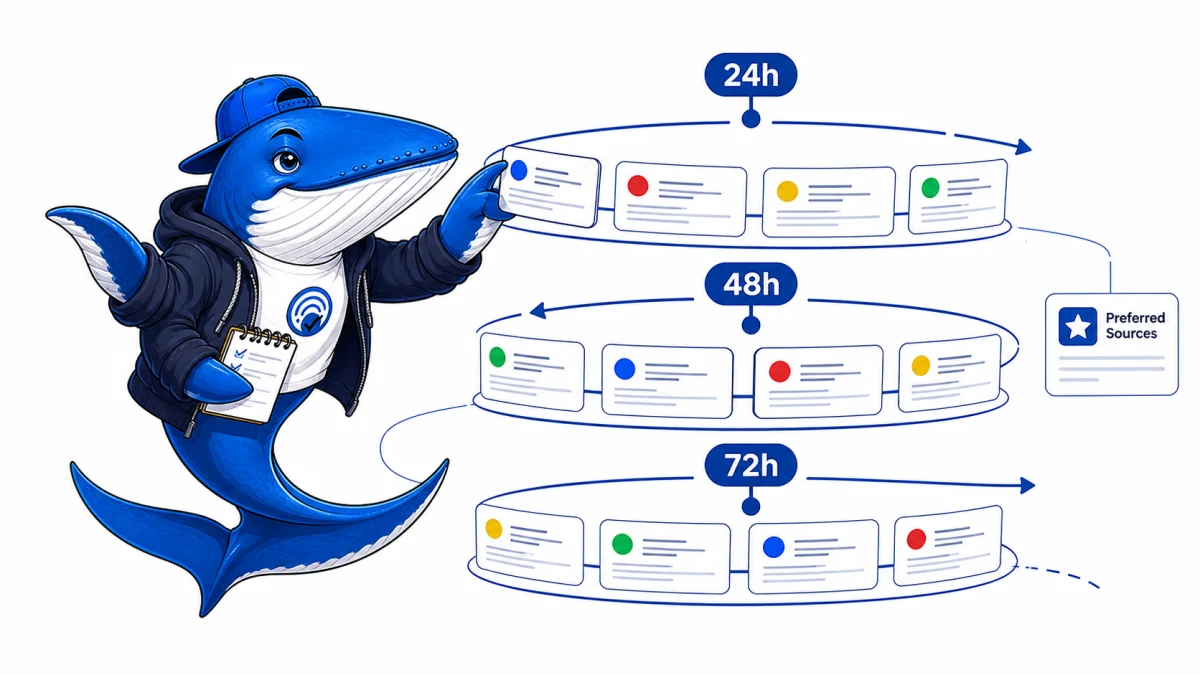
Direct answer: Google AI Mode can now show prominent link carousels for developing topics. The cards can include articles, webpages, and a user’s preferred sources when relevant. The new surface increases link visibility inside the answer, but Google has not published click data or a source-selection formula.
Publishers should test the carousel as a time-sensitive news surface. Record which sources enter, move, and disappear during the first 72 hours instead of assuming that a preferred-source selection guarantees placement.
What Google added to AI Mode
On August 26, 2026, Search Engine Land reported Google’s confirmation that link carousels were live in AI Mode for developing topics. A similar treatment had already appeared in AI Overviews.
Google said the carousel can put relevant articles and webpages, including preferred sources, “front & center.” The stated aim is to connect searchers with original coverage and perspectives. That wording explains the product intent; it does not disclose the ranking inputs or prove click gains.
A developing topic is also a moving target. Publication time, originality, updates, syndication, local relevance, and the changing shape of the story can all coincide with carousel movement. The test needs a timeline.
Preferred Sources is one state, not a guarantee
Google’s Preferred Sources publisher guide says selecting a source can make its content more likely to appear prominently for that user. It does not guarantee a Top Stories position, AI Mode link, AI Overview citation, or visit.
Record preferred-source state as one field in the observation. Do not treat it as the explanation for every appearance. Our Preferred Sources implementation guide covers the user-facing button and the limits publishers should communicate.
| Field | Record | Reason |
|---|---|---|
| Query and topic state | Exact wording and why the topic is developing | Prevents unrelated queries from being pooled |
| Observation time | Publish age and capture timestamp | Shows entry and removal over time |
| Source card | Domain, URL, headline, position | Identifies the selected page, not only the brand |
| Originality relationship | Original report, analysis, rewrite, syndication | Tests Google’s stated original-coverage goal |
| User and interface | Preferred-source state, account, locale, device, AI surface | Keeps personalized and product states separate |
Run the 24, 48, and 72-hour test
- Select five to ten genuinely developing topics that match the publication’s beat.
- Capture AI Mode and AI Overview separately at publication, 24 hours, 48 hours, and 72 hours.
- Record every visible source card and its exact destination URL.
- Classify whether each page contains original reporting, first-party evidence, analysis, or aggregation.
- Repeat one observation with the publication selected as a preferred source and one in a fresh state where available.
- Compare carousel presence with referral logs and Search Console data without assuming that an impression belongs to the carousel.
If a page appears briefly and disappears, retain the capture. Developing-topic results are expected to change as new evidence arrives. The useful output is a source timeline, not a permanent ranking table.
Editorial work that remains justified
Publish the original fact, method, document, interview, dataset, or direct observation as early as accuracy allows. Make update times and material corrections visible. Link the primary source close to the claim and distinguish what the publisher observed from what a platform announced.
Those practices help readers even when no carousel appears. They also align with the evidence standard in the evidence-led publishing guide and the publication’s editorial policy.
Do not manufacture “freshness” by changing dates without a meaningful update. Do not split one developing story into thin pages to create more candidate URLs. The carousel announcement provides no exemption from ordinary quality, duplication, or site-reputation concerns.
What the announcement does not prove
The new layout does not prove that AI Mode sends more traffic than a standard citation, that preferred sources always enter the carousel, or that a carousel card receives an independent Search Console label. It also does not reveal how Google distinguishes original coverage from fast rewrites in every case.
The defensible publisher action is to collect a dated source ledger and compare it with referrals. Any claim about click lift should state the query set, observation window, denominator, account state, and analytics method.
Sources, method, and limits
Sources: Search Engine Land’s report containing Google’s confirmation and Google’s official Preferred Sources publisher guide.
Method: We converted the announcement into a 72-hour source-presence protocol that separates page selection, presentation, personalization, and referral traffic.
Limits: No click study or multi-market carousel sample is included. Google has not documented selection weights, rollout coverage, or a carousel-specific performance report.
Keep learning
Continue this topic
Next in this topic
Search and AI Changes: August 24–30, 2026
Earlier in this topic
Google AI Overviews Can Expand Before You Scroll
AEO & AI Search
Ask a question or join the discussion