Gemini 3.8 Flash Is Live: Test Search Citations Before Switching
Gemini 3.8 Flash is generally available with Google Search grounding, but capability is not evidence of better citations. Use a matched query-and-claim ledger before migrating.
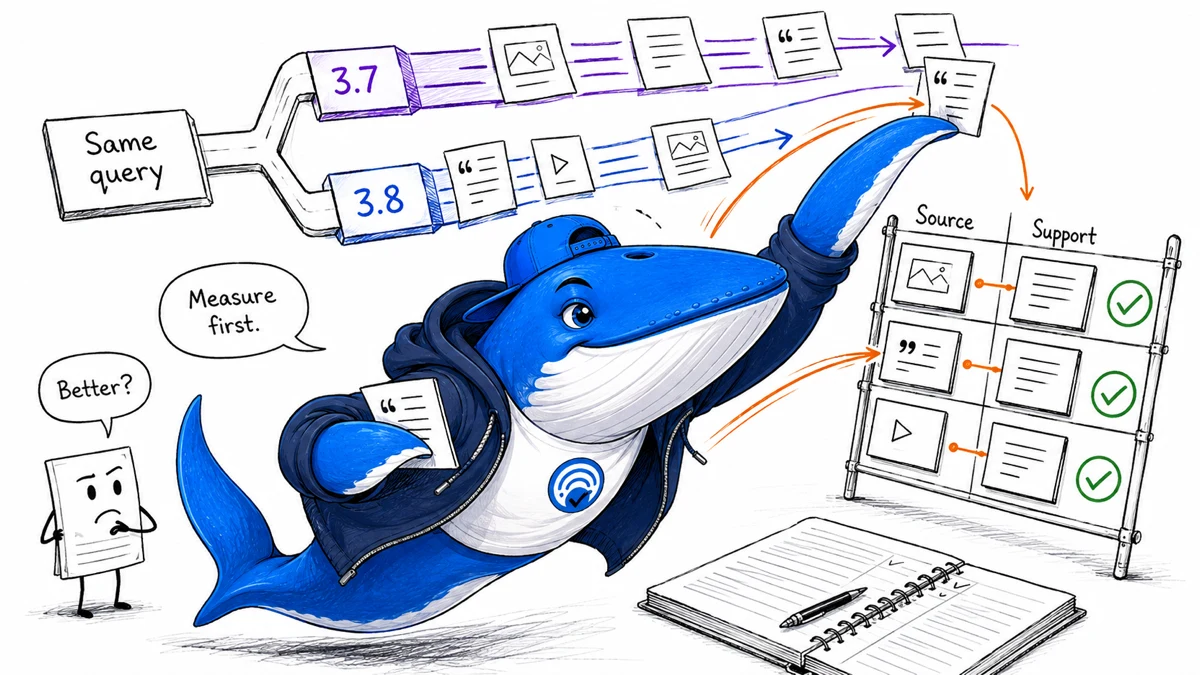
Google lists gemini-3.8-flash as a stable, generally available Gemini API model from September 2, 2026, with Google Search grounding support. That makes a production migration possible; it does not prove that 3.8 produces more accurate answers, stronger sources, or better citations than 3.7. Google’s October 8 routing change means a new request for 3.7 now reaches 3.8. Evaluate the active deployment and any documented archived baseline; two differently named request IDs no longer establish two different models.
The useful question is not “Does the model support grounding?” Both capability and output quality need evidence. The model page documents the feature. Your test must establish how it behaves on the questions, languages, sources, and freshness windows your product actually uses.
What Google documents for Gemini 3.8 Flash
The Gemini API changelog marks Gemini 3.8 Flash generally available on September 2. Google’s model page lists text, image, video, audio, and PDF inputs with text output. The documented input limit is 1,048,576 tokens and the maximum output is 65,536 tokens.
Supported capabilities include Google Search grounding, Google Maps grounding, File Search, function calling, code execution, caching, structured outputs, URL context, and computer use in preview. The page lists low, medium, and high thinking levels. It warns that setting minimal causes an error.
| Documentation establishes | Your evaluation must establish |
|---|---|
| Search grounding is supported | Whether the answer cites useful and valid sources for your query set |
| A supported model identifier is documented | Which model was actually served and whether its output is acceptable |
| Long inputs are accepted up to the stated limit | Whether long-context evidence is retrieved and used correctly |
| Structured output is supported | Whether grounded citations survive your chosen schema and parser |
Write hypotheses without writing the result
A model release can justify three hypotheses: 3.8 may select different sources, attach citations to different claims, or change latency and output shape. None is a finding until measured. Avoid labels such as “improved grounding” unless Google explicitly documents the improvement or your controlled evidence supports it.
Our earlier Gemini 3.7 Flash grounded-answer test provides reusable query families and scoring definitions. It is not proof that an independent 3.7 endpoint remains available. Preserve original capture dates when using archived responses. The Gemini citation-span guide explains why a returned source list is not the same as claim-level support.
Run a matched grounding comparison
Download the Gemini 3.8 grounding comparison ledger (CSV). Every starter row is marked EXAMPLE-REMOVE and contains no observed result.
- Freeze a query set before looking at model outputs. Include recent facts, multi-claim questions, source conflicts, and stable reference facts.
- Use the frozen prompts and settings with the currently available model. Compare with dated archived 3.7 responses only when their provenance is preserved; do not treat fresh 3.7 and 3.8 requests as distinct models.
- Save the requested ID, returned identity or routing evidence, UTC time, response, grounding metadata, URLs, latency and error state.
- Atomize each answer into checkable claims. Mark a claim supported only when a cited source directly supports it.
- Report citation validity and claim support separately. A URL can resolve while failing to support the nearby sentence.
- Repeat enough times to detect output variability; do not cherry-pick the cleanest response.
If the query is time-sensitive, capture the source page at test time. A correct answer can appear wrong after the source changes, and a stale answer can appear right after a later edit.
Score citations at the claim level
Use at least four states: supported, contradicted, unverifiable, and not citation-required. The denominator should be factual claims that require evidence, not paragraphs or sentences. One sentence can contain several claims, and one citation can support only part of it.
| Metric | Formula | Why it matters |
|---|---|---|
| Valid URL rate | Resolvable cited URLs ÷ cited URLs | Detects broken or malformed references |
| Claim support rate | Supported factual claims ÷ factual claims needing evidence | Measures evidence fit, not citation decoration |
| Contradiction rate | Contradicted claims ÷ checked factual claims | Surfaces high-risk errors |
| Source concentration | Claims supported by the most-used host ÷ supported claims | Reveals dependence on one source |
| Completion latency | Client-observed end minus start | Shows migration cost to the user experience |
For visibility research, add whether your domain was cited, whether it was linked, and whether the linked URL matched the supporting page. Do not treat domain presence as recommendation. Our cited-versus-recommended protocol keeps those states distinct.
Migrate with a reversible gate
Start with shadow traffic or an offline replay. Define thresholds before comparing models: maximum contradiction rate, minimum claim-support rate, acceptable latency, parser success, and cost envelope. A candidate that is faster but loses citation metadata may be unacceptable for a research product; a candidate with stronger evidence but higher latency may suit a batch workflow.
Keep an independently available, accepted fallback or a safe pause mode. Switching the request string back to 3.7 does not restore its old behavior. Log both requested and served identity with every answer. If downstream code assumes a particular grounding shape, include contract tests for missing sources, multiple citations, redirects, and zero-citation answers.
Do not send sensitive or licensed material merely because the context window is large. Apply the same data-minimization, retention, and access rules used for the earlier model.
A defensible release decision
Approve the migration only if the candidate meets the predefined evidence and operational thresholds on representative work. Record failures as well as passes. If results differ by query type, route selectively instead of averaging away a serious weakness.
The strongest conclusion available before testing is narrow: Gemini 3.8 Flash is a stable GA model that supports Search grounding. Everything about comparative citation quality remains a question for the ledger.
Source, method, and update note
Primary sources: Google’s Gemini API changelog and Gemini 3.8 Flash model page, rechecked October 12, 2026, alongside the deprecation schedule.
Method: SearchEngineAnswer mapped documented capabilities to an unrun matched-model protocol. We report no comparative quality, citation, latency or cost result. The October revision corrects the baseline and fallback assumptions after automatic routing changed.
Recheck trigger: Update if Google changes the stable model ID, capability table, context limits, thinking levels, grounding metadata, or deprecation schedule.
Keep learning
Continue this topic
Next in this topic
Rank Math Support Agent: Consent, Credentials & Cleanup
Earlier in this topic
ChatGPT Becomes an EU VLOSE: What Publishers Need to Track
AEO & AI Search
Ask a question or join the discussion