Rank Math Support Agent: Consent, Credentials & Cleanup
Rank Math's AI Support Agent could create a broad WordPress API credential before feature consent. We trace the code, cleanup, limits, and audit questions.
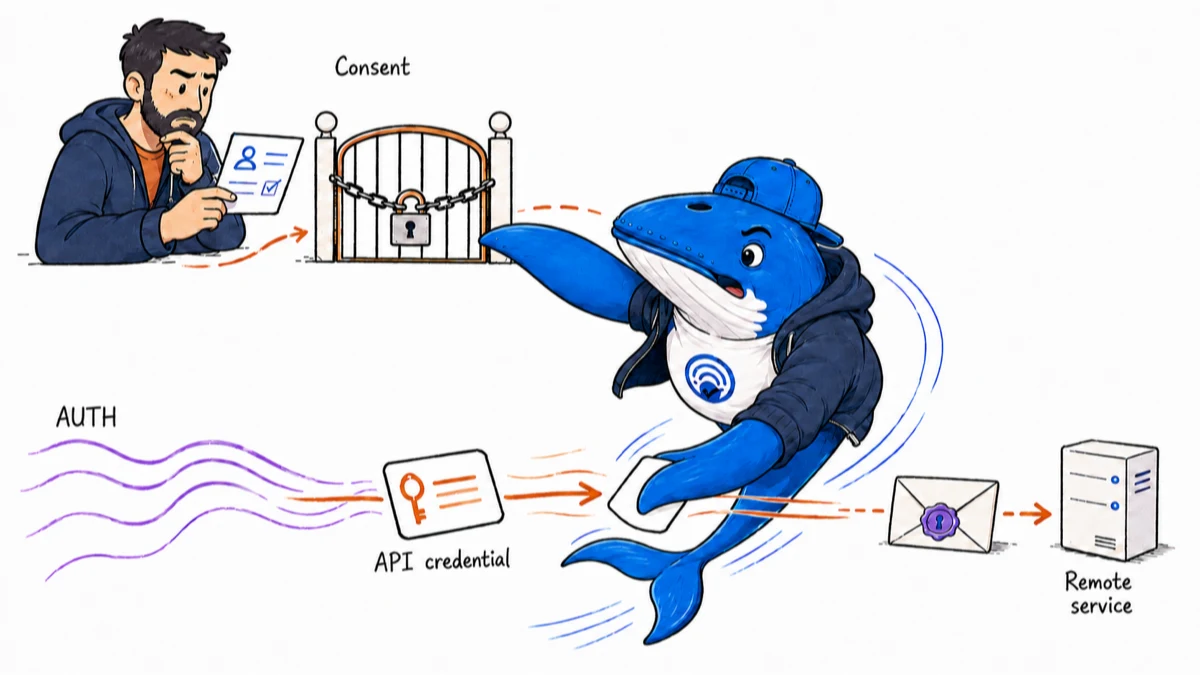
Direct answer: Rank Math 1.0.277 introduced an AI Support Agent that could create a WordPress Application Password when an eligible administrator opened the plugin’s Help & Support screen. The public plugin code shows that authentication started in parallel with the consent check, so the credential could be created before the user accepted the feature’s terms.
The credential was encrypted before it crossed the network, and Rank Math says the Support Agent was read-only. Both points need context. The remote service held the key needed to decrypt and use the credential, while the WordPress Application Password itself inherited the linked user’s API permissions. “Read-only” described the agent’s reported service-side policy, not a read-only limit enforced by the credential.
Rank Math removed the agent in version 1.0.277.2 and added a cleanup migration for its named Application Passwords. This was a consent and least-privilege failure, not evidence that Rank Math was hacked or that all four million active installations created a credential.
What happened
Rank Math released version 1.0.277 on August 26, 2026. Its official changelog announced a Support Agent inside the plugin and new abilities that let AI assistants configure Rank Math settings. Version 1.0.277.1 followed the same day with a fix related to Application Password availability.
After the credential flow drew public scrutiny, version 1.0.277.2 arrived on August 31 and temporarily removed the Support Agent. Rank Math later acknowledged that the plugin had not explained the credential creation clearly enough. It said a rebuilt version would ask for access before creating any credential.
| Date | Event | Evidence status |
|---|---|---|
| August 26 | Rank Math 1.0.277 adds the Support Agent and AI configuration abilities. | Official changelog and plugin package |
| August 26 | Version 1.0.277.1 fixes an Application Password notice displayed in the wrong places. | Official changelog |
| August 28 | Plugin developer Sybre Waaijer publicly describes the credential and consent behavior. | Public technical report |
| August 31 | Version 1.0.277.2 removes the agent and includes credential cleanup code. | Official package comparison |
| September 1 | Rank Math publishes its explanation and says the agent will return with explicit pre-creation consent. | Vendor statement |
| September 2 | The Repository reports a call for plugin infrastructure audits and early Plugins Team discussions. | Attributed reporting; no public policy yet |
What opening Help & Support triggered
Search Engine Answer compared the official WordPress.org packages for Rank Math 1.0.276, 1.0.277, 1.0.277.1, and 1.0.277.2. The important sequence sits in the bundled Support Agent and WAP client code.
- The screen was gated. The Support Agent appeared only on a site connected to a Rank Math account and for a logged-in user who passed the
manage_optionscapability check. On a normal single-site installation, that is usually an administrator. - Consent and authentication were separate. The chat script initialized its terms check and then immediately started the session. The consent state disabled the message composer, but it did not gate the authentication call.
- WordPress created an API credential. The authentication request provisioned a WordPress Application Password for the current user.
- The site sealed the credential locally. The code encrypted the username and Application Password to a public key supplied by the remote WAP service.
- Rank Math issued a session wrapper. The sealed credential, site URL, product information, key identifier, and Rank Math connection key went to Rank Math’s token endpoint. The returned bearer token was then used for WAP calls.
The code comment describes the terms gate as running “in parallel with auth.” That is the decisive consent issue. A user could be prevented from sending a support message until accepting the terms while the credential needed for the session was already being created.
This was not a new administrator account and not the user’s normal WordPress password. It was a separate, revocable API credential tied to the current user. WordPress states that Application Passwords authenticate API requests, not interactive logins through wp-login.php.
“Encrypted” did not mean “inaccessible”
Rank Math says the credentials were encrypted and were not stored or persisted on its side. The public client code supports a narrower, testable part of that statement: the plaintext credential was sealed locally and the Rank Math relay received ciphertext rather than the readable password.
But encryption answered the transport question, not the authorization question. The credential was sealed to the WAP service’s public key. The corresponding private key was therefore required to recover and use it. That was the intended design, not a cryptographic flaw.
The plugin package cannot establish how the production backend protected its private key, which staff or systems could reach it, what was logged, or whether plaintext was ever retained after decryption. Rank Math says it was not persisted. Without the backend code, configuration, and logs, that remains a vendor operational claim rather than an independently verified fact.
A read-only agent can still receive a broad credential
The cleanest way to understand the dispute is to separate four layers that were often collapsed into one.
| Layer | Lifetime | Scope | What public code establishes |
|---|---|---|---|
| WordPress Application Password | No built-in expiry field | Authenticates as the linked user at permitted API endpoints | Created for the current manage_options user and retained until revoked or cleaned |
| Sealed credential | Transport object | Contains the username and Application Password | Encrypted locally to WAP’s public key |
| GRND bearer token | JWT expiry | WAP session wrapper | Returned through Rank Math and supplied to the browser for WAP calls |
| Support Agent policy | Backend-controlled | Rank Math says it was read-only | The production allowlist is not present in the public plugin package |
| WordPress endpoint permission | Evaluated per request | Uses the authenticated user’s capabilities | Still applies after the Application Password authenticates the user |
Rank Math may be accurate when it says the Support Agent was configured to read only. That is a statement about the remote agent’s tool policy. The Application Password had no equivalent read-only scope. WordPress’s original Application Password integration guide treated per-application authorization scoping as future work.
The distinction matters because the same Rank Math release also registered WordPress abilities capable of changing SEO settings, homepage metadata, modules, and automatic-update behavior. Those abilities checked manage_options, and the WAP client supplied the site’s MCP endpoint to the remote backend.
That combination does not prove the Support Agent executed changes or was allowed to call every registered ability. The production role policy is unavailable. It does prove that the credential was broader than the stated behavior of the agent using it. A service-side allowlist was the least-privilege boundary; WordPress was not enforcing that boundary in the credential itself.
This is a useful test for any AI SEO product with agentic features: audit the maximum authority of the credential, not only the actions the current interface promises to perform.
The disclosure gap was more than a modal
Rank Math 1.0.277’s readme.txt included an External Services section presented as a complete disclosure of the services used, the data sent, and the conditions that triggered each request. It documented several Rank Math, Google, IndexNow, and Content AI services.
It did not identify the group.one WAP backend, the g1i.one key host, Application Password creation, the sealed credential, the site MCP endpoint supplied to WAP, or the support-chat data flow.
WordPress.org’s plugin documentation guidance asks developers to explain third-party services in clear language, including when they are used and where users can find the service’s terms and privacy policy. The detailed plugin guidelines also restrict external contact without authorized consent, while recognizing that installing, activating, registering, or configuring a SaaS service can establish consent.
The existing Rank Math account connection makes a categorical rules verdict less simple. The more defensible conclusion is that 1.0.277 raised a serious compliance question: a newly introduced credential pathway was absent from the package’s stated external-service disclosure, and the feature’s own terms had not been accepted before authentication began. No public WordPress.org ruling reviewed for this article declares a formal violation.
What version 1.0.277.2 removed and cleaned
Version 1.0.277.2 did more than hide the chat interface. Package comparison shows that it removed the Support Agent integration and the bundled WAP client, returned Help & Support to the earlier external support route, stopped new Support Agent credentials from being created, and added a migration that deletes Application Passwords named WAP – Rank Math Support Agent across users.
The migration runs through Rank Math’s update process on admin_init. In practice, an administrator should update and then load wp-admin so the migration has an opportunity to execute. A manual check is still sensible, particularly when an update was deployed automatically or from the command line without an administrative page request.
This corrects an important overstatement in some discussion of the incident. Existing credentials were not deliberately left untouched by the update. The package contains cleanup code. Verification is still necessary because having a migration and confirming that it ran on a particular site are different things.
A five-minute check for site owners
If a connected site ran Rank Math 1.0.277 or 1.0.277.1, use this narrow verification sequence:
- Update Rank Math to 1.0.277.2 or later. The affected agent is absent from that package.
- Load wp-admin once after the update. This gives the update migration a chance to run.
- Inspect Application Passwords on relevant user profiles. Confirm that no entry named
WAP – Rank Math Support Agentremains. - Investigate unexplained credentials. Check the owner, label, last-used time, and last-used IP where WordPress records them, then revoke credentials that have no confirmed purpose.
- Inventory before disabling the feature globally. Other legitimate integrations may rely on Application Passwords. Prefer a dedicated, least-privileged integration user where the service permits it.
WordPress usage metadata is coarse. A benign or empty last-used record is useful context, not proof that no request occurred. There is no public evidence of malicious exploitation of this Support Agent flow.
What “four million active installs” does not mean
The WordPress.org listing places Rank Math in the four-million-plus active-install band. That number describes plugin adoption, not the number of credentials created.
The relevant code path required several conditions: the site had to be connected to a Rank Math account, an eligible logged-in user had to pass the capability gate, the site had to be running 1.0.277 or 1.0.277.1, and that user had to open Help & Support. Public data does not show how many sites met all of those conditions.
The incident’s significance comes from the authority and consent design in a widely installed plugin, not from an unsupported claim that four million sites exposed credentials.
The affected release also carried security fixes
Version 1.0.277 was not only a feature release. Rank Math’s changelog says it strengthened plugin security. WPScan’s current Rank Math record lists seven public vulnerabilities as fixed in 1.0.277 and one more as fixed in 1.0.277.1. That public list does not substantiate every higher vulnerability count repeated in secondary coverage.
One of the separate flaws was an Author-plus remote-code-execution vulnerability affecting versions through 1.0.276. Patchstack records 1.0.277 as the patched version and scores the issue at CVSS 7.2.
This produced a difficult release sequence: site owners needed security fixes that arrived in the package that introduced the Support Agent credential flow. The practical resolution is not to remain on 1.0.276. It is to run 1.0.277.2 or a later secure release, then verify the credential cleanup.
Plugin infrastructure audits are still a proposal
The Repository reported that WordPress co-founder Matt Mullenweg called in WordPress Slack for mandatory infrastructure audits of plugins that take administrator-level access. It also reported that Plugins Team co-representative David Perez described discussions as being at an early stage.
As of September 3, the official Plugins Team blog and the team’s August 31 public update did not contain a finished audit policy. No public specification reviewed for this article defined the trigger, auditor, scope, renewal period, enforcement process, funding model, disclosure standard, or appeal route.
A credible policy would need to answer questions that source-code review alone cannot:
- Does the audit trigger on any external service, remote management, or only credentials capable of material site changes?
- Is risk measured by the agent’s advertised behavior or by the maximum authority of its credential?
- Will WordPress.com and Automattic-connected services face the same criteria as independent vendors?
- Must auditors inspect backend code, key custody, staff access, logs, retention, incident response, and subcontractors?
- Does a material permission or infrastructure change require a new audit?
- Will reports, exceptions, remediation deadlines, and enforcement decisions be public?
- Who pays, selects the auditor, manages conflicts, and hears appeals?
WordPress.org already has rules covering consent, security, external-service disclosure, and developer responsibility. Infrastructure audits could add assurance for systems that cannot be evaluated from a plugin ZIP. They will help only if their criteria are observable, vendor-neutral, and tied to credential authority rather than brand trust.
For more coverage of how AI systems interact with search and publishing infrastructure, see the AI Search topic hub. Our sourcing, correction, and disclosure standards are documented in the Search Engine Answer editorial policy.
Frequently asked questions
Was Rank Math hacked?
No evidence reviewed for this article shows a breach connected to the Support Agent. The incident concerned product design, consent, disclosure, and credential scope. A separate Author-plus remote-code-execution vulnerability affecting versions through 1.0.276 was fixed in 1.0.277.
Could the Application Password log into wp-admin?
No. WordPress Application Passwords are intended for API authentication and cannot be used as an interactive password on wp-login.php. They can still authorize consequential REST, XML-RPC, plugin, or MCP requests where the linked user and endpoint permissions allow them.
Was the password sent in plaintext?
The official plugin code sealed the username and Application Password locally with the WAP service’s public key. The Rank Math token relay received ciphertext. WAP held the corresponding private key needed to decrypt and use the credential.
Could the Support Agent change the site?
Rank Math says the Support Agent role was read-only. The public plugin package does not expose the production backend’s role allowlist, so this review cannot independently verify that policy or claim the agent performed a write. The underlying WordPress Application Password was not read-only scoped.
Does the update remove the credential?
Version 1.0.277.2 contains an exact-name cleanup migration for WAP – Rank Math Support Agent credentials. Update, load wp-admin once, and verify the profiles of relevant users. Manual verification checks whether the migration ran; it does not mean the vendor omitted cleanup.
Method, sources, and limitations
Search Engine Answer downloaded the official WordPress.org ZIP files for versions 1.0.276, 1.0.277, 1.0.277.1, and 1.0.277.2 and compared the Support Agent, WAP client, abilities, disclosure, and update-migration code. We checked those findings against Rank Math’s public explanation, WordPress Application Password documentation, WordPress.org plugin guidance, WPScan’s public vulnerability record, Patchstack, and The Repository’s reporting.
The remote WAP backend source, production role configuration, access logs, retention controls, private-key custody, and incident telemetry were not available. Rank Math’s statement that it did not persist credentials remotely cannot be proven or disproven from the public client package. The Slack comments and Plugins Team interview reported by The Repository were not available in an official public transcript and remain attributed reporting. No malicious use was identified.
Disclosure: Search Engine Answer has no stated commercial relationship with Rank Math, group.one, The Repository, WordPress.org, WPScan, or Patchstack in connection with this review. This article is an independent technical analysis and not legal advice.
Keep learning
Continue this topic
Next in this topic
Google’s AI Search Opt-Out Is Worldwide: Audit Property Inheritance
Earlier in this topic
Gemini 3.8 Flash Is Live: Test Search Citations Before Switching
AEO & AI Search
Ask a question or join the discussion