DOJ Backs OpenAI in The New York Times AI Copyright Case
The Justice Department reportedly backed OpenAI's fair-use position, but the court has not decided the case. Publishers should separate filing, ruling, and remedy.
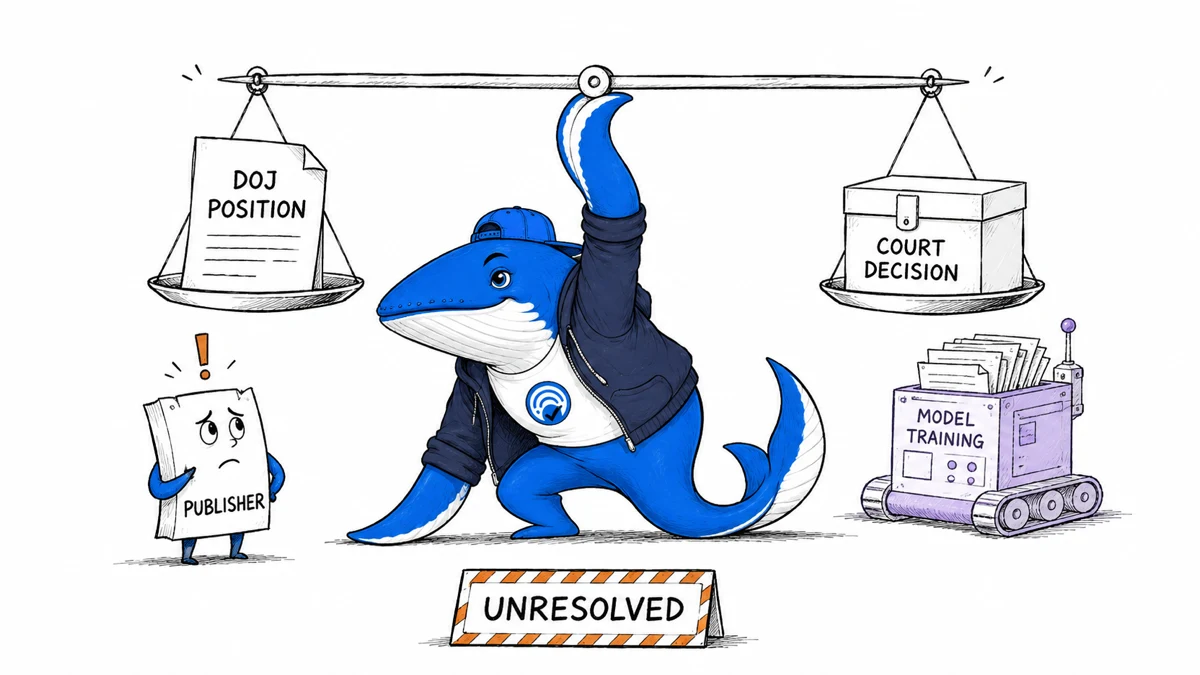
The U.S. Department of Justice has reportedly backed OpenAI’s fair-use position in The New York Times copyright case—but the court has not decided that OpenAI wins. The distinction is central for publishers: a government filing is an argument in pending litigation, not a new rule that settles whether training or output conduct is lawful.
What is known about the new filing
The Associated Press reported on September 2, 2026 that the Justice Department supported OpenAI’s fair-use argument in papers filed the previous day. The underlying dispute is part of the consolidated litigation that includes The New York Times’ claims against OpenAI and Microsoft.
The most important verb is supported. The DOJ is not the judge, its filing does not dismiss the claims, and the report does not establish that every alleged use of publisher material is legally identical. Readers can follow the proceeding through the public docket index, subject to filing access and docket updates.
Keep position, ruling, and remedy separate
A reliable newsroom note should carry three independent fields. Position records what a party or government office argues. Ruling records what the court actually decides. Remedy records what conduct must change or what damages follow if liability is established.
For this development, the position field has changed; the ruling and remedy fields have not. Headlines that collapse the three can mislead readers into believing the case is over. The visual accompanying this article deliberately leaves the court-decision box closed and marks the outcome unresolved.
Why fair use cannot be reduced to one slogan
Section 107 of the Copyright Act identifies four non-exclusive factors: the purpose and character of the use, the nature of the copyrighted work, the amount and substantiality used, and the effect on the potential market. The statutory text says the factors are considered together.
That means neither “training is transformative” nor “the work was copied” completes the analysis by itself. The court may have to evaluate disputed facts, the specific conduct alleged, relevant precedent, market evidence, and the relationship between training and generated outputs. Search Engine Answer is not predicting that judgment.
What publishers should document now
Publishers do not need to wait for a final judgment to improve their records. Preserve publication dates, revisions, licensing terms, access conditions, crawler policies, server logs, known output examples, referral data, and any takedown or licensing correspondence. Keep original files and reliable timestamps.
Separate crawler control from copyright position. A robots rule can express or enforce some access preferences, but it does not decide every legal question. Our AI-crawler decision guide maps operational tradeoffs; it is not a substitute for advice from qualified counsel about a specific dispute.
The next events that could change the analysis
- A public copy of the DOJ filing or a court description that clarifies its scope.
- A decision on the relevant fair-use arguments.
- Further factual findings about acquisition, training, memorization, retrieval, or outputs.
- An appeal, settlement, license, injunction, or damages ruling.
- Related decisions that the court treats as persuasive or controlling.
Each event should be dated and linked to its own document. Updating the article by overwriting old claims would erase the sequence readers need to understand how the case developed.
A five-question reading check
- Who filed or said it?
- Is the document an allegation, brief, order, opinion, judgment, or settlement?
- Which conduct and legal claim does it address?
- Has the court adopted the argument?
- What remains unresolved?
This small check prevents an advocacy document from being reported as a judgment and helps publishers decide whether a development changes operations today or merely changes the litigation record.
A separate publisher suit was filed on September 16
Twenty-six news publishers filed Times Publishing Company et al v. Microsoft Corporation et al in the Southern District of New York on September 16, 2026. The defendants listed on the public docket include Microsoft, OpenAI and related entities.
The filing is a separate case and its claims are allegations, not findings. It does not change the status of the DOJ position discussed above, and it does not establish a court rule for every publisher or AI system. What it changes is the litigation map: more publishers are now asking a federal court to evaluate alleged uses of their work.
For monitoring, keep each docket in a separate row with its court, case number, plaintiffs, defendants, claims, latest filing and latest judicial action. Combining multiple suits into one narrative can make an allegation in one case look like a ruling in another.
Sources, method, and limit
Sources: Associated Press reporting dated September 2, the public case docket, and the official text of 17 U.S.C. §107, checked September 4, 2026.
Information gain: the article separates government position, court ruling, and remedy, then gives publishers a preservation and update framework.
Limit: the new-event claim relies on AP’s description because we did not independently retrieve a public copy of the September 1 DOJ filing. This article is news analysis, not legal advice.
Keep learning
Continue this topic
Next in this topic
Google AI Mode shopping prices: compare offers, not just products
Earlier in this topic
ChatGPT Enterprise Search Can Use Cached Results: What Publishers Should Test
AEO & AI Search
Ask a question or join the discussion