ChatGPT Enterprise Search Can Use Cached Results: What Publishers Should Test
Restricted ChatGPT Enterprise and Edu workspaces may use cached web results or disable search. Test live, cached, and off states before making freshness claims.
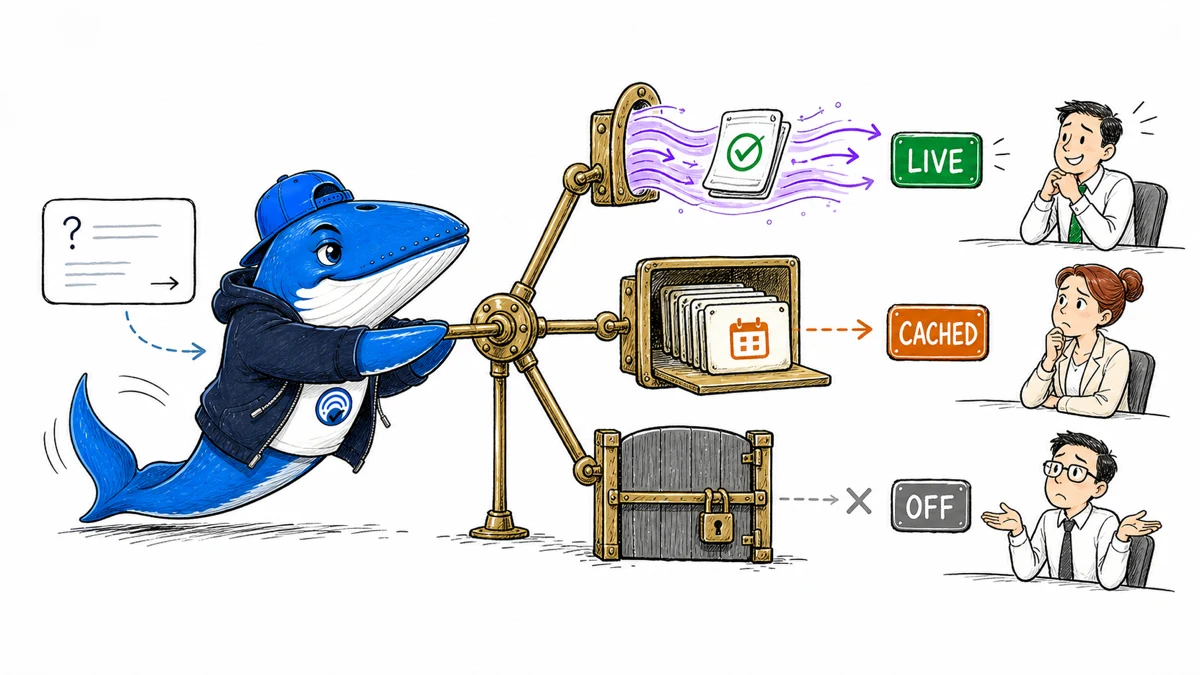
ChatGPT Enterprise and Edu administrators can restrict web search, but a restricted workspace can still produce answers from cached web results in some configurations. That distinction matters to security teams and to publishers measuring whether current pages are being retrieved. An answer that contains web-derived information is not proof that ChatGPT fetched the live page during that session.
What OpenAI documents for Enterprise and Edu search
OpenAI’s current Enterprise and Edu search guide describes workspace-level controls, role permissions, connected sources, restricted modes, and Lockdown. It also says restricted modes may use cached results or disable web search, depending on the administrator’s configuration.
OpenAI says search queries sent to Bing or specialized providers are disassociated from the user’s ChatGPT account and may include approximate location. ChatGPT for Healthcare is documented differently: it does not use Bing or specialized search providers. The guide also warns that workspace web-search controls do not apply to third-party GPTs, which need a separate governance decision.
Separate live, cached, and off before testing
A useful audit needs three states, not a simple on-or-off column. Live means the test produced evidence consistent with current web retrieval. Cached means web-derived information may be available without a fresh fetch. Off means the configured role or restricted mode blocks the search path.
Do not infer one state from the wording of an answer. Record the workspace setting, role, Lockdown state, connected-source state, GPT type, visible citations, source timestamps, and your own server logs. If the same prompt is tested in several workspaces, treat each workspace as a separate environment.
A reproducible workspace search test
- Create a harmless canary page. Publish a unique sentence and record the exact UTC publication time, canonical URL, response headers, and sitemap entry.
- Freeze the prompt. Ask a question whose correct answer depends on that sentence. Do not add the URL unless URL fetching is the behavior you intend to test.
- Record the control plane. Capture the workspace search toggle, role override, restricted mode, Lockdown status, connected sources, and whether the conversation uses a third-party GPT.
- Run matched sessions. Test in fresh conversations and keep wording, account role, region, and timing constant.
- Check delivery evidence. Compare citations and answer text with CDN or origin logs. A citation is not proof of a same-session request.
- Repeat after a controlled edit. Change only the canary sentence. A new answer matching the edit is stronger evidence of freshness than a general mention of the page.
This complements an answer-level ChatGPT search evidence review; it does not replace crawler, referral, or server-log analysis.
What publishers can—and cannot—measure
Publishers can measure observed requests, referrals, citation URLs, cited versions, and the lag between a page change and an answer change. They cannot see a customer’s confidential workspace settings, prove which upstream provider supplied every fact, or determine from a missing request whether a result came from cache.
Keep four evidence layers separate: documented product capability, administrator configuration, observed retrieval, and answer output. This is the same discipline used in a web-versus-app citation drift test. Combining those layers into one “ChatGPT found us” metric creates false certainty.
The administrator checklist
Start with the most restrictive applicable role because OpenAI says a role-level Off setting overrides On. Review Lockdown separately, then inventory third-party GPTs and connected sources. Decide whether cached web results are acceptable for the work being performed and document the expected behavior for sensitive teams.
For publisher research, retain screenshots or exported settings only when policy allows it. Never ask testers to expose confidential prompts, credentials, or private connected-source content. A valid measurement plan can record state labels and outcomes without collecting the underlying enterprise material.
Five interpretation mistakes to avoid
- Treating a citation as proof of a live request.
- Assuming all roles inherit the workspace default.
- Applying native ChatGPT controls to every third-party GPT.
- Combining connected-source retrieval with open-web retrieval.
- Comparing Healthcare behavior with Enterprise or Edu without noting the provider difference.
These errors can make a security control look ineffective or make a publisher visibility report look more precise than the underlying evidence supports.
Source, method, and limit
Primary source: OpenAI’s Enterprise and Edu search documentation, checked September 4, 2026.
Information gain: the article converts the documented control surface into a live/cached/off protocol that joins administrator state, answer evidence, and publisher logs.
Limit: this is a test design, not a benchmark of ChatGPT freshness. Product behavior can vary by plan, workspace policy, region, provider availability, and later documentation changes.
Keep learning
Continue this topic
Next in this topic
DOJ Backs OpenAI in The New York Times AI Copyright Case
Earlier in this topic
Google’s AI Search Opt-Out Is Worldwide: Audit Property Inheritance
AEO & AI Search
Ask a question or join the discussion