Should You Block AI Crawlers? A Founder’s Decision Guide
Separate model training, AI-search discovery, user-requested retrieval, and private access before choosing crawler rules or enforcement.
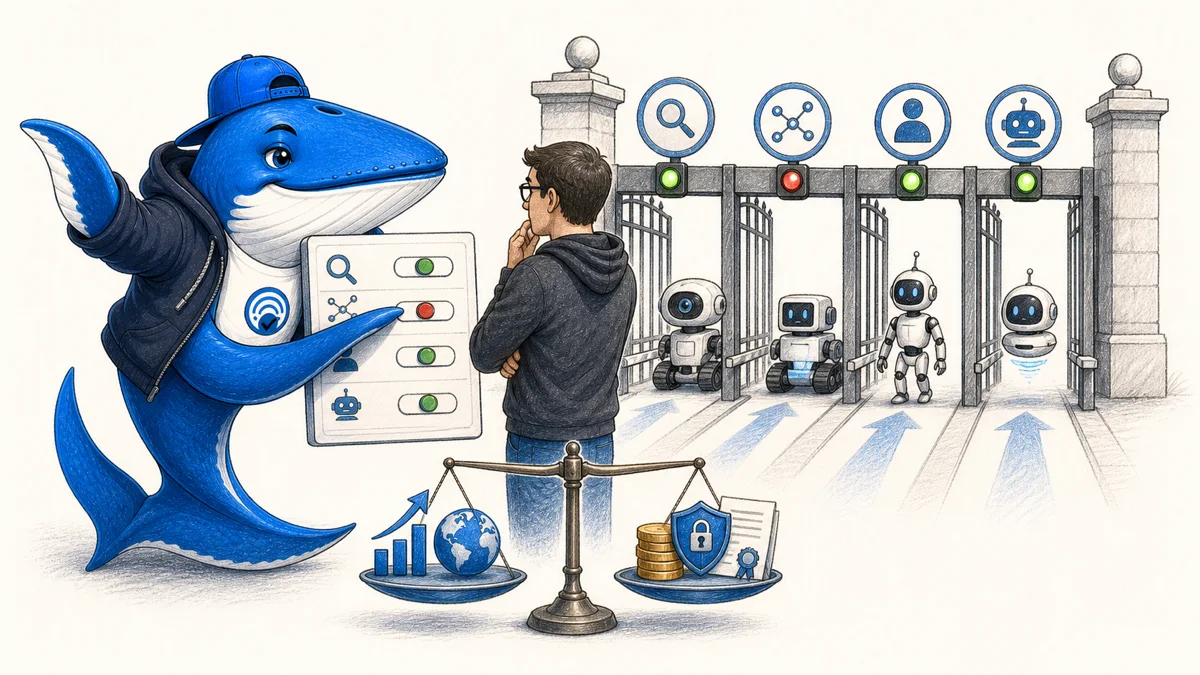
The founder’s answer: do not make one blanket “allow AI” or “block AI” decision. Separate training, search discovery, and user-requested retrieval; decide what each route may do; publish the matching robots rules; and use server-side enforcement when access control actually matters.
First decide what you are protecting
A crawler decision is a business-control decision, not merely a technical preference. Name the material at risk: licensed reporting, paid research, customer data, private documentation, product pages, support answers, or public marketing content. Then name the acceptable use: normal search discovery, AI-search retrieval, user-triggered page access, model training, or none.
Do not put secrets or customer-only data on a public URL and expect robots.txt to secure it. Cloudflare’s managed robots documentation describes robots directives as voluntary instructions, not enforcement. Authentication, authorization, rate limits, bot controls, and firewall rules are the enforcement layer.
Separate the crawler jobs
Vendors increasingly publish more than one control. Google documents Googlebot for Search, including Discover, and a separate Google-Extended control token for certain Gemini model training and grounding uses. Google states that Google-Extended does not affect inclusion or ranking in Google Search.
Anthropic documents distinct agents for training (ClaudeBot), user-directed retrieval (Claude-User), and search indexing (Claude-SearchBot) in its crawler guidance. Blocking the search or user agent can therefore reduce the corresponding discovery or retrieval path. Read the current vendor documentation before treating one name as a universal switch.
| Use | Typical question | Control to review |
|---|---|---|
| Search discovery | Should this page be eligible to appear in results? | Search crawler and page-level indexing controls |
| AI-search retrieval | May an answer product find or fetch this public page? | Vendor search/user agents and product documentation |
| Training | May content be used for model improvement? | Published training crawler/control token |
| Private access | Must unauthenticated clients be denied? | Authentication and server-side authorization |
Use a four-question founder test
- Does discovery create value? Record whether qualified visits, citations, leads, or customer support reduction matter to the business.
- Do you have rights to permit the use? Separate owned content from licensed, user-generated, or confidential material.
- Can you measure the outcome? Define logs, referrals, citations where reported, conversions, infrastructure cost, and complaint signals.
- Can you enforce the boundary? A voluntary directive may express preference; sensitive access needs a technical control.
Choose a policy by content class
Many publishers need more than one policy. Public company pages and free documentation may benefit from search and answer discovery. A licensed archive may allow ordinary search snippets but deny training. A customer portal should require authentication regardless of crawler identity. Record these classes in a policy table instead of maintaining a collection of unexplained user-agent lines.
| Content class | Search | AI retrieval | Training | Enforcement |
|---|---|---|---|---|
| Public marketing pages | Allow | Test | Business decision | Rate limits and logs |
| Free documentation | Allow | Allow when useful | Rights review | Abuse controls |
| Licensed archive | Contract-dependent | Contract-dependent | Deny unless licensed | Access rules |
| Customer portal | Deny | Deny | Deny | Authentication |
Deploy without accidental collateral damage
- Inventory current
robots.txt, meta robots, CDN bot rules, WAF rules, and authenticated paths. - Create a dated matrix of vendor, agent or token, declared purpose, decision, owner, and evidence URL.
- Test the final public robots file with exact user-agent spelling and path scope.
- Watch server logs and Search Console for unintended changes.
- Recheck vendor documentation monthly or when a product announcement changes the controls.
Avoid blocking Googlebot when the intent is only to opt out of a documented Gemini use. Avoid assuming that an unknown bot will obey a named rule. Avoid IP allowlists built from unverified community lists. Where a vendor publishes verification guidance, validate both the user agent and network identity before granting special access.
Run a reversible 30-day decision
For public content where the tradeoff is uncertain, define a reversible trial: the pages in scope, the exact rule change, release time, referral and citation observations, crawl volume, infrastructure cost, sales or support signals, guardrails, and rollback trigger. Preserve the baseline and do not change multiple controls mid-window.
The result will still be bounded. A traffic change does not automatically prove that one crawler rule caused it, and a quiet log does not prove that content was never used elsewhere. The value of the trial is a better documented decision, not certainty where the platforms do not provide it.
Assign ownership before publishing the rule
The founder should approve the commercial boundary, but one person should not silently own every layer. Editorial identifies content classes and licensing constraints. Legal or rights owners interpret contracts. Engineering implements and tests access rules. Security handles abuse and private data. Analytics defines observable outcomes. Name one policy owner who reconciles these inputs and records the final decision.
- Decision record: vendor, declared purpose, content class, allow or deny, evidence, approver, and date.
- Implementation record: exact robots line, WAF rule, authentication change, test result, and rollback.
- Monitoring record: verified bot traffic, infrastructure cost, referrals, citations where reported, errors, and complaints.
- Maintenance trigger: vendor documentation change, contract change, new content class, or unexpected access.
Publish a short external policy when readers, contributors, or licensors need to understand the position. Keep operational detection details private when disclosure would make abuse easier. Most importantly, make the visible policy match the technical state; an unimplemented statement creates false confidence.
OpenAI’s three crawler controls produce different outcomes
OpenAI’s publisher FAQ separates OAI-SearchBot, GPTBot and ChatGPT-User. OAI-SearchBot controls inclusion in ChatGPT search summaries and snippets. GPTBot controls potential use for training foundation models. ChatGPT-User represents user-requested visits and is not the same discovery policy.
A blanket “allow AI” or “block AI” rule therefore hides three decisions. Write the desired outcome for each content class first, then configure the relevant user agent.
| Control | Primary decision | Evidence to check |
|---|---|---|
| OAI-SearchBot | Search summaries and snippets | robots policy, logs, citations |
| GPTBot | Foundation-model training access | robots policy and logs |
| ChatGPT-User | User-requested page access | request logs and resulting visits |
There is one non-obvious state. OpenAI says a blocked page may still appear as a title and link when its URL is learned from another page or third-party source. Blocking retrieval can remove the summary without necessarily removing the URL reference.
If a page should not appear at all, OpenAI points publishers to noindex. The crawler must be allowed to retrieve the page before it can read that directive. Blocking the crawler and expecting it to obey an unseen page-level tag is internally inconsistent.
Download the crawler outcome matrix
Download the crawler-control CSV. Map each content class to a user agent, robots policy, page-level directive, desired outcome, log evidence and rollback trigger.
The EXAMPLE-REMOVE row is illustrative. Replace it with your own URLs and observed outcomes.
Primary documentation
Keep learning
Continue this topic
Next in this topic
ChatGPT Ads Europe: 31-Market Access Guide
Earlier in this topic
Bing AI Performance: Audit Citation Share With a 29-Field Ledger
AEO & AI Search
Ask a question or join the discussion