Cloudflare Pay Per Use: Build a 31-Field Pilot Ledger
Separate Cloudflare’s experimental Pay Per Use partner models from live controls, then reconcile reported uses, rights, deductions, payouts and rollback evidence.
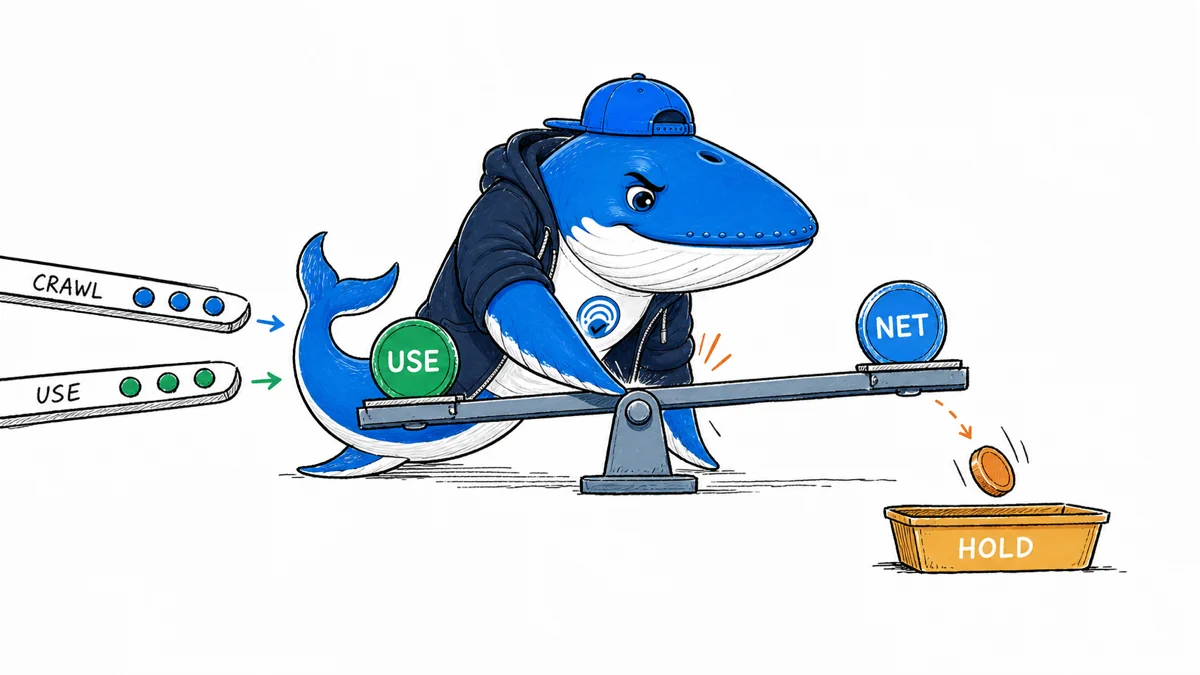
Direct answer: Cloudflare Pay Per Use is still a set of partner experiments, not a generally available publisher revenue product. A publisher can prepare an evidence contract now, but it should not forecast income until the partner defines the payable event, reporting fields, rights scope, deductions, payout state and exit path.
This guide turns that boundary into a 31-field pilot ledger. It separates a crawl from a reported use, a citation from a referral, and gross value from money that can actually be reconciled. The method was checked against Cloudflare’s current July 2026 announcement and press materials, retrieved August 29, 2026.
Pay Per Use is still an experiment
Cloudflare says it is shaping Pay Per Crawl into Pay Per Use with Ceramic.ai and You.com. The same announcement calls the work experimental and describes different partner models. Ceramic’s stated design pays an opted-in publisher when its content appears in Ceramic search results. You.com’s stated design lets an agent pay on demand for a specific piece of premium content.
Those descriptions do not establish a shared rate, common reporting contract or universal definition of “use.” They also do not prove that a publisher is eligible, that a report is available in every account, or that a payment has cleared. Treat the announcement as evidence of a pilot direction and named partner designs. Do not convert it into a launch date or revenue claim.
Keep five product states separate
| State | What the source supports | What remains unproven |
|---|---|---|
| Crawler controls | Cloudflare customers can make access choices subject to product and plan conditions. | A rule does not prove a downstream model honored a commercial purpose. |
| Smarter-search signals | Cloudflare says it is testing freshness signals with AI companies. | The announcement does not publish a reproducible effectiveness result. |
| Pay Per Crawl | A prior model associated payment with crawl access. | A paid fetch does not establish answer use or reader value. |
| Pay Per Use | Named partner experiments connect compensation to partner-defined use events. | No general publisher product or shared rate is documented. |
| Publisher outcome | A participant may receive partner reports or payments under its agreement. | One participant’s result is not an Internet-wide benchmark. |
Define the payable event before the rate
A price is meaningless until the denominator is fixed. Ask whether payment is triggered by a fetch, an eligible query, a search-result appearance, a quoted passage, a citation, an answer inclusion, access to premium content or a completed user action. Record who counts the event, which timestamp controls it and how duplicates, retries, tests, fraud and refunds are handled.
Keep partner terminology in a dedicated field rather than normalizing unlike events into “AI uses.” A Ceramic search-result appearance and a You.com on-demand content purchase can both be legitimate pilot events while answering different economic questions. The ledger therefore stores the partner, program state and event type beside every amount.
Freeze content and rights scope
Before opting in, define the included domains, URL patterns, article versions, media types, excerpts, premium materials, territories and time window. Separate search retrieval from agent use and foundation-model training. A payment permission for one event should not silently become permission for another use.
Store a content-version timestamp or hash with the event. A later page can differ from the material used in the pilot, and a report that names only a current URL cannot resolve that difference. Keep license and policy documents in a private evidence store; the public worksheet should reference them without exposing confidential terms or identifiers.
Reconcile partner reports with publisher evidence
| Evidence plane | Useful fields | Limit |
|---|---|---|
| Partner report | Event, page, query class, amount, status, report time | Uses the partner’s counting rules. |
| Cloudflare control | Zone, access state, classification, rule time | Shows configuration, not payment settlement. |
| Origin log | Request time, path, verified identity, status, bytes | A fetch does not prove answer use. |
| Analytics | Referral source, landing page, session and outcome | Visits do not count citations or unseen uses. |
| Finance | Gross, fees, reversals, net and payout state | Settlement does not explain discoverability. |
Use a safe correlation reference to join these planes. Do not publish raw request IDs, personal data or confidential contract identifiers. A discrepancy field should state exactly what failed to reconcile, such as “reported event has no matching content version” rather than “partner data is wrong.”
Count crawl, use, citation and referral separately
One page can be crawled without being used, used without being visibly cited, cited without sending a visit, or visited without generating a payable event. Report each layer independently. Cloudflare’s claim that much AI crawler traffic refetches unchanged pages is a company network observation; it is not a denominator for an individual publisher unless the publisher can reproduce the classification in its own scope.
For visibility analysis, use the AI visibility measurement crosswalk. For crawler and publisher-control decisions, use the publisher-control outcome matrix. Neither resource turns partner-defined payment events into citations or conversions.
Calculate net payment after fees and reversals
Record gross amount, currency, fees, reversals, net amount and payout state. Do not label an accrued balance as revenue received. Currency conversion, minimum thresholds, dispute windows, invalid-traffic rules and tax treatment can change the usable value of the same gross figure.
Choose one reporting currency and preserve the original amount. If conversion is necessary, store the rate source and date in the private calculation notes. Compare net payment with the operational cost of rights review, reporting, reconciliation and incident handling. A pilot can produce a positive gross amount and still fail its declared continuation rule.
Protect private and contractual data
Query logs and payment records can expose reader intent, commercial terms, unpublished content or account identifiers. Retain only the fields needed to reconcile the program. Aggregate query text when the contract permits, replace identifiers with scoped references and restrict access to raw partner reports.
The downloadable ledger contains no secret, token, raw IP address or personal identifier. Its two example rows are marked EXAMPLE-REMOVE and must be replaced. A public case study should report the observation window, denominator, inclusion rules and redactions without publishing the underlying private correlation key.
Write the stop and rollback rule first
Define who can opt in, pause or revoke the pilot. Record how quickly access changes should propagate, what happens to cached material, how unsettled events are handled and when the final report is due. Keep the pre-pilot access configuration so a rollback does not depend on reconstructing it from memory.
A practical stop rule might require auditable net payment above operating cost, no expansion beyond the approved rights scope and a discrepancy rate below a declared threshold. That is an example decision design, not a recommendation for a universal threshold. The owner should set the numbers before seeing the result.
Review the pilot in four windows
| Window | Primary check | Decision |
|---|---|---|
| Before opt-in | Rights, content scope, baseline access and reporting contract | Start or hold |
| Early operation | Event shape, missing fields, privacy and technical errors | Repair or pause |
| Settlement | Gross-to-net reconciliation, disputes and payout status | Accept or challenge |
| Final review | Net value, crawl load, visibility, referrals and rights compliance | Expand, revise or stop |
Download the 31-field pilot ledger
Download the Cloudflare Pay Per Use pilot ledger. Use one row per reported payable event or reconciled event group, but never mix those units in one file. Replace both EXAMPLE-REMOVE rows, document the grouping rule and keep contract documents outside the public CSV.
The contribution is an inspectable reconciliation method, not a revenue forecast. It lets a publisher show which event was reported, which page version and rights scope applied, which evidence planes were available, what amount settled and who made the continuation decision.
What the evidence can and cannot support
The current sources support that Cloudflare is experimenting with partner-defined Pay Per Use models and has described possible reporting and publisher benefits. They do not establish general availability, a standard price, universal attribution accuracy or durable publisher revenue.
Primary sources: Cloudflare’s Pay Per Use announcement, the related July 1 press release, and the historical Pay Per Crawl announcement. Retrieved August 29, 2026. The experimental state should be rechecked before any public update or pilot decision.
For continuing coverage, follow the AI Search topic archive. Stop at the documented boundary: a promising payment design becomes an operational product only when the publisher can inspect its own eligibility, event contract, report and settlement.
Keep learning
Continue this topic
Next in this topic
Microsoft Web IQ: Audit Evidence Objects Before Trusting Benchmarks
Earlier in this topic
ChatGPT Restaurant Results and Reserve Buttons: A Verification Guide
AEO & AI Search
Ask a question or join the discussion