Learn AI SEO: A Free 30-Day Evidence-First Practice Plan
Learn AI SEO through seven practical modules and a 30-day portfolio: foundations, crawler controls, claims, citations, referrals, experiments and automation.
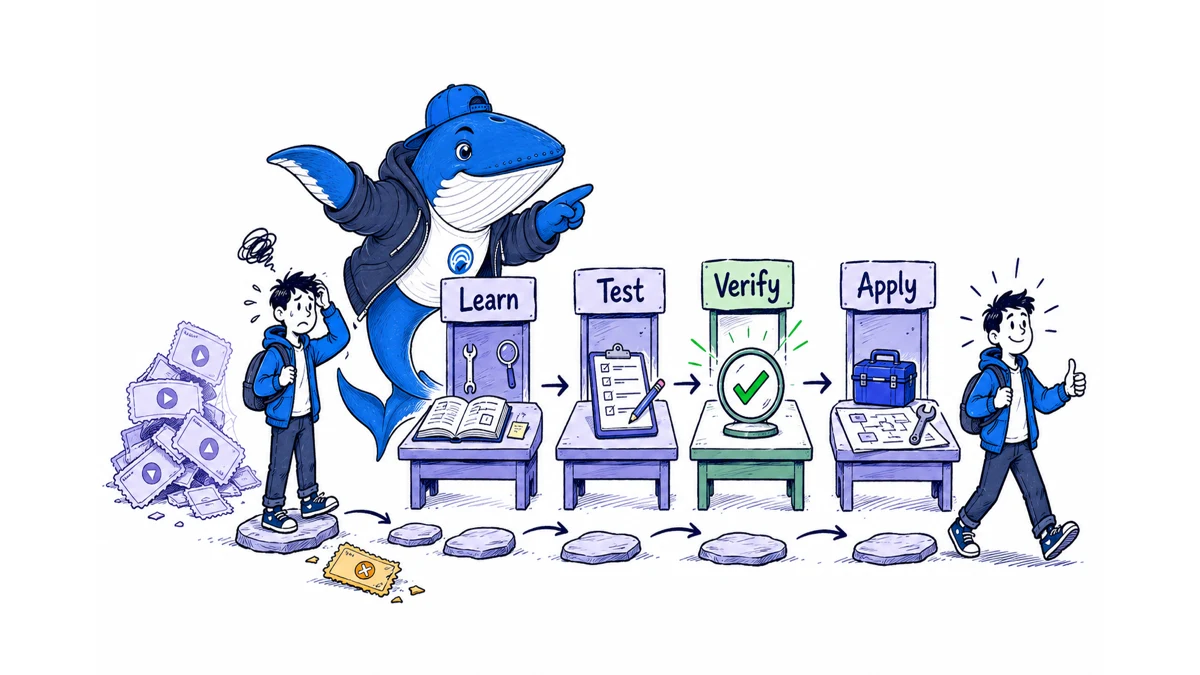
You can learn AI SEO by mastering four loops: learn a documented concept, test it on a controlled sample, verify the evidence, and apply only what survives review. The fastest path is not watching more tool demos; it is producing small, auditable work artifacts.
Module 1: Learn the search foundations
Study crawling, rendering, indexing, canonicals, snippets, internal links and measurement. Google’s SEO Starter Guide is a primary foundation. Then read its AI optimization guidance, noting which advice is documented and which popular claims are absent.
Exercise: audit ten URLs for status, canonical, index eligibility and clear primary answer. Deliver a one-page finding list with evidence.
Module 2: Learn platform controls
Compare OAI-SearchBot and GPTBot, PerplexityBot and Perplexity-User, and your CDN’s purpose-based controls. Record role, vendor source, robots token, verification method and intended policy. Avoid copying a universal robots.txt template.
Exercise: build a crawler control matrix and verify one authentic log request or mark it unknown. Use our AI crawler guide.
Module 3: Learn claim-level content
Take one existing page and classify sentences as documented fact, first-party observation, interpretation, recommendation or unknown. Replace secondary reporting with primary sources where available. Add one worked example and one meaningful limitation. Do not increase length unless the reader gains decision support.
Exercise: complete the workflow in our AI-search page rewrite guide and keep a before-and-after diff.
Module 4: Learn citation observation
Create 20 prompts from real user jobs. Freeze wording, locale and platform state for a cycle. Save answers, cited URLs and claim-support verdicts. Preserve failures and report numerator plus denominator. Repeat after a defined interval, not until the outcome looks good.
Exercise: produce a citation ledger with at least five manually verified source-claim relationships.
Module 5: Learn referral and outcome measurement
Configure known AI referral rules, campaign parameters, landing-page analysis and conversions. Document dark-traffic limits. Compare observed citations with detected visits without assuming every citation should generate a click or every direct visit came from AI.
Exercise: build a small report separating mention, citation, referral and revenue using our four-ledger framework.
Module 6: Learn controlled experimentation
Select comparable pages, define one treatment, capture a baseline and choose a review window. Prefer treatments that help readers even if no AI effect appears. Record simultaneous changes and avoid causal language when the design cannot isolate them.
Exercise: preregister a page-level test with hypothesis, metric, denominator, exclusion rule and rollback trigger.
Module 7: Learn responsible automation
Automate source collection, formatting and review handoffs before automating publication. Require source IDs, human approval, least-privilege credentials, idempotency and rollback. Test missing-source, duplicate-slug and failed-public-check paths.
Exercise: diagram a draft-only workflow and pass every failure case in staging. Our n8n SEO workflow provides the gates.
Your 30-day practice plan
- Week 1: foundations and crawl/index audit.
- Week 2: claim-led rewrite and source verification.
- Week 3: frozen prompt study and citation validation.
- Week 4: referral report, experiment design and retrospective.
Keep a portfolio containing the audit, evidence ledger, rewritten page, prompt sample, measurement report and test plan. That portfolio demonstrates judgment better than a certificate or tool badge.
Download the 30-day AI SEO practice plan. Replace the examples, attach proof for each exercise and mark a module complete only after the Verify step—not merely after reading it.
Keep the AI SEO guide and task hub as your syllabus index, then follow only the specialist route required by the evidence in your practice portfolio.
Keep learning
Continue this topic
Next in this topic
Google Publisher Tag and Back-Button Returns: A September 8 Test Plan
Earlier in this topic
AI SEO for WordPress: A Plugin-Neutral Setup and Audit
SEO
Ask a question or join the discussion