Content Optimization for AI Search: A Page-Level Rewrite Workflow
Repair an existing page with a clear claim, primary evidence, worked example and limitation—then measure the result without erasing the baseline.
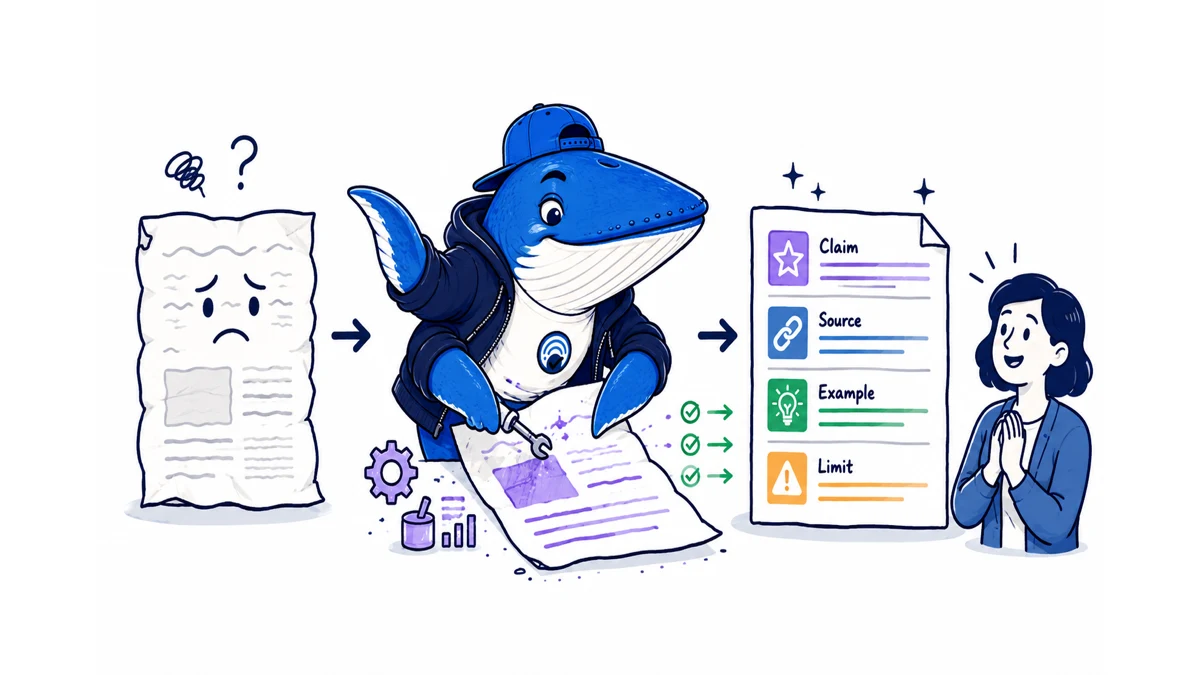
Content optimization for AI search means repairing a page so its main claim, evidence, example and limitation are clear—without padding it, flattening expert nuance or pretending a rewrite guarantees citation. The best candidate is an already useful page with a specific decision-support gap.
Select pages by opportunity and risk
Start with pages that already earn relevant impressions, referrals, citations, conversions or support usage. Add pages containing important facts that are outdated or hard to locate. Avoid rewriting everything at once; simultaneous sitewide changes destroy your baseline and can remove content readers already value.
Capture title, canonical, index state, query-page pairs, conversion data, citations and last-updated date before editing.
Write the page’s answer contract
In one sentence, state the question, audience, direct answer and boundary. Example: “For indexed pages, Google says no special AI schema is required for eligibility, but eligibility does not guarantee an AI-feature link.” This contract keeps the rewrite from drifting into a generic topic overview.
Compare the contract with your existing citation-ready content guidance and competing pages on the site.
Repair claims at sentence level
Classify important sentences as fact, first-party observation, interpretation, recommendation or unknown. Link time-sensitive product facts to primary documentation. Add date and scope. Remove citations that merely mention the topic but do not support the claim.
Google’s AI optimization guide recommends accurate, unique and useful content while warning against scaled low-value production. It does not require artificial chunks or a target word count.
Add the missing information gain
| Gap | Useful repair |
|---|---|
| Abstract advice | Worked example with inputs and outcome |
| Vendor claim | Primary-source evidence plus your analysis |
| Unclear choice | Decision table with tradeoffs |
| Unrepeatable result | Test protocol and downloadable ledger |
| Missing constraint | Explicit limitation and failure case |
Information gain is not novelty theater. It can be a clearer synthesis, a verified correction or a reusable tool that saves the reader work.
Improve structure without writing for a robot
Lead with the answer. Use descriptive H2 headings, concise paragraphs, real tables and steps in the order they are performed. Keep definitions near first use. Add internal links only when the next page serves a different job. Delete repetitive summaries and FAQ questions already answered in the body.
Do not replace precise terminology with awkward synonyms to increase keyword variation.
Review the human and evidence risks
Have a subject-aware reviewer check whether the rewrite changed meaning, removed a caveat, exposed confidential data or overstated a result. Verify every external link and promised download. Compare the final draft with the prior version and keep a rollback copy.
Our AI content brief guide includes safeguards for assisted drafting.
Measure through a fixed post-edit window
Record the publication date and changed sections. Watch index status, relevant queries, engagement, conversions, observed citations and support feedback. Do not attribute movement to the rewrite when other major changes occurred. If the page loses useful performance, inspect the query and conversion mix before rolling back.
Download the AI-search page rewrite ledger. Replace the example rows and require an evidence ID, expected reader benefit, reviewer and rollback decision for every substantive change.
Use a claim-level before-and-after test
Consider a weak sentence: “AI search prefers authoritative, well-structured content.” It names no platform, evidence, decision, or limit. A useful revision might say: “Google says pages must be indexed and eligible for a snippet before they can appear as supporting links in its AI features; eligibility still does not guarantee selection.” The revision is not better because it is longer. It is better because the platform, requirement, outcome, and boundary can be checked.
Save the original sentence, revised sentence, supporting primary source, reader benefit, and review date in the ledger. Then inspect the paragraph around it: the source should support the exact claim, the page should explain what the reader does next, and nearby wording should not quietly turn eligibility into a promise. If the claim is based on your own observation, record the sample and conditions instead of presenting it as platform policy.
Repeat this method for the few claims that control the reader’s decision. A page with five precise, actionable claims can be more useful than one with fifty generic tips. For cluster planning and measurement boundaries, return to the AI SEO guide and task hub.
Keep learning
Continue this topic
Next in this topic
AI SEO for WordPress: A Plugin-Neutral Setup and Audit
Earlier in this topic
AI SEO for Small Business: The 90-Day Strategy You Can Run
SEO
Ask a question or join the discussion