ChatGPT Search-Call Syntax: Evidence Review
A dated browser capture suggests ChatGPT changed how it represents search calls. The syntax is observable; its freshness and SEO meanings remain unproven.
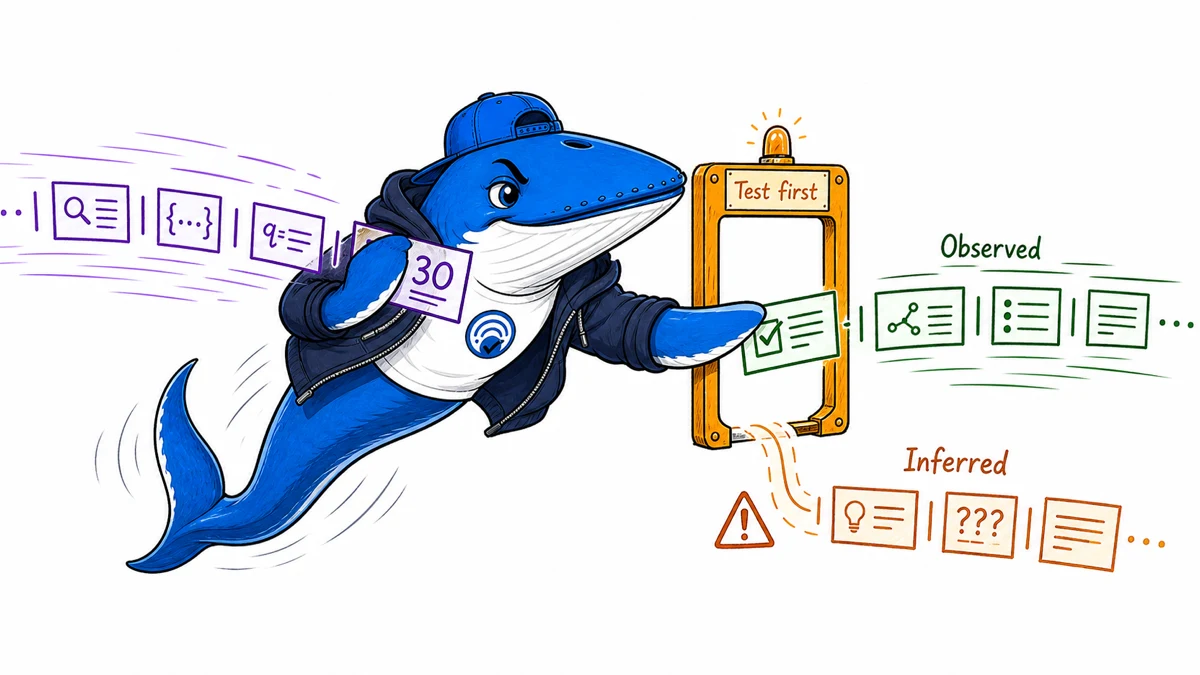
Direct answer: A dated browser capture provides credible evidence that one ChatGPT Plus account exposed a different search-call representation between August 16 and August 20, 2026. It does not prove that the representation is universal, that its numeric field counts days, or that a value of 30 creates a 30-day ranking cutoff.
The useful lesson is methodological. Treat the visible call as an observation surface, separate documented behavior from inferred field meanings, and test those meanings before changing a publishing schedule.
What the browser capture actually establishes
SEO practitioner Suganthan Mohanadasan published the underlying observation on August 21. His browser-traffic analysis shows a JSON-style search call on August 16 and pipe-delimited lines on August 20 after asking the same question from the same account.
The repeated structure can be summarized without assigning meaning to every field:
call_type|rewritten query|number|optional domain
length|short, medium, or long
The author then checked eight questions covering software comparisons, physical products, local businesses, news, sports, and finance. He reported call labels associated with general web retrieval, products, businesses, images, and rendered components.
That is useful observational evidence, with an important boundary: all examples came from one Plus account in one location. The article does not publish a complete raw dataset, repeated trials, client build, exact model state, memory configuration, or cross-account reproduction. It therefore establishes what appeared in those captures, not a stable public ChatGPT search protocol.
OpenAI confirms search fan-out, not the pipe syntax
OpenAI’s current ChatGPT Search documentation says ChatGPT may rewrite a prompt into one or more targeted queries. It may also issue more specific follow-up queries after reviewing initial results. Memory, approximate IP location, optional device location, and prompt context can affect those searches.
The documentation supports the broad idea that one user question can become several searches. It does not document the pipe-delimited representation, define the observed call labels, or assign public meanings to the number, domain, and length fields.
| Statement | Evidence status | Safe conclusion |
|---|---|---|
| The visible payload changed in the captured account | Attributed direct observation | Report the account and dates |
| ChatGPT rewrites and expands searches | Officially documented | Search fan-out is a supported product behavior |
| The number is a day-based freshness window | Plausible hypothesis | Test against the dates of returned documents |
| A value of 30 excludes older commercial pages | Unsupported extension | Do not treat it as a ranking cutoff |
| The final field targets a domain | Strong pattern inside the capture | Useful diagnostic clue, not a guaranteed public parameter |
Why 30 is not yet a freshness rule
The capture associated small numbers with fast-changing subjects and larger numbers with slower or archival questions. Values included 2 for a stock-price question, 7 for sports results, 30 for software comparisons, 90 for earnings guidance, and 365 or 3650 for Reddit-focused searches.
That pattern is consistent with a recency control measured in days, and the source article labels it as an assumption. Several other explanations remain possible: a soft age preference, a search-provider parameter, a cache or retrieval policy, a vertical-specific setting, or a value whose meaning changes by call type.
A hard cutoff is easy to falsify. Record every returned URL and its supported publication or meaningful-update date. If a search carrying 30 retrieves an eligible document older than 30 days, the number is not a universal hard exclusion rule. Even if every result falls inside the proposed window, repeated controls are still needed to distinguish a cutoff from ordinary preference for current documents.
The responsible publishing action is narrower: keep prices, product capabilities, availability, and comparison facts materially current, show honest revision dates, and preserve a change record. Do not refresh a date or rewrite a paragraph every 30 days merely because an undocumented field displayed 30.
Product and local results need a wider model
The captured product and business calls fit OpenAI’s public description of separate shopping and local experiences. That does not make the internal labels a complete optimization specification.
OpenAI’s shopping documentation says product selection can consider the query, memory or custom instructions, structured metadata from first- and third-party providers, other third-party content, model responses produced before new search results, safety rules, availability, price, reviews, and other context. It also says not every available product will be shown.
A product card is evidence that an item was eligible and selected in that response. Its absence does not reveal whether the cause was missing catalog data, relevance, personalization, availability, policy, merchant ranking, or ordinary output variation. Our analysis of ChatGPT product feeds and organic shopping explains why feed acceptance, product serving, answer mentions, and paid inventory need separate measurements.
Local results have similar boundaries. OpenAI documents approximate and optional precise location, maps, trusted third-party listing data, and reservation availability from OpenTable, Resy, and Yelp. A local business should reconcile its website, major listings, location details, and reservation providers. Absence from one captured business call does not prove that the website is powerless to help entity reconciliation.
Reddit retrieval is not an influence trace
The most interesting example in the source article is also the easiest to overstate. In one conversation, the author counted 84 Reddit threads among 221 entries in the retrieval pool. None of those 84 threads received a citation in the finished answer; vendor pages received the visible citations.
Those counts establish retrieval and attribution outcomes for that conversation. They do not show whether the Reddit snippets changed a claim, altered a recommendation, or were ignored. Content entering a retrieval pool is not the same as proven causal influence.
A separate Promptwatch monitoring report found that Reddit’s share of ChatGPT citations averaged 3.83% from July 18 through August 7, then averaged 0.52% from August 14 through August 17. Only responses with at least one citation entered that calculation. Promptwatch describes the movement as an 86.4% relative decline, while warning that its chart shows when the change happened—not why—and that a collection issue cannot be ruled out.
OpenAI and Reddit announced a Data API partnership in 2024. That verifies structured access to Reddit content. It does not disclose current retrieval weights, citation rules, freshness controls, or whether a specific answer used Reddit as an uncredited input.
Track three metrics separately: Reddit items retrieved, Reddit URLs visibly cited, and answer claims whose dependence can be demonstrated. Only the first two are available in the published capture.
What publishers can act on now
- Preserve eligibility. If ChatGPT Search inclusion is desired, allow
OAI-SearchBotand confirm that the CDN or firewall permits OpenAI’s published searchbot addresses. Search eligibility, training, user-triggered fetches, citations, and referrals are different outcomes. Use the AI crawler decision guide before changing a blanket bot rule. - Maintain facts, not dates. Update commercial pages when prices, features, policies, availability, evidence, or conclusions change. Keep the original publication date and show a meaningful update date.
- Reconcile entity signals. Maintain correct brand names, canonical domains, redirects, profiles, listings, and merchant records after a migration or rebrand.
- Measure each surface separately. Record ordinary web citations, product cards, local components, maps, widgets, Sources-panel links, and referral sessions as distinct events. A single visibility score can hide those differences; our AI referral tracking guide provides a comparison framework.
- Archive the observation environment. Model, plan, client, account state, location, memory, prompt, conversation state, date, raw payload, citations, and screenshots belong in the same test record. The AI visibility measurement crosswalk shows why the interface is part of the result.
These actions remain useful if the pipe representation disappears. Optimizing directly for an undocumented payload is fragile; improving accurate, accessible source data is not.
A replication protocol that could prove more
A useful next study should test the proposed meanings instead of counting how often an attractive pattern appears. Start with 30 fixed prompts: six each for breaking news or finance, evergreen information, software comparison, physical-product shopping, and local discovery.
Run each prompt in three account states and repeat it three times in a fresh conversation. That creates at least 270 observations before adding another device or region. Record the exact model, plan, client, locale, location permission, memory state, timestamp, prompt, raw call text, returned URLs and dates, visible citations, Sources-panel links, and rendered component.
| Hypothesis | Required test | Failure condition |
|---|---|---|
| The representation is broadly deployed | Repeat across accounts, plans, models, regions, web, and mobile | It appears only in a bounded client, model, or rollout |
| The number is a hard day cutoff | Compare the value with every returned document date | One qualifying result is older than the proposed window |
length controls returned excerpt size | Measure payload or snippet length by label | Short, medium, and long do not produce a stable ordered difference |
| The domain field determines the searched host | Compare the field with result hosts and migrated-brand controls | Results regularly come from unrelated hosts or context changes the domain |
| Widgets eliminate links | Inspect answer, Sources panel, interaction state, device, and region | A supported link appears elsewhere in the component flow |
Publish the raw observation table with the result. If the field meanings change during collection, close that observation period and begin another rather than combining incompatible representations.
Sources, method, and limits
Sources: Suganthan Mohanadasan’s August 21 browser capture; OpenAI’s current ChatGPT Search, Shopping, and publisher documentation; OpenAI’s 2024 Reddit partnership announcement; and Promptwatch’s August 18 citation-share report. Links appear beside the claims they support.
Method: This evidence review classified each consequential statement as official documentation, attributed direct observation, supported inference, or unresolved hypothesis. It then looked for a test capable of rejecting the proposed interpretation.
Limits: SearchEngineAnswer did not independently reproduce the internal-looking call representation for this article and has no OpenAI specification for it. Promptwatch’s public report does not disclose the full prompt, model, account, region, or response-count composition needed to judge representativeness. Product and interface behavior can vary by context, plan, model, device, provider, location, and rollout.
The capture is worth monitoring because it exposes testable questions. The next defensible step is to run the replication protocol, not convert an undocumented 30 into a publishing calendar.
Keep learning
Continue this topic
Next in this topic
Reddit’s ChatGPT Citation Share Fell 86%, but the Drop Was Platform-Specific
Earlier in this topic
EU DMA Google Search Data for AI Chatbots
AEO & AI Search
Ask a question or join the discussion