OpenAI traced fake bylines pitching articles to real news outlets
OpenAI’s false-front investigation describes deceptive contributors reaching real outlets. Verify authorship and source provenance before accepting a pitch.
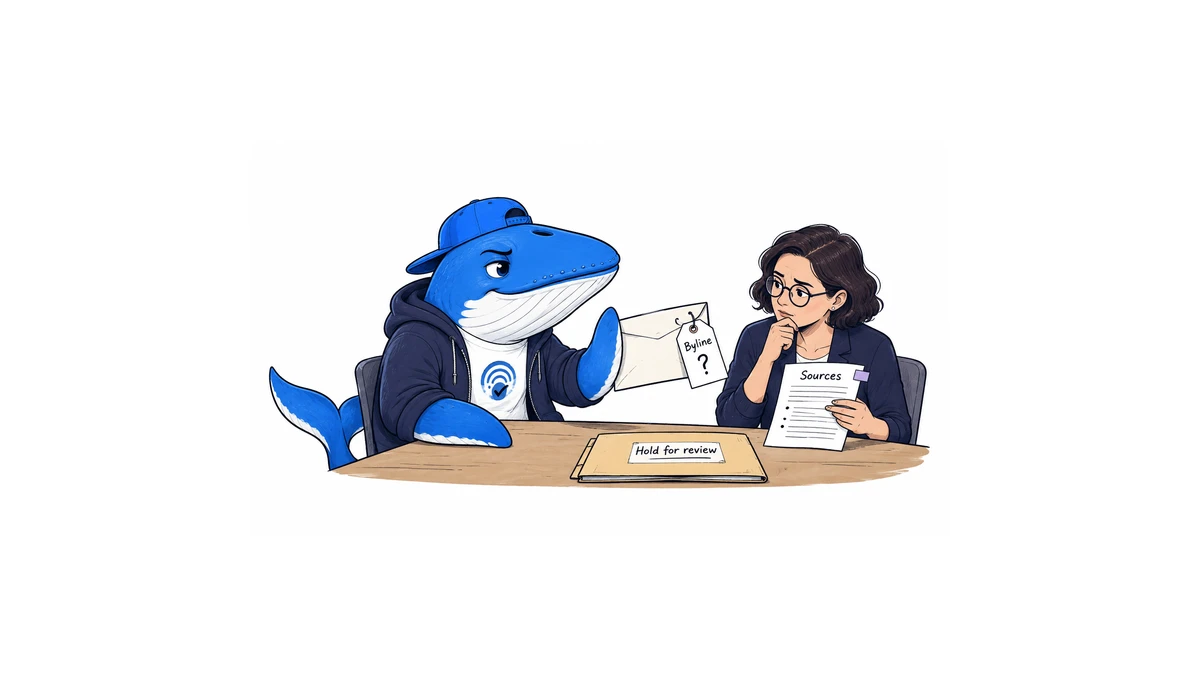
A real publication can lend credibility to a contribution whose author identity is false. In its October 8 false-front investigation, OpenAI says an Iran-origin operation used seven deceptive bylines to pitch long-form articles. It identified almost 100 articles published or syndicated under those bylines across roughly a dozen outlets worldwide.
OpenAI calls that operation “Bogus Bylines.” The report also describes a separate Russia-origin operation, “Dark Clark,” involving a front research entity. These are findings attributed to OpenAI’s investigation, not independent accusations by Search Engine Answer against contributors or publications.
The publisher was part of the distribution route
The relevant change for an editor is the route into an established outlet. An article can pass through ordinary submission and editing processes while the contributor’s identity remains unresolved. Good prose and adherence to a house style tell the editor something about the submission, but little about who stands behind it.
That route differs from the fabricated-site network described by Anthropic. One concerns material placed in real outlets; the other concerns an investigated network of fake news sites. Combining their article counts would obscure both the distribution mechanism and the scope of each investigation.
Separate the questions a pitch needs to answer
For a contributed article, establish an accountable contact and a credible basis for the claimed expertise. Independently verify previous work or institutional relationships through channels other than links supplied by the pitch. A byline page created for the submission is not, by itself, independent confirmation.
Next, review the article’s evidence. Open the material sources and check the passages supporting the claims. Identify original reporting, commentary, and recycled material. An author identity check cannot rescue an unsupported fact; a sound fact cannot validate a false credential.
Ask who controls reuse rights, disclose any relevant interests, and identify who can respond to a correction request. Those are distinct acceptance decisions. Keep them visible in the editorial record rather than compressing them into one reassuring “verified contributor” label.
A fictional pitch, three possible decisions
Imagine an unknown contributor offering a polished analysis with links to their own newly created profile and several credible public reports. This is an invented intake example, not a message received by this publication.
Hold the submission while the claimed identity or affiliation is unresolved. Check the sources independently and ask for a verifiable route to the person responsible. Do not circulate a public accusation merely because the contributor is unfamiliar with the topic or uses AI assistance.
Accept only after the editor can justify the authorship, evidence, rights, and disclosure decisions. If the contribution is commentary rather than original reporting, label it accordingly. Reject a material misrepresentation that remains unresolved, documenting the reason without speculating about a geopolitical connection.
What the investigation does not tell an SEO team
The report documents particular investigated operations. It does not estimate the prevalence of deceptive contributors across the web, establish a Google penalty, or measure AI-search citation contamination. OpenAI also distinguishes between evidence it can corroborate and operators’ self-reported impact. Retain that distinction when discussing reach.
For publishers, the justified response is a stronger intake decision, not a ban on all unfamiliar contributors. The Google AI-content guidance analysis covers a different issue: what a page contributes for readers. An editor still needs to know who is accountable for that page and whether its claims survive source review.
Keep learning
Continue this topic
Next in this topic
Gemini 4 Argon in AI Mode needs its own visibility-test baseline
Earlier in this topic
Exa Places Adds Business Data: Verify the Branch Before the Hours
AEO & AI Search
Ask a question or join the discussion