How to Read a Search Patent Without Calling It a Ranking Factor
Trace a search patent’s identity, family, legal status, claims, specification, and external implementation evidence before making a product or ranking claim.
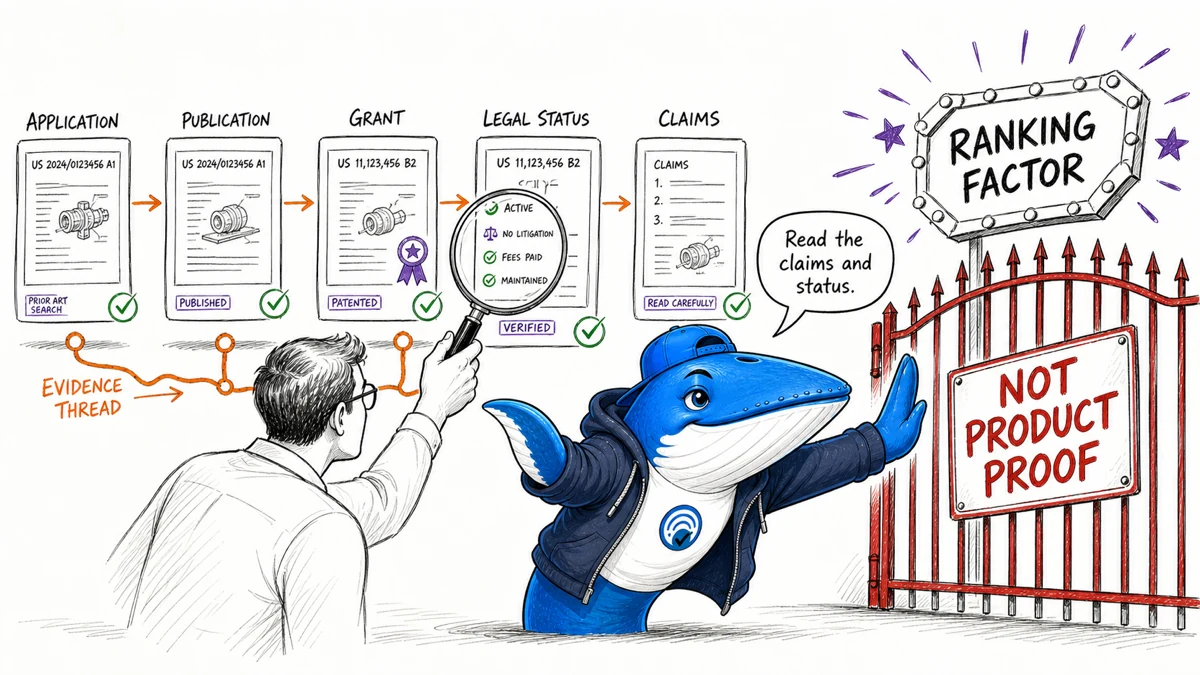
Published August 9, 2026: This research method uses official USPTO, WIPO, and European Patent Office records.
A search patent is evidence that an inventor described and claimed an invention. It is not proof that a search engine uses the invention in production, that every claim was granted, or that the document reveals a current ranking factor.
Read patents in layers: identity, family, legal status, claims, specification, citations, and external implementation evidence. Stop the interpretation at the strongest layer you can verify.
Start with the record
Save the publication number, title, inventors, applicant or assignee, priority date, filing date, publication date, jurisdiction, and current status. A copied patent title without its number and jurisdiction is not enough to identify the record reliably.
Use the USPTO’s official search tools for United States records, PATENTSCOPE for Patent Cooperation Treaty publications, and the European Patent Register for European files. Assignment records can show recorded ownership changes, but a recorded assignment is not proof that a product implements the claims.
Trace the family and status
One invention can appear as an early application, an international publication, national applications, continuations, divisional filings, and grants. Their claims and status may differ. Build a family table rather than treating the first PDF in a search result as the final version.
| Layer | Question | Common error |
|---|---|---|
| Identity | Which exact publication or grant is this? | Citing a title without a number |
| Family | Which related filings share priority? | Mixing claims from different members |
| Status | Pending, granted, expired, lapsed, abandoned, or revoked? | Calling an application an active patent |
| Claims | What legal scope is actually claimed? | Treating examples in the description as granted scope |
| Implementation | What external evidence links this to a product? | Assuming filing equals deployment |
Official registers are the best starting point for status, but status can be jurisdiction-specific and legally complex. When the conclusion matters commercially or legally, confirm it with a qualified patent professional.
Read the claims before the story
The abstract is a summary. The drawings and detailed description explain embodiments and possibilities. The claims define the requested or granted legal boundaries. Begin with independent claims, then read dependent claims for added limitations. Check the prosecution history when amendments or rejections affect the meaning.
Translate a claim into elements without replacing its language with SEO vocabulary. For each element, note the exact text, your plain-language interpretation, and the uncertainty. A claim describing scores, documents, or links does not automatically describe the live Google Search ranking system.
Look for implementation evidence
- Official product documentation or engineering publications describing the mechanism.
- Statements from named engineers or inventors with a date and product scope.
- Reproducible tests whose observations distinguish the patented method from alternatives.
- Source code, standards contributions, or technical disclosures that map to claim elements.
- Later patents or papers that clarify the lineage without proving deployment by themselves.
Absence of public implementation evidence does not prove non-use; it limits the conclusion. The safe wording is “the patent describes…” or “the granted claim covers…” rather than “Google ranks pages by…”.
A patent evidence card
- Record: publication or grant number, jurisdiction, dates, and official URL.
- Family: related filings and the member whose claims you are reading.
- Status: dated register observation with a jurisdiction boundary.
- Claim: independent claim number and the elements relevant to the research question.
- Implementation evidence: source that does—or does not—connect the invention to a product.
- Safe conclusion: one sentence that does not exceed the record.
Store the card beside the article’s claim ledger. Recheck status before a material update, and retain the date because registers can change. Apply the evidence-led publishing workflow to separate documented fact, interpretation, and recommendation.
Primary registers
Keep learning
Continue this topic
Next in this topic
A URL Can Return HTTP 200 and Still Fail Before the Client Reads HTML
Earlier in this topic
AI Visibility Metrics: Google, Bing and ChatGPT Reporting Crosswalk
Research
Ask a question or join the discussion