Category Entry Points for AI Search: Test Protocol
Semrush reports gains from buyer-situation content. We audit the vendor case study and provide a frozen-prompt replication protocol for citations, mentions, recommendations, and referrals.
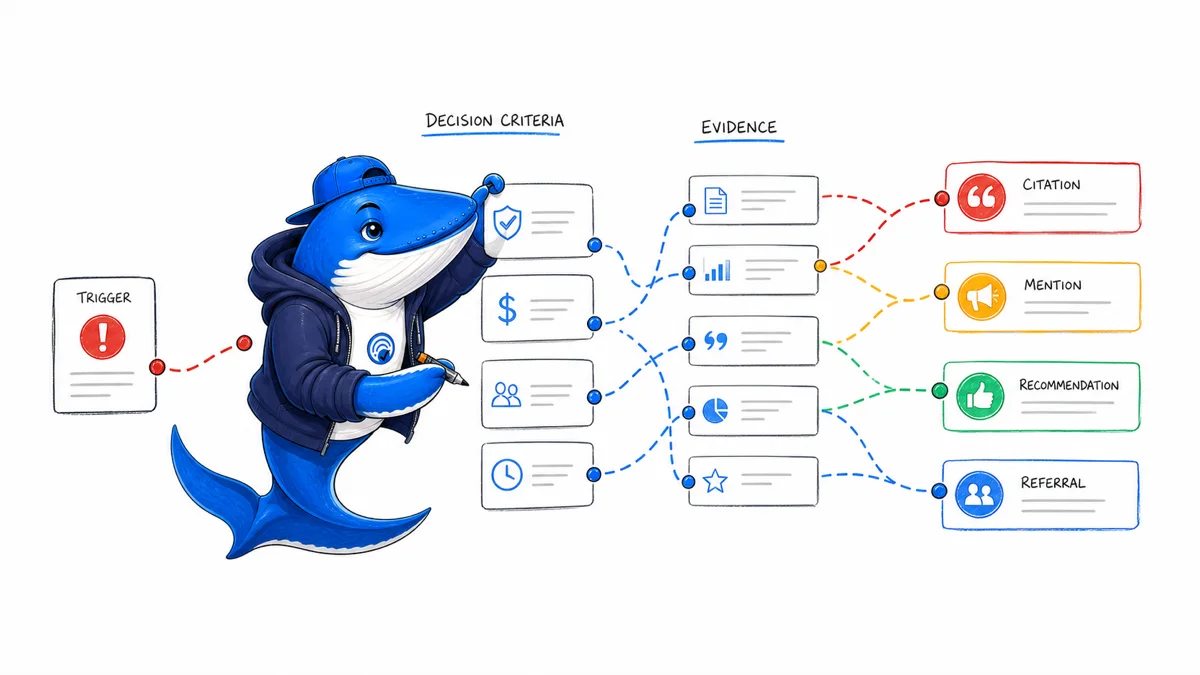
Write for the buying situation, then measure mentions and citations separately
A category entry point is the situation, need, trigger, or context that makes a buyer think about a category. For AI search, that produces a more useful content brief than “write about our product topic”: identify the situation, the decision criteria, the alternatives, the evidence, and the next action.
Semrush reports promising results from situation-led articles, but the evidence is a vendor case study, not a universal ranking law. The right next step is a controlled SearchEngineAnswer replication with frozen prompts and separate measures for retrieval, citation, brand mention, recommendation, and referral.
What the Semrush case study reports
The current lead came from Semrush on X and points to its category entry points article. Semrush reports that one situation-led article was cited weekly for more than four months. It reports another target prompt cluster moving from 15% to 26% share of voice after publication, while a broader benchmark moved from 21% to 22%.
| Reported observation | Why it matters | What is missing |
|---|---|---|
| Weekly citations for 4+ months | Suggests the page was repeatedly retrievable for a defined situation. | Full prompt/output archive, denominator, model drift, and independent replication. |
| 15% to 26% target-cluster share of voice | A larger movement than the reported broad benchmark. | Confidence interval, competing releases, prompt changes, and causal isolation. |
| 21% to 22% broad benchmark | Provides context against sitewide movement. | Exact comparability and external demand effects. |
Semrush sells AI visibility products and is studying its own content. That does not invalidate the observation, but the commercial and self-measurement context should be disclosed.
Turn a category entry point into a useful brief
- Situation: What happened immediately before the search or prompt?
- Reader: Who owns the problem, budget, implementation, or risk?
- Decision: What choice must be made now?
- Criteria: What constraints separate a good option from a bad one?
- Alternatives: What other methods, categories, or vendors could solve it?
- Evidence: What first-party data, demonstrations, limitations, and sources can support the answer?
- Outcome: What can the reader do or verify after reading?
For example, “AI visibility software” is a topic. “Our brand is cited by ChatGPT but never recommended—how do I diagnose the gap?” is a situation. The latter invites a diagnostic framework, states, examples, and a measurable next step.
Our replication protocol
1. Freeze prompt clusters before publication
Create a primary cluster for the situation and a comparison cluster for the broad topic. Save exact wording, platform, model or mode, account state, location, language, date, and expected reader intent. Hash or version the prompt file so later edits are visible.
2. Capture a baseline
Run the prompts on a fixed schedule before publication. Archive the full answer, cited URLs, brand mentions, recommendation position, and accessible referral data. Do not reduce every outcome to one proprietary score.
3. Publish distinct evidence
The article should answer the situation directly, include original examples or data, make authorship and update history clear, and link to primary sources. “Mention the category more often” is not the intervention.
4. Observe without changing the test midstream
Keep prompts and schedule stable for the declared window. Record model or interface changes as events. Run broad-topic prompts in parallel to distinguish a target-cluster movement from a sitewide change.
Do not call every appearance a citation
| State | Question | Evidence |
|---|---|---|
| Known | Does the system recognize the entity? | Accurate identity without prompting it. |
| Retrieved | Is the page or evidence apparently used? | Inspectable retrieval trace where available. |
| Cited | Is a URL linked as a supporting source? | Saved answer and exact cited URL. |
| Mentioned | Is the brand named in the answer? | Answer text, with no assumption of endorsement. |
| Recommended | Is the brand presented as an option for the situation? | Recommendation wording and position. |
| Referred | Did a person visit or convert? | Analytics, logs, and first-party outcome data. |
This extends our AI visibility measurement crosswalk. A content program can improve one state without improving the next.
The practical decision
Use category entry points to improve editorial specificity now. Treat visibility lift as a hypothesis to measure, not a guaranteed reward for changing the brief. Publish fewer pages with distinct situations and better evidence, then compare them with topic-only pages using frozen prompt cohorts.
Sources and evidence limits
We reviewed Semrush’s current case study and its linked X post on August 29, 2026. Reported figures are attributed to Semrush and have not been independently replicated by SearchEngineAnswer. Our proposed protocol is designed to produce a transparent replication rather than repeat a vendor conclusion as a general rule.
Keep learning
Continue this topic
Next in this topic
Dreambeans vs Google Discover: Publisher Guide
Earlier in this topic
ChatGPT Restaurant Reservations: Local Search Guide
AEO & AI Search
Ask a question or join the discussion