AI Keyword Research: Turn Search and Grounding Data Into Topics
Combine Search Console, modeled demand, grounding reports and fixed prompt observations without pretending they share the same unit.
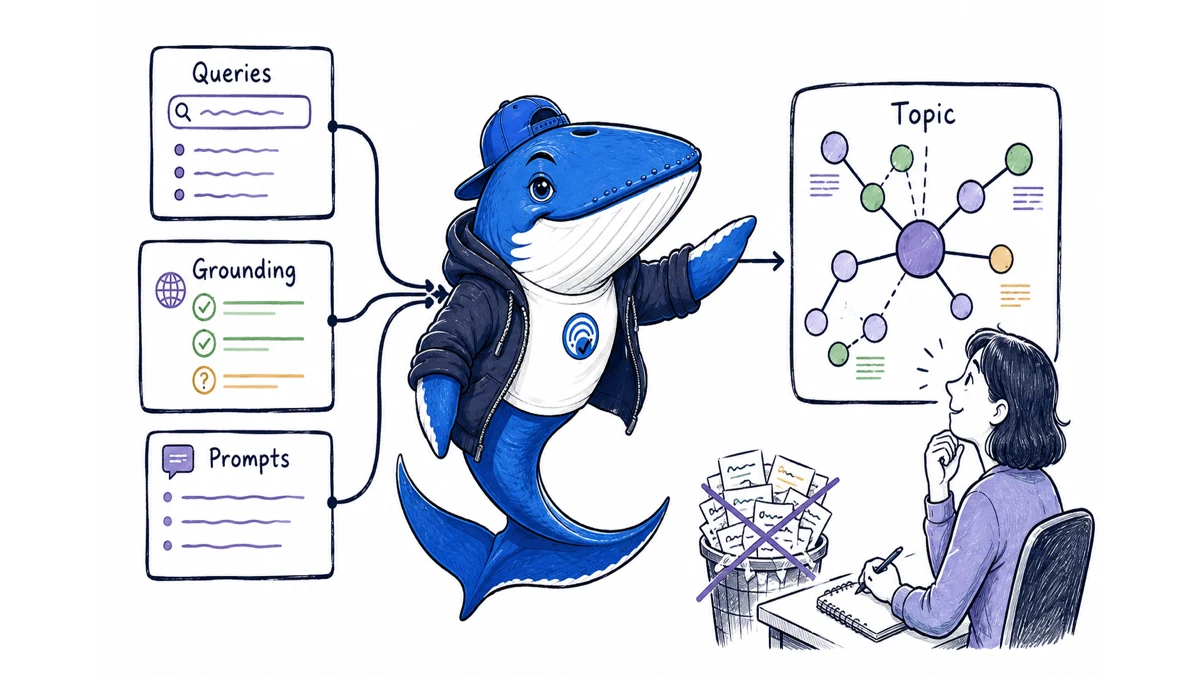
AI keyword research combines conventional query evidence with grounding and prompt observations, but it must not convert every conversational phrase into a fake search-volume keyword. The output is a topic-and-task map with known demand, observed AI behavior and clearly labelled hypotheses.
Use four evidence streams without blending them
| Stream | What it can show | What it cannot prove |
|---|---|---|
| Search Console | Queries and pages that produced measured impressions/clicks | Total market demand |
| Keyword tools | Modeled demand and SERP patterns | Exact traffic or conversion |
| Grounding reports | Queries a supported platform reports using | Universal prompt behavior |
| Prompt observations | How a fixed sample answers today | Population-wide frequency |
Google’s generative AI performance reports show impressions, pages, countries, devices and dates for eligible sites in the rollout. They do not expose grounding queries. Bing’s AI Performance report does provide sampled grounding-query phrases for supported Microsoft experiences. Preserve each product’s scope and unit; neither export is conventional search volume.
Begin with a business problem
Write the customer decision in plain language: choose a provider, fix a technical issue, compare approaches, understand a change or complete a task. Add the product, audience, geography and constraint. A topic is valuable when helping that decision can create trust or a useful next step, not merely when an AI tool generates many variants.
Use our topic-cluster method to define one primary job per page.
Collect measured search evidence
Export Search Console query-page pairs with clicks, impressions, position and dates. Add internal site-search terms, sales questions and support tickets. Keep zero-click queries; they can reveal language even when your page did not earn a visit. Protect privacy by aggregating or redacting customer data.
Keyword-tool volumes are estimates. Store vendor, market, match logic and retrieval date. Round numbers appropriately rather than displaying false precision.
Collect AI and grounding observations
Create a fixed prompt set from real jobs, not a list designed to mention your brand. For each run, save exact wording, platform state, locale, answer, cited URLs and any reported grounding query. If the platform does not expose a grounding query, mark it unavailable, do not reverse-engineer a confident keyword from the prose.
Separate a citation observation from demand. A page cited once for a niche prompt may be useful evidence of source fit, but it does not establish a high-volume opportunity.
Cluster by task and evidence
Group phrases when the same page could satisfy the same decision with the same evidence. Split when the audience, method, risk or expected artifact changes. A “what is” query, migration checklist and buyer comparison often belong to different pages even if they share a noun.
For each proposed URL, name the information gain: original measurement, tested workflow, annotated template, comparison method, expert record or primary-source synthesis. If you cannot name the gain, improve an existing page instead of adding another URL.
Prioritize with transparent scores
Use a simple decision score rather than a proprietary “AI potential” number. Rate business fit, evidence strength, unmet usefulness, production effort and maintenance burden on defined scales. Keep every input visible. A lower-volume topic with first-party data and strong product fit may outrank a broad term dominated by generic summaries.
Review the overlap against your current inventory, including the core AI SEO guide and related measurement pages.
Validate after publication
Track index status, query-page alignment, citations, referrals and conversion outcomes through a fixed window. Annotate edits. If two pages split the same query set, decide whether distinct conversions justify both. If a page earns impressions but no engagement, revisit its promise and usefulness before generating more content.
Where SISTRIX Prompt Research fits
SISTRIX’s October 5 Q3 recap documents Prompt Research access through API functions ai.topicresearch.overview, ai.topicresearch.list and ai.topicresearch.topic, plus its MCP Server. This is a quarterly publication date, not proof that every feature launched that day. SISTRIX’s question and topic counts describe its vendor dataset, not Google search volume.
Use the overview to frame a topic, the list to identify candidate questions, and topic detail to inspect the proposed brief. Check account access, dataset market and language coverage before interpreting an export. No SISTRIX API export was obtained for this update.
A fictional brief, with the evidence columns kept separate
Suppose a topic tool suggests “How do I stop translated Shopify descriptions becoming stale?” That is a candidate reader job. If your own Search Console export shows impressions for a related phrase, retain the actual query, page, period and count in a separate field. Without that export, mark measured site demand unavailable rather than assigning a made-up number.
Then check the current library. If one page already explains the same freshness decision, update it. If the new requirement is a different decision with different evidence, it may deserve a new page. For example, Shopify’s weekly translation change needs a source-to-locale timing explanation, while AI-shopping price pairs need variant and currency checks. Both concern commerce, but they do not answer the same job.
Before accepting an automatically generated brief, ask it to name the claim requiring a source, the worked example the reader will receive, and the existing URL it might duplicate. Reject generic briefs that cannot answer those questions. A larger prompt dataset can improve discovery coverage; it does not justify producing more pages than the publication can maintain.
Keep learning
Continue this topic
Next in this topic
AI SEO for Small Business: The 90-Day Strategy You Can Run
Earlier in this topic
AI SEO Audit Checklist: Find Gaps Before Buying Another Tool
SEO
Ask a question or join the discussion