Google AI Mode SEO: Map Query Fan-Out Without Publishing Thin Pages
Map related questions around one user problem, then decide which belong in a deep guide and which truly deserve a separate URL.
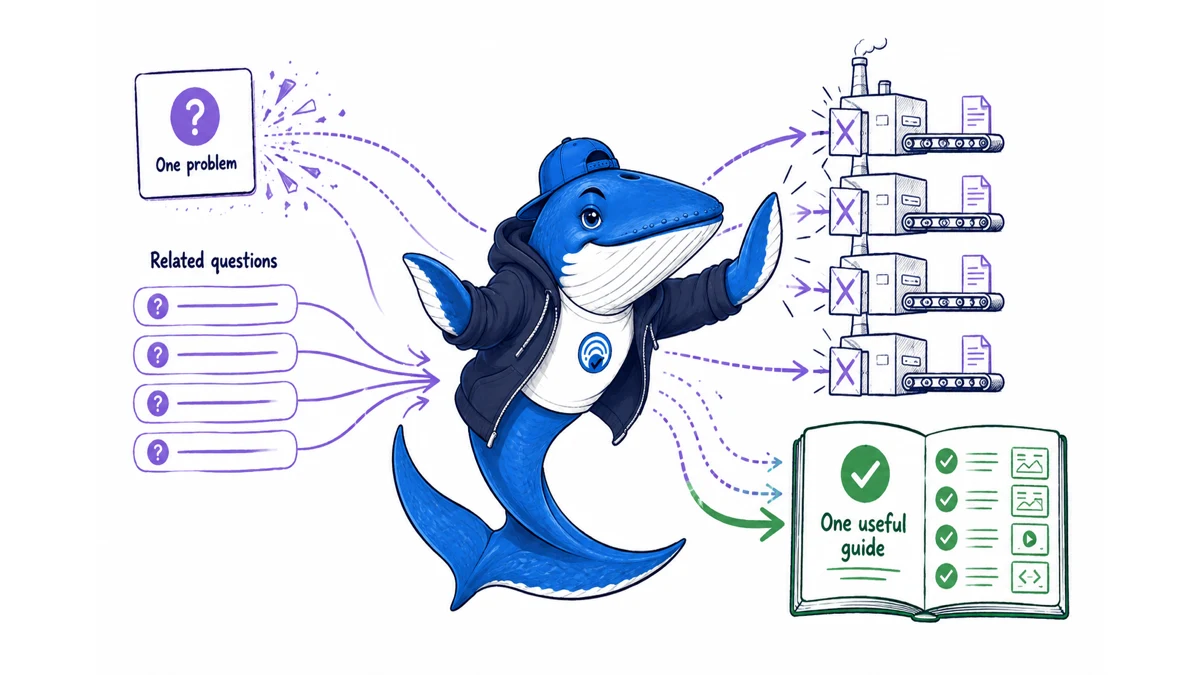
Google AI Mode SEO is not a license to manufacture one page for every imagined follow-up question. Google says AI features may use query fan-out—issuing related searches across subtopics and data sources—but its guidance still favors useful, non-commodity pages and warns against scaled low-value content.
The practical move is to map related questions, group them by one user problem, and build the smallest set of pages that genuinely resolves those jobs.
What query fan-out changes
Google’s AI search optimization guide says AI features can use query fan-out to find supporting responses. This means a broad prompt may trigger searches for definitions, comparisons, constraints, recent changes and next steps. It does not mean publishers can see the full hidden query set or that each subquery deserves its own URL.
Treat fan-out as a research model: “What must the system and reader understand to answer this task responsibly?”
Build a fan-out map from observable evidence
Start with Search Console queries, site search, support logs, sales objections and repeated prompt patterns. For one core problem, list the likely subjobs: define, diagnose, compare, implement, validate and recover. Mark the source for every branch. Label invented branches as hypotheses until demand or user research supports them.
Our AI keyword research workflow shows how to combine search and grounding data without passing estimates off as measured demand.
Decide when a subtopic earns a separate page
| Signal | Keep on one guide | Create another page |
|---|---|---|
| User job | Same decision and audience | Distinct decision or workflow |
| Evidence | Shares sources and method | Needs a different evidence set |
| Depth | Can answer clearly in one section | Requires a full procedure or tool |
| Search result | Same page types dominate | Different intent and page types dominate |
A separate keyword is not enough. The new URL should earn its maintenance cost and provide information that would make the parent page unwieldy.
Write one useful guide, not a page factory
Lead with the direct answer, then cover prerequisites, method, example, validation and limits. Use a comparison table or worksheet where it saves the reader time. Link out to a narrower implementation page only when the reader needs a different tool or context.
Google’s spam policies prohibit scaled content abuse when many pages are produced primarily to manipulate rankings, regardless of whether automation or humans create them. Review our scaled-content risk guide before automating URL creation.
Test the cluster for cannibalization
Export queries and landing pages for the cluster. Look for multiple URLs swapping positions for the same intent, inconsistent canonicals, near-identical introductions and internal links with ambiguous anchors. Compare conversions too: two URLs can rank without serving the same decision.
When merging pages, preserve genuinely useful sections, redirect retired URLs and update internal links. Do not merge solely because a tool flags keyword overlap.
Measure outcomes fan-out cannot reveal
Google does not expose every hidden subquery used inside an AI response. Separate what is documented from what you infer. Monitor indexation, Search Console page/query trends, observed supporting links, referral behavior and conversions. Add annotations when templates, titles or product availability change.
Do not call an impression change an “AI Mode lift” unless the reporting surface and design support that attribution. Our AI impressions versus traffic guide explains the denominator problem.
A repeatable editorial decision
- Name the user problem.
- Collect observed subquestions and mark hypotheses.
- Group by decision, evidence and workflow.
- Choose one deep page or a small, linked set.
- Add a testable artifact or example.
- Review overlap quarterly and after major product changes.
Download the AI Mode query fan-out map. Replace its example rows, then use the “page decision” column to record why a branch belongs on the guide, deserves a separate URL or should not be published.
Return to the AI SEO guide and task hub to compare this Google AI Mode workflow with other answer surfaces and shared SEO foundations.
Keep learning
Continue this topic
Next in this topic
AI Search Ranking Factors: What Platforms Document—and What They Don’t
Earlier in this topic
Google AI Overviews SEO: What Makes a Page Eligible for Citations
AEO & AI Search
Ask a question or join the discussion