Google AI Overviews SEO: What Makes a Page Eligible for Citations
Google documents ordinary Search eligibility for AI Overview supporting links—not a special schema or guaranteed inclusion. The workflow starts there.
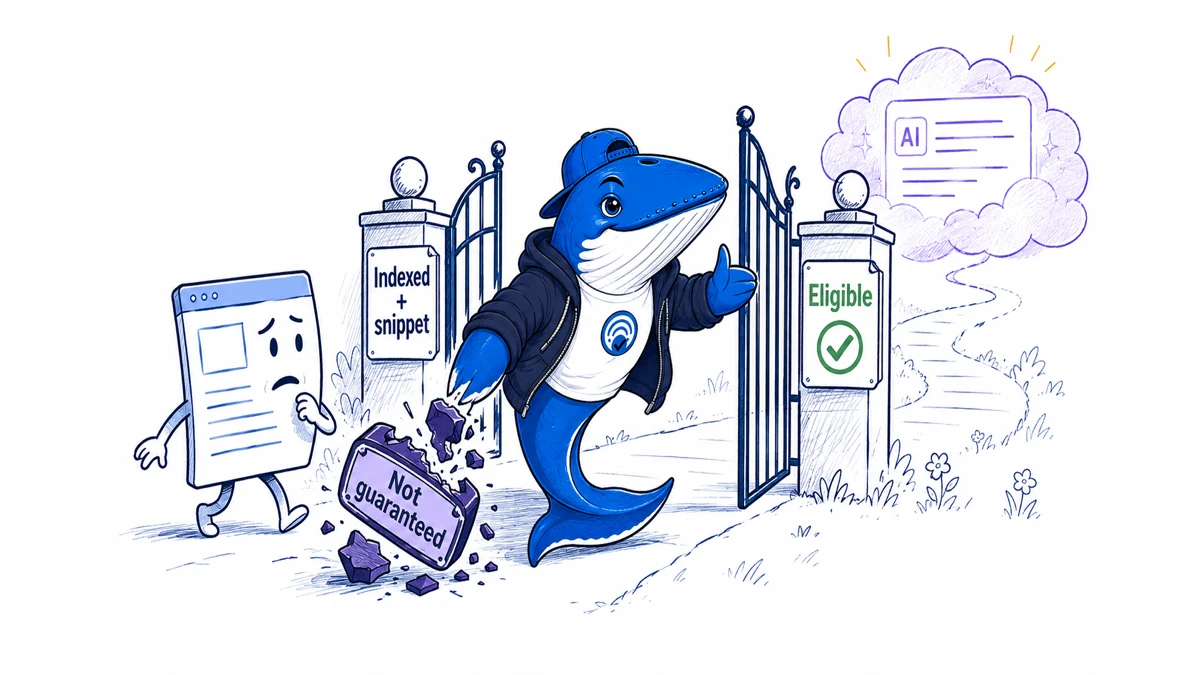
SEO for Google AI Overviews begins with ordinary Search eligibility: the page must be indexed and eligible to appear with a snippet. Google does not document a special AI schema, an AI text file or a guaranteed optimization recipe. The useful strategy is to remove eligibility blockers, answer a real query well, and measure supporting-link appearances separately from clicks.
Understand what Google actually documents
Google’s AI features and your website documentation says the standard technical requirements for Search apply to supporting links in AI Overviews and AI Mode. A page needs to be indexed and snippet-eligible. It also states that no special schema.org markup, machine-readable file or “AI text file” is required.
That establishes eligibility, not selection. Google explicitly notes that meeting requirements does not guarantee crawling, indexing, serving or appearance. Any provider promising a special tag that forces inclusion is selling beyond the documentation.
Remove the common eligibility blockers
- Confirm the preferred URL returns 200 and is not soft-404 content.
- Check robots.txt, noindex and X-Robots-Tag together.
- Verify the canonical points to the intended page and Google selected it.
- Make the main answer available in rendered HTML.
- Review nosnippet and max-snippet controls deliberately.
- Implement paywalled-content markup correctly where relevant.
Do this at template level, not one URL at a time. Our new-site SEO audit provides the broader technical sequence.
Build a page around the user’s decision
Google’s AI search optimization guidance recommends unique, non-commodity content and warns against scaled pages that add little value. Start with the decision a person must make. Give the direct answer, evidence, method, example and limit in a structure a reader can scan.
If the query asks whether a setting is required, state “required,” “optional,” or “not documented” near the top. If the answer varies, name the variable. Useful precision beats paragraphs filled with synonyms for the target keyword.
Design for supporting claims, not isolated chunks
A self-contained passage should remain part of a coherent page. Define the term, support factual claims with primary sources, add a worked example and connect the reader to the next action. You do not need to fragment a subject into dozens of tiny pages merely because retrieval systems analyze passages.
Use descriptive headings and tables where they reduce comparison effort. Avoid FAQ sections that repeat the article in question form. Our topic-cluster guide explains how to cover adjacent intent without cannibalization.
Measure AI Overview visibility cautiously
Save observations with query, country, device, account state, date, answer type, cited URL and screenshot or HTML evidence where permitted. Google interfaces change, personalization can matter and a single manual check is not a stable rank. Describe the sample and its limits.
In Search Console, analyze page and query performance, but do not infer that every impression or click came from an AI Overview unless the reporting surface explicitly provides that dimension. Use server and analytics evidence for downstream behavior.
Run a page-level improvement test
- Select pages with meaningful demand and weak decision support.
- Capture index, query and conversion baselines.
- Add one substantive asset: original data, a decision table, test procedure or calculator.
- Strengthen primary-source citations and label uncertainty.
- Request recrawl only when appropriate, then observe through a fixed window.
- Report changes without claiming causality the design cannot prove.
Avoid the five expensive myths
There is no documented AI Overview schema. There is no guaranteed word count. There is no evidence that adding “according to experts” creates authority. An AI crawler visit does not prove selection. And a third-party visibility score is not revenue. Each myth collapses a multi-stage system into an easy sales claim.
Download the AI Overviews eligibility and observation log. It keeps technical eligibility, observed source selection and business outcomes in separate columns so your next decision survives product changes.
Use the AI SEO guide and task hub to connect this Google-specific observation log with WordPress, content, reporting, and other platform workflows.
Keep learning
Continue this topic
Next in this topic
Google AI Mode SEO: Map Query Fan-Out Without Publishing Thin Pages
Earlier in this topic
ChatGPT SEO: How to Earn Discovery, Citations and Clicks
AEO & AI Search
Ask a question or join the discussion