ChatGPT Becomes an EU VLOSE: What Publishers Need to Track
The European Commission designated ChatGPT a Very Large Online Search Engine. Publishers should separate DSA duties, product controls, and observed search outcomes through the January 2027 window.
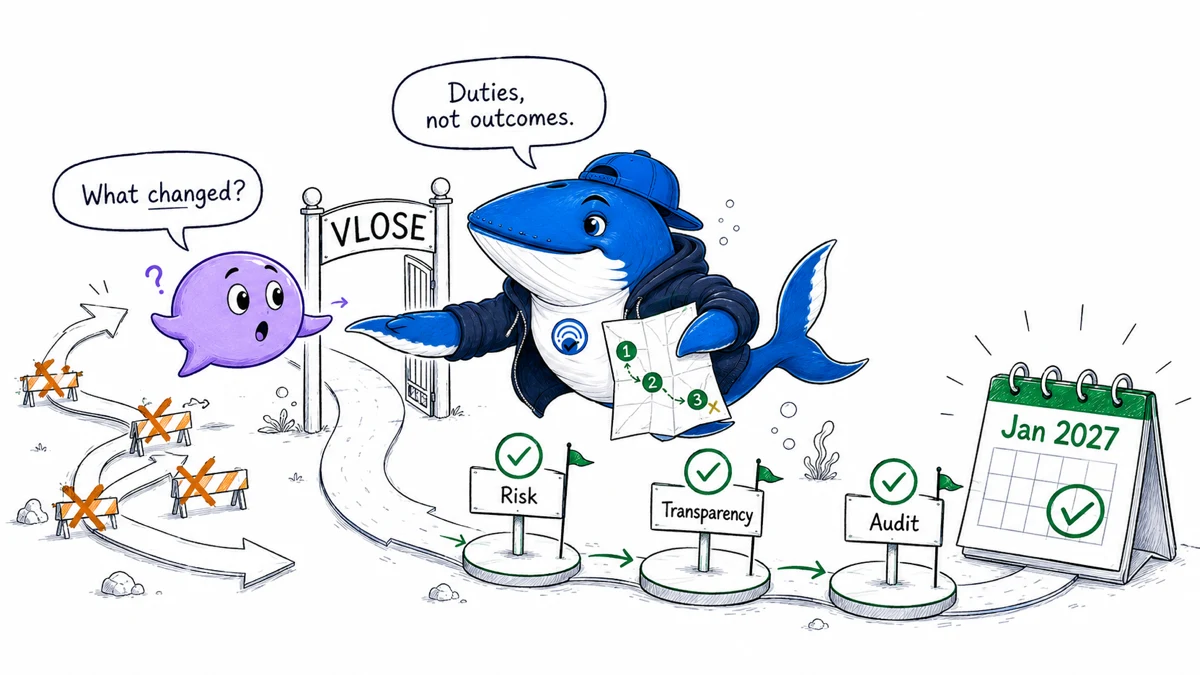
Direct answer: The European Commission designated ChatGPT a Very Large Online Search Engine under the Digital Services Act on August 31, 2026. OpenAI declared at least 45 million average monthly users in the EU, the threshold used for designation, and the Commission says ChatGPT has four months—by January 2027—to comply with the additional VLOSE obligations.
For publishers, this is a governance milestone, not a promise of rankings, referrals, removals, or compensation. Track what the Commission requires, what OpenAI documents for publishers, and what you actually observe as three separate evidence layers.
What the Commission designated
The Commission’s announcement groups three services under the DSA’s largest-platform framework: ChatGPT as a VLOSE, and Reddit and Roblox as Very Large Online Platforms. The ChatGPT designation is the relevant search-service classification here. It follows OpenAI’s declaration that the service crossed the EU’s 45-million-user threshold.
The Commission names systemic-risk assessment and mitigation areas including illegal content, protection of minors and well-being, fundamental rights, elections, and public security. The announcement also points to transparency and independent-audit responsibilities. Those obligations apply to the designated service and regulator relationship; they should not be rewritten as a new publisher ranking checklist.
| Framework | Question it addresses | Publisher mistake to avoid |
|---|---|---|
| Digital Services Act | Platform accountability, systemic risks, transparency, and oversight | Calling it an AI-model safety certification |
| Digital Markets Act | Contestability and fairness obligations for designated gatekeepers and services | Assuming every DSA designation creates DMA data access |
| EU AI Act | Rules organized around AI-system roles and risk categories | Treating VLOSE status as an AI Act risk classification |
What publishers should watch before January
Watch for service-specific disclosures: the scope of the designated service, risk-assessment summaries where publishable, transparency reporting, audit information, complaint routes, researcher-access mechanisms, and changes to content or account controls. Preserve the publication date and exact URL for every notice because a later help-center edit can otherwise erase the state that informed a decision.
For search visibility, collect evidence from the product rather than from the designation label. A publisher can observe whether a URL was fetched, cited, linked, referred traffic, or appeared in an answer. It usually cannot observe why one result won, which internal risk control affected a response, or whether a regulatory duty caused a product change.
Our ChatGPT user-agent and robots.txt guide covers product controls. Those controls are useful operational evidence, but they are not substitutes for the Commission’s DSA materials.
Build a four-month evidence tracker
Download the ChatGPT VLOSE publisher tracker (CSV). Its EXAMPLE-REMOVE rows are planning prompts, not a legal determination or a claim that OpenAI has taken the listed actions.
- Save the Commission designation as the baseline event.
- Assign separate owners for regulatory updates, publisher controls, technical observations, and complaints.
- Record the source, publication date, affected surface, required action, and evidence retained.
- Mark an item “observed” only after testing or receiving a service-specific notice.
- Schedule a January review, but do not assume every obligation will produce a visible interface change on one date.
The tracker’s most important column is “documented trigger.” It stops teams from turning a policy expectation into an observed fact. A control mentioned in OpenAI documentation is product policy; a requirement described by the Commission is regulatory guidance; a result from your test is an observation.
Run a publisher-facing baseline now
Before the compliance window closes, capture a small reproducible baseline. Select representative informational, commercial, news, and sensitive-topic pages. For each query, save location, account state, interface, prompt, timestamp, answer, cited URL, linked URL, and landing-page session. Redact personal or confidential information.
Repeat at fixed intervals without changing the prompt set. This will not identify the cause of every change, but it provides a before-and-after record if controls, disclosures, or answer behavior move. Use a separate incident row for removal requests, impersonation, illegal content, or safety concerns; those are not ranking tests.
If your concern is data access under European search rules, see our existing EU Google Search Dataset guide. It covers a different legal and technical program and should not be blended with ChatGPT’s VLOSE designation.
Claims the designation does not support
The designation does not establish that ChatGPT is a traditional web index, that any publisher has a right to rank, that cited content will send traffic, or that a particular answer is compliant. It also does not prove that OpenAI has completed the additional obligations; the Commission explicitly describes a four-month compliance period.
Do not claim that every ChatGPT feature is necessarily within the same service boundary without a source. Do not infer that the 45-million figure is a daily-user count or a current global total. The announcement describes average monthly EU users at or above the designation threshold.
Legal teams should evaluate obligations and rights from the official text and counsel. Editorial and SEO teams should focus on verifiable public changes, reproducible product tests, and accurately scoped language.
A practical publisher response
First, nominate one person to own regulatory source monitoring. Second, version your robots rules and publisher documentation. Third, retain evidence for important ChatGPT observations instead of relying on screenshots without prompts or dates. Fourth, make complaints specific: identify the affected URL, answer, time, harm, desired remedy, and evidence.
Finally, keep your public explanation readable. “ChatGPT was designated a VLOSE and must meet additional DSA obligations by January 2027” is supportable. “The EU now requires ChatGPT to send publishers traffic” is not.
Source, method, and update note
Primary source: the European Commission’s August 31 designation announcement, checked September 3, 2026.
Method: SearchEngineAnswer separated the designation, stated compliance window, listed risk areas, publisher-facing documentation, and product observations. This article is operational guidance, not legal advice.
Recheck trigger: Update when the Commission or OpenAI publishes material implementation, transparency, audit, complaint, or service-scope details.
Keep learning
Continue this topic
Next in this topic
Gemini 3.8 Flash Is Live: Test Search Citations Before Switching
Earlier in this topic
Perplexity SEO: Audit Crawlers, Citations, Referrals and Source Labels
AEO & AI Search
Ask a question or join the discussion