Google AI Impressions Are Not AI Traffic: Reconcile Search Console With GA4
Map an AI impression, click, browser visit, analytics session and conversion as separate events, then reconcile them with a bounded measurement ledger.
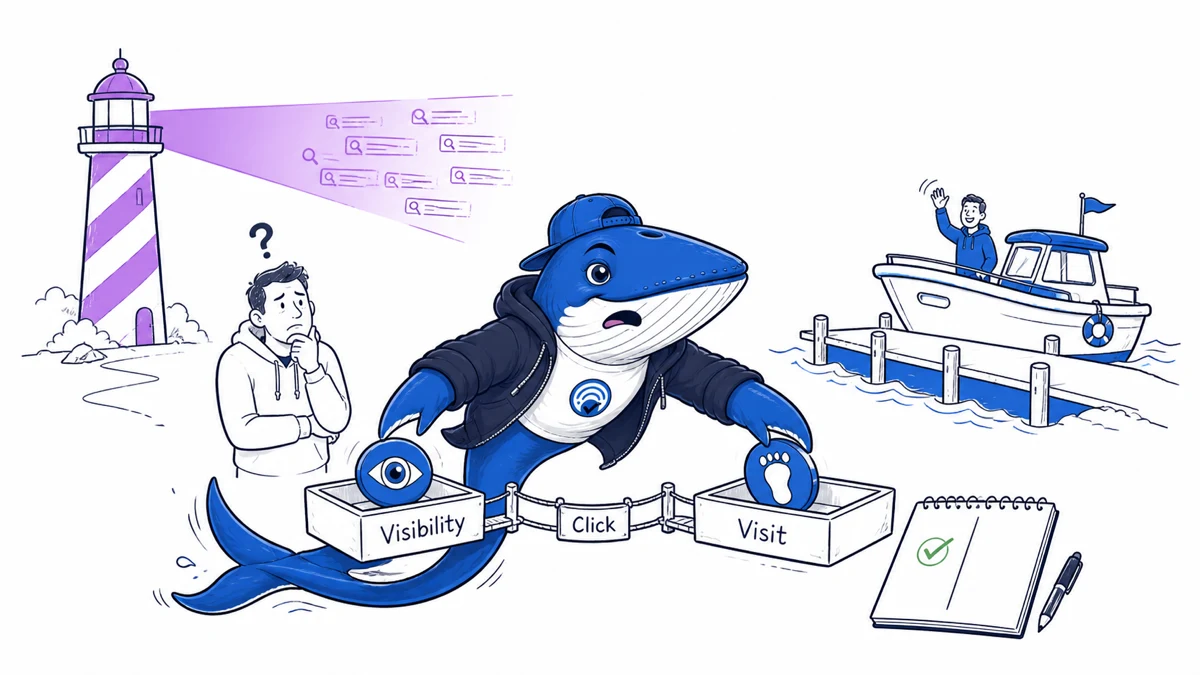
Direct answer: a Google AI impression is not an AI referral session. Search Console can report visibility associated with Google’s generative AI experiences, while GA4 records a visit only when a browser reaches the measured site and the analytics implementation records it. Reconcile the reports as a visibility-to-visit path, not as matching totals.
Google’s generative AI report is in limited rollout. Google says it reports impression data for AI Overviews and AI Mode by page, country, device and date, and that it excludes Search Labs. Report eligibility, dimensions and aggregation can change, so preserve the retrieval date and the exact property state.
Map the events before comparing totals
| Layer | Evidence | Typical owner |
|---|---|---|
| AI visibility | Search Console generative AI impression | Google report |
| Search interaction | Click when the report exposes it | Google report |
| Browser arrival | Landing request, URL and referrer | Server, CDN or browser |
| Measured session | GA4 session and source dimensions | Site analytics configuration |
| Outcome | Key event, lead, sale or subscription | Analytics and business system |
The reports do not share one denominator. A page can receive an AI impression without a click. A click can reach a page but fail analytics consent or tagging. A session can be attributed under rules that do not reproduce the Search Console surface name. None of those mismatches proves that a report is wrong.
Build a reconciliation ledger
Export both systems for complete dates and use the same site scope. Record Search Console property, report availability, page, country, device and date. In GA4, record hostname, landing page, session source, session medium, consent state, channel rules and relevant campaign parameters. Add server or CDN landing requests when the gap needs another observation layer.
- Start with page and date, the dimensions the two systems can most safely share.
- Compare trends and distribution, not one-to-one event identity.
- Segment countries and devices only after checking dimension coverage.
- Keep AI visibility, clicks, landing requests, measured sessions and outcomes in separate columns.
- Record reporting latency, filters, thresholding and known implementation changes.
The existing generative AI reporting guide explains the report boundary. The GA4 AI-referral workflow covers source grouping without turning referral labels into a citation report.
Use the right metric for the decision
Use AI impressions to study eligibility and visibility within the report’s stated surface. Use clicks or landing requests to study traffic. Use sessions and on-site events to study measured behavior. Use business records to study accepted leads, subscriptions or revenue. Keep citations separate unless a platform provides a citation report or you capture the answer itself.
A rising-impression, flat-session pattern can mean greater visibility without more clicks, a changed page mix, consent or tagging loss, attribution differences, or report aggregation. A falling-impression, stable-session pattern can reflect a smaller AI-visible sample while other traffic sources compensate. The chart shape narrows the investigation; it does not select one cause.
Run a bounded 30-day observation
- Freeze the current reporting configuration and page groups.
- Save weekly AI-impression exports and GA4 landing-page exports.
- Annotate releases, news cycles, consent changes and campaign activity.
- Review pages with visibility but no measured visit separately from pages with visits but no AI-report visibility.
- Choose one page-level improvement only after the gap has a plausible mechanism.
- Keep the next observation window unchanged and preserve null results.
This is an observation method, not a ranking test. Better source proximity, direct answers and original reporting can improve the page for readers and extraction, but the report does not guarantee more impressions, clicks or citations. Use the citation-ready passage test when the page itself needs editorial work.
Ask a question or join the discussion