AI Mode Connected Apps Turn Search Into an Action Layer
Map AI answers, connected apps, provider data, deep links, consent, and completed actions so businesses can monitor the full search-to-action handoff.
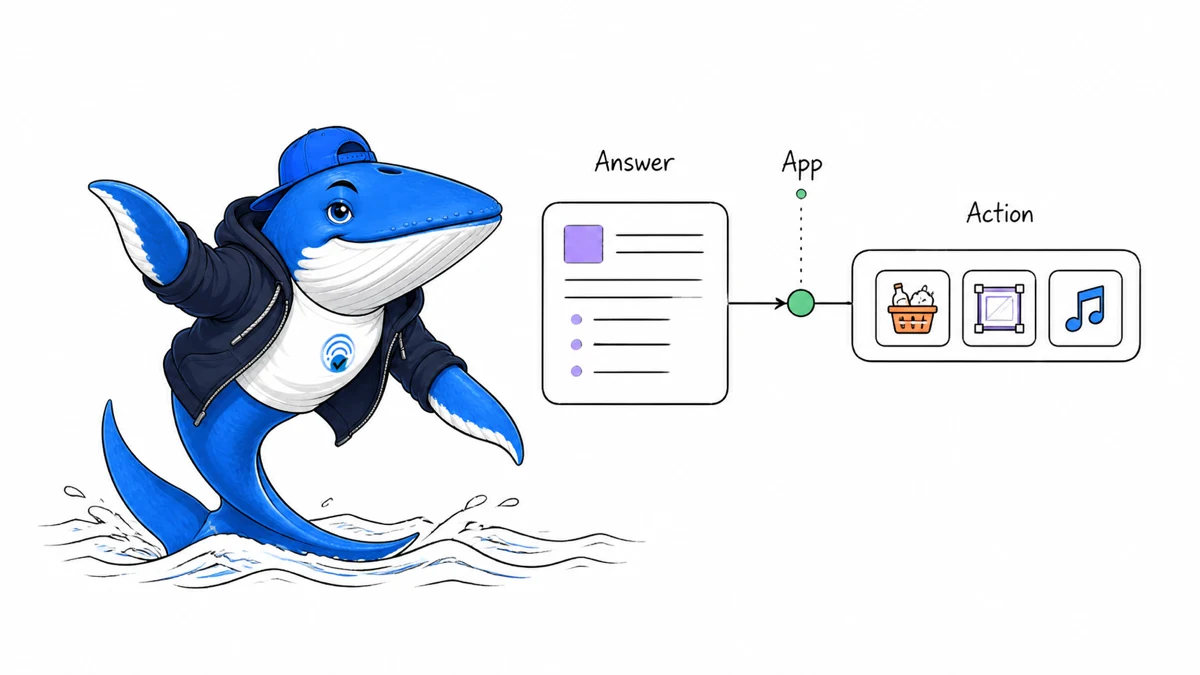
Google’s connected apps and experimental agentic tasks can move a search experience from answering a question to completing an action. Publishers and businesses should separate the web source, AI answer, connected app, inventory or business data provider, destination, and completed action. They are different surfaces with different eligibility and measurement.
Google announced connected experiences involving apps such as Instacart, Canva, and YouTube Music, and documents Search Labs tasks for reservations, tickets, and appointments. Availability varies by app, account, language, region, and experiment. Participation is not a ranking factor, citation guarantee, or proof that ordinary web crawling selected a business.
Map the action chain
| Layer | Evidence to record | Question |
|---|---|---|
| Query | Exact task, account, language, region, timestamp | What did the user ask? |
| Answer | Visible claims, sources, limitations | What information was presented? |
| Connected app | App, consent state, capability, handoff | Which service performed the action? |
| Provider data | Feed, Business Profile, inventory, booking system | Where did availability come from? |
| Destination | Deep link, web page, parameters, referral | Where did the user land? |
| Completion | Reservation, cart, creation, save, failure | Did the task finish? |
Monitor the data businesses control
Keep names, locations, hours, availability, price, inventory, policies, images, and booking destinations accurate in the systems that own them. Test mobile deep links and fallback web pages. A correct source page is not enough if the connected provider has stale inventory or the final checkout fails.
Do not add speculative schema or an AI-specific file to chase the feature. Google’s normal AI-search technical guidance still applies to web eligibility, while connected actions may use separate product relationships and account permissions.
Audit consent and context
Connected apps can use information under product and account settings. Review Google’s connected-app privacy help, the permissions shown to the user, retention expectations, and the ability to disconnect. For organizational accounts, document who authorized the connection and what data class may cross the boundary.
Run a reproducible observation
- Choose a fixed task such as finding and reserving a table under declared constraints.
- Record region, language, account, experiment enrollment, app connections, and date.
- Capture the answer, providers, business candidates, sources, and handoffs.
- Complete the path only with permission; record success, failure, price, and final destination.
- Repeat without changing multiple variables at once.
- Report availability in the sample, not as a universal rule.
Measure ordinary search clicks, connected-app referrals, bookings, and completed transactions separately. A citation shows retrieval in one response. A deep link shows a handoff. A completed action shows task completion. None alone proves a permanent ranking.
Use the citation-ready passage test for the web information and the AEO guide for answer structure, while maintaining the provider data that makes actions possible.
Trace one failed action before changing content
Suppose an AI Mode response names a restaurant, opens a reservation provider, and then shows no available tables even though the restaurant’s own site has inventory. That observation does not establish a search-ranking problem. Save the query, account and region; identify the cited web source; record the connected app and provider; inspect the business profile, booking configuration, inventory window, deep link, and final response. The failure may belong to any handoff in that chain.
Assign the repair to the system that owns the conflicting fact. Update page content when the published information is wrong or incomplete. Update the provider when inventory or booking rules are stale. Repair the destination when the deep link or fallback page fails. Re-test the same task after the expected propagation window and retain both observations. This produces a useful incident record without claiming that a content edit changed AI Mode ranking.
For a cross-platform model of access, answer appearances, citations, referrals, and outcomes, use the AI SEO guide and task hub.
Primary documentation
Keep learning
Continue this topic
Next in this topic
How to Audit First-Party Review Pages for AI Answers
Earlier in this topic
AI Crawlers Explained: Which Bots Index, Train, or Fetch
AEO & AI Search
Ask a question or join the discussion