AI Crawlers Explained: Which Bots Index, Train, or Fetch
Compare search, training, user-fetch and advertising crawlers, verify request identity, and configure special-case robots groups correctly.
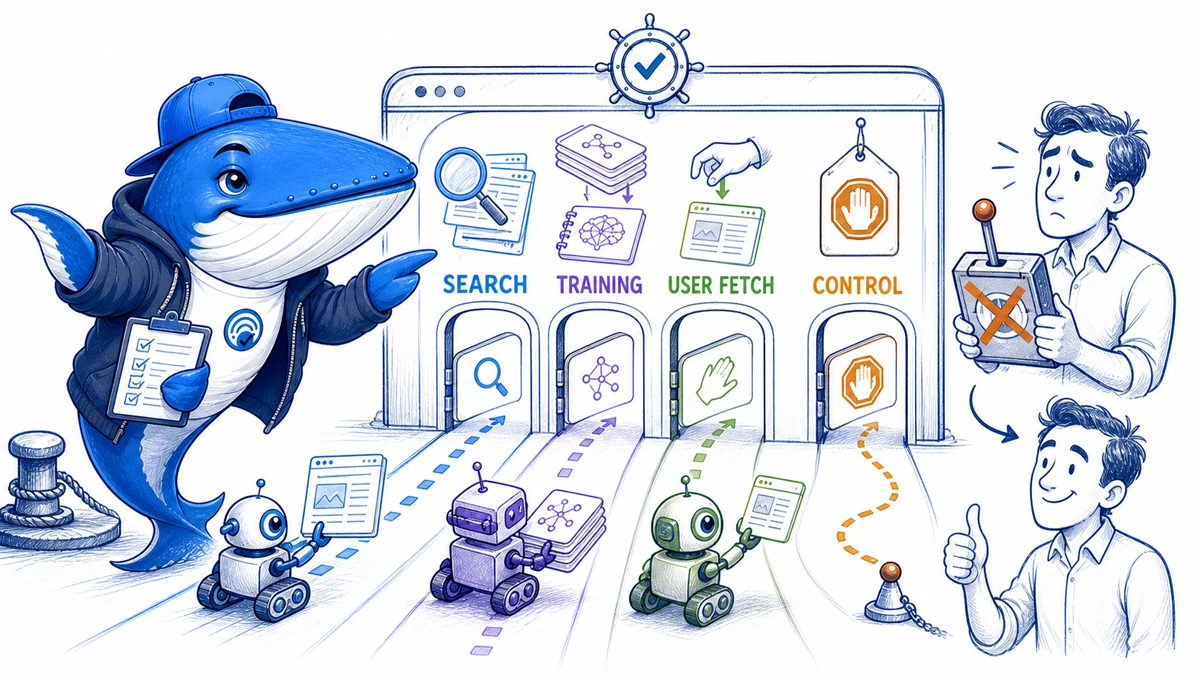
Direct answer: AI crawlers are automated clients that discover pages for search, collect public content for model development, or fetch a URL because a user asked an assistant to open it. They do not all build indexes, they do not all obey the same controls, and a visit from one does not prove that your page was trained on, cited, recommended, or ranked.
Optimizing a website for AI starts with a policy decision: which jobs do you want to permit? Then make the permitted pages technically accessible, easy to interpret, supported by evidence, and measurable. This guide covers the major documented identities and controls current on August 12, 2026.
What AI crawlers actually do
The phrase AI bot hides four different jobs. Treating them as one class leads to broken search discovery, ineffective training opt-outs, and firewall rules that trust a name anybody can copy.
| Job | What happens | Examples | What a visit can establish |
|---|---|---|---|
| Search or answer index | The operator discovers and refreshes public pages for a searchable corpus | Googlebot, Bingbot, OAI-SearchBot, Claude-SearchBot, PerplexityBot | The bot requested a URL; not that the URL was indexed or cited |
| Training or corpus collection | Public content may contribute to model development or a reusable dataset | GPTBot, ClaudeBot, Meta-ExternalAgent, Amazonbot, CCBot | The collector fetched a response; not how the response was later used |
| User-triggered fetch | An assistant opens a URL or retrieves current information for a user’s task | Claude-User, Perplexity-User, Amzn-User, Google-Agent | A particular fetch occurred; not a persistent index or stable visibility |
| Use-control token | A robots group expresses a preference over later use of content fetched by another crawler | Google-Extended, Applebot-Extended | No request at all;the token is read from robots.txt |
Some operators use a single crawler for more than one purpose. Apple says Applebot supports search experiences and that crawled material may also be used to train Apple foundation models. Its separate Applebot-Extended token lets a publisher express a training-use preference while keeping Applebot available for search. Google documents a similar separation: Googlebot crawls for Search, while Google-Extended controls specified Gemini training and grounding uses without changing Google Search inclusion or ranking.
Major AI bots and controls compared
This registry covers major identities with current operator documentation or a verified directory record. It deliberately excludes copied names whose operator, purpose, or verification method could not be established. Recheck the linked documentation before deploying a long-lived rule.
| Operator | Token or user agent | Primary job | robots.txt behavior | Publisher decision |
|---|---|---|---|---|
Googlebot | Google Search index, including pages eligible for AI features | Honors supported robots rules | Allow public pages wanted in Google Search | |
Google-Extended | Use-control token for specified Gemini training and grounding | Read as a robots group; sends no requests | Set separately from Search crawling | |
| OpenAI | OAI-SearchBot | ChatGPT search discovery, summaries and snippets | Honors robots controls | Allow pages wanted in ChatGPT search consideration |
| OpenAI | GPTBot | Potential model-training collection | Honors robots controls | Choose independently of OAI-SearchBot |
| Anthropic | Claude-SearchBot | Web search quality and visibility | Anthropic says it honors robots.txt | Allow public pages wanted in Claude search |
| Anthropic | ClaudeBot | Content that could contribute to model development | Anthropic says it honors robots.txt | Set a separate training policy |
| Anthropic | Claude-User | User-requested page retrieval | Anthropic says it honors robots.txt | Decide whether public pages should open in user tasks |
| Perplexity | PerplexityBot | Search index | Honors robots.txt | Allow pages wanted in Perplexity search consideration |
| Perplexity | Perplexity-User | User-triggered live fetch | Generally ignores robots.txt | Use access control for truly restricted content |
| Microsoft | bingbot | Bing search index used across Microsoft search experiences | Honors robots.txt and Bing crawl controls | Allow pages wanted in Bing discovery |
| Apple | Applebot | Spotlight, Siri, Safari search; content may also support model training | Honors robots and documented meta controls | Keep search access distinct from training preference |
| Apple | Applebot-Extended | Foundation-model use-control token | Read as a robots group; sends no requests | Express model-use preference without blocking Applebot search |
| Amazon | Amazonbot | Content collection for Amazon AI model development | Amazon documents robots support | Set a training/content-use policy |
| Amazon | Amzn-SearchBot | Amazon search; Amazon says it is not for generative-AI training | Amazon documents robots support | Allow if Amazon search discovery is useful |
| Amazon | Amzn-User | User-requested current-information fetch | Check current Amazon controls and protect private URLs at the server | Do not treat it as a persistent index crawler |
| Meta | meta-externalagent | Training or product improvement through direct crawling | Verified directories provide a robots token | Review as a training decision |
| Meta | meta-externalfetcher | AI-assistant or user-driven fetching | Do not assume the training rule covers it | Classify and control separately |
| Common Crawl | CCBot | Open web corpus distributed to third parties | Honors robots.txt and publishes rate guidance | Decide whether open-corpus inclusion fits the content policy |
Cloudflare also lists other AI-related identities, including DuckAssistBot, MistralAI-User and Google-CloudVertexBot. The correct response is not to paste every observed name into robots.txt. Add an identity only after you can document its operator, job, desired business outcome, verification method, and review owner.
Understand the platform families before optimizing
Google Search and Gemini controls
Googlebot is the ordinary crawler behind Google Search. Google says pages appearing in AI Overviews or AI Mode need no special AI schema or file: the supporting page must meet normal Search requirements and be eligible for a snippet. Blocking Googlebot to stop one Gemini use would also affect Search crawling.
Google-Extended solves a narrower policy problem. It is a robots.txt token controlling whether Google-crawled content may be used for future Gemini training and for grounding in Gemini Apps and Grounding with Google Search on Vertex AI. It is not a user agent, so a log report claiming “Google-Extended visits” is mislabelled.
Google also documents user-triggered clients such as Google-Agent and Google-GeminiNotebook. These operate because a user requested an action or supplied a source and generally ignore robots.txt. Authentication, authorization and non-public URLs;not a robots file;must protect sensitive content.
OpenAI search and training controls
OpenAI separates OAI-SearchBot from GPTBot. OpenAI says OAI-SearchBot access is needed for inclusion in ChatGPT summaries and snippets; GPTBot controls potential training use. A publisher can therefore allow search discovery and disallow potential training. The detailed OpenAI publisher-controls guide separates crawl access, citations and referrals.
OpenAI also notes that a title and link can surface through third-party search or other discovery even when direct crawling is disallowed. If a page must not appear, a supported noindex instruction may be relevant;but the crawler must be able to read it. Blocking the URL in robots.txt while expecting the crawler to see a page-level noindex is contradictory.
Claude and Perplexity live fetchers
Anthropic documents three explicit roles: ClaudeBot for content that could contribute to model development, Claude-SearchBot for web search, and Claude-User for a fetch made at a user’s request. Anthropic says all three honor robots.txt and publishes source-IP information. It also warns that a network block can stop the crawler from reading a changed robots policy, so IP blocking is not a durable preference mechanism.
Perplexity makes a different commitment. PerplexityBot builds its search index and respects robots.txt. Perplexity-User retrieves a page for a user and generally ignores robots.txt. Perplexity publishes JSON IP ranges for both. This is why “block all AI bots in robots.txt” is not a security plan.
Bing, Apple, Amazon and Common Crawl
Bingbot is Microsoft’s standard crawler for the Bing index. That index can support search and AI experiences, but an individual Bingbot request does not prove a Copilot citation. Bing provides a public verification tool and crawl controls; use them instead of trusting the user-agent string.
Apple and Amazon both document multipurpose families. Applebot supports Apple search experiences, while Applebot-Extended expresses a foundation-model use preference. Amazon separates Amazonbot, Amzn-SearchBot and Amzn-User so publishers can distinguish model-development collection, search discovery and user-requested fetching.
CCBot is different again: Common Crawl creates an openly available web corpus. A fetch can lead to corpus inclusion that many downstream users may access, but the request cannot identify a particular model, training run, answer, or citation.
Choose an AI-bot access policy by purpose
Start with the business decision, not the syntax. For every identity, record whether access helps readers find public work, supports a product you value, conflicts with licensing or privacy obligations, creates unacceptable load, or remains unknown. The Search, Agent and Training bot policy provides the broader governance framework.
| Field | Example value | Why it matters |
|---|---|---|
| Operator and identity | OpenAI / OAI-SearchBot | Prevents one rule from being assigned to a product name |
| Declared job | Search discovery | Separates visibility from training or user fetching |
| Desired outcome | Eligible for ChatGPT summaries and snippets | Gives the allow decision a purpose |
| Content scope | Public articles and guides only | Avoids sending drafts, accounts or licensed archives |
| Robots rule | Allow public paths | Records the cooperative preference |
| WAF rule | Allow verified identity; rate-limit anomalies | Prevents a generic challenge from overriding robots |
| Verification | Official IP JSON plus user agent | Reduces spoofing errors |
| Evidence and owner | Status, bytes, log time, reviewer, next check | Makes the policy maintainable |
A sensible public publisher policy often allows search discovery, evaluates training separately, and keeps private or licensed material behind real access control. A documentation site that wants broad model use may choose differently from a subscription publisher. Neither choice can be copied safely without the content and business boundary.
Use robots.txt without treating it as a firewall
RFC 9309 standardizes how compliant crawlers find and interpret /robots.txt. The file expresses crawl preferences. It does not encrypt a page, revoke previously collected copies, bind unknown scrapers, or replace authentication.
Mediapartners-Google is a separate advertising crawler
Google’s September 17 crawling-documentation update clarifies that Mediapartners-Google affects several ad-related products, including AdSense and Google Ad Manager. It is a special-case crawler, not an AI training bot or ordinary Google Search crawler.
The control detail is easy to miss: Google’s special-case crawler reference says the global User-agent: * group is ignored. A publisher who wants path-specific rules for this crawler must create an explicit User-agent: Mediapartners-Google group.
User-agent: Mediapartners-Google
Allow: /
Disallow: /account/
Disallow: /preview/
SearchEngineAnswer field check, September 18: the live robots file had no explicit Mediapartners-Google group. Requests carrying that user-agent string returned HTTP 200 for the homepage and a representative article, with the same response byte counts as the comparison browser user agent. That verifies delivery under those requests. A user-agent string can be spoofed, so it does not prove the requester was Google or explain an AdSense review outcome.
| Crawler | Primary job in this decision | Global * group | What a successful fetch can establish |
|---|---|---|---|
| Googlebot | Search crawling and indexing | Normally applicable | Google Search could retrieve the tested URL under those conditions |
AdsBot-Google | Google Ads landing-page and ad-quality checks | Ignored; use an explicit group | The tested landing page was reachable for that advertising check |
Mediapartners-Google | Ad-related products including AdSense and Ad Manager | Ignored; use an explicit group | The tested page was reachable for contextual ad crawling |
If a site uses both Google Ads and publisher advertising, audit AdsBot-Google and Mediapartners-Google separately. Allow only public, monetizable or campaign landing-page paths that each product needs. Keep account, preview, checkout and private routes behind real access controls. A clean crawler response can remove an access problem from the diagnostic tree; it cannot establish Search indexing, ad approval, policy compliance or content value.
The following example represents one possible policy: allow documented search crawlers while declining selected training or open-corpus uses. It is a template to review, not a universal recommendation.
User-agent: OAI-SearchBot
Allow: /

User-agent: Claude-SearchBot
Allow: /

User-agent: PerplexityBot
Allow: /

User-agent: GPTBot
Disallow: /

User-agent: ClaudeBot
Disallow: /

User-agent: meta-externalagent
Disallow: /

User-agent: Amazonbot
Disallow: /

User-agent: CCBot
Disallow: /

User-agent: Google-Extended
Disallow: /

User-agent: Applebot-Extended
Disallow: /
This file does not need explicit allow groups for Googlebot, Bingbot, Applebot or Amzn-SearchBot when a site’s existing wildcard group already permits the public paths. Add only rules that make the final policy easier to audit, and test how specific groups interact with existing wildcard groups.
For a mixed public and restricted site, exclude non-public path patterns from every relevant compliant crawler, but enforce the boundary with login and authorization:
User-agent: *
Disallow: /account/
Disallow: /checkout/
Disallow: /internal-search/
Disallow: /private-downloads/

Sitemap: https://www.example.com/sitemap.xml
Do not list secret paths merely to hide them; robots.txt is public. Do not block a URL and rely on a meta robots tag at that URL, because the blocked crawler cannot read it. Do not assume a training-bot rule covers a same-operator user fetcher or control token.
Verify real bots at the CDN, WAF and origin
A user-agent is a string supplied by the requester. A scraper can call itself Googlebot, GPTBot, or anything else. Discover traffic with the user agent, then authenticate or corroborate it with the strongest operator-supported method available.
- Match the exact documented token. Preserve the full raw user agent and request time instead of normalizing every visitor into “AI bot.”
- Check the network identity. Use official IP JSON, reverse-DNS plus forward verification, or the operator’s verification tool. Cache verified results rather than performing DNS work on every request.
- Prefer signed identity when available. Web Bot Auth uses HTTP message signatures to prove the requester controls a registered key. The publisher verification guide explains how to stage it without breaking unsigned search crawlers.
- Inspect rule precedence. A correct robots file cannot repair a CDN rule that challenges the bot before it reaches the origin. Check managed bot settings, custom WAF rules, rate limits, country blocks and cache variants.
- Test the delivered response. Record status, redirects, content type, bytes, canonical, robots meta, body hash and whether the main content is present. A browser test with cookies is not equivalent to a clean crawler request.
Cloudflare’s verified-bot program can identify requests through signed identity, published IP ranges with stable user agents, or reverse DNS. “Verified” means the identity and behavior met Cloudflare’s criteria; it does not mean every publisher should allow every verified bot.
Optimize the website that permitted bots receive
There is no shared “AI index” switch. The durable technical work is ordinary web publishing performed carefully for the exact clients you permit.
- Return the intended final status. Public canonical pages should normally resolve to a stable
200. Repair redirect loops, soft 404s, intermittent 5xx responses and bot-only 403 challenges. - Keep robots, meta robots and access policy consistent. Decide whether the page should be crawled, indexed, previewed and used for each documented purpose. Test the final public files after CDN transforms.
- Expose the main answer in rendered HTML. Do not require a click, login, client-only state, canvas or fragile script merely to reveal the core text. Server-rendered or reliably rendered HTML lowers the failure surface.
- Use stable canonical URLs. Point duplicate and parameter variants to the correct public source, link internally to that source, and keep XML sitemaps free of redirects, errors and non-canonical URLs.
- Make important links crawlable. Use real anchor elements with descriptive text. Keep primary navigation, related guides and evidence sources reachable without a scripted search box.
- Keep page identity visible. Show one clear title, author, publication or update date, section headings, organization context and a correction path. Accurate structured data can repeat that visible identity; it must not invent it.
- Serve accessible media. Provide useful alternative text, captions or transcripts, correct dimensions and a stable media URL. Do not hide the only explanation inside an image.
- Control page weight and crawl traps. Avoid infinite parameter spaces, faceted loops, calendar expansion and duplicate internal-search results. Monitor response size and timeouts for both browsers and verified bots.
Google explicitly says its AI features require no special schema or AI-specific file. The safer rule is broader: use documented schema that matches visible content, and do not expect llms.txt, a bot allowlist, or a new meta tag to override the target platform’s actual eligibility contract.
Optimize the content for safe answer use
Crawlability creates an opportunity to inspect a page. It does not make the page worth using. The editorial layer should help a reader;and any system quoting the passage;retain the claim’s subject, scope and evidence.
- Lead with the direct answer. Put the conclusion near the heading that names the question.
- Define the boundary. State the product, geography, population, date or scenario covered by the claim.
- Keep proof beside the claim. Prefer current operator documentation, standards, original research and reproducible first-hand evidence.
- Add a useful distinction. Explain what readers commonly confuse;for example, crawling versus indexing, or citation versus recommendation.
- Show the limit. Say what the evidence cannot establish and what would change the recommendation.
- Contribute information gain. Add a tested workflow, decision table, calculation, template, comparison or failure state instead of rearranging other summaries.
The citation-ready passage test turns those principles into a repeatable edit. The broader Answer Engine Optimization guide connects eligibility, clarity, support and measurement across answer surfaces.
Measure access, visibility and value separately
A useful dashboard preserves the chain instead of collapsing it into one AI-visibility score.
| Layer | Evidence | Does not prove |
|---|---|---|
| Policy | Versioned robots and WAF rules | That a bot fetched or respected the rule |
| Access | Verified request, URL, status, bytes and response hash | Indexing, training or retrieval |
| Discovery | Search Console, Bing Webmaster data or operator report | Why the page was selected |
| Answer use | Saved answer, linked passage and resolved citation | A stable rank, endorsement or recommendation |
| Referral | Landing-page analytics with source and consent state | All mentions or unseen citations |
| Business result | Declared conversion and attribution window | That one crawler or edit caused the outcome |
For logs, retain the verified operator, exact identity, URL, method, timestamp, status, bytes, cache state, country or network evidence, applied rule and body signature where policy permits. Group public article requests separately from feeds, assets, parameter traps and error pages. A high crawl count can reflect waste or repeated refetching rather than useful visibility.
Classify bot requests by page type without mistaking them for citations
Microsoft added Page Classification to Clarity Bot Activity on September 22, 2026. The dashboard combines content-based and URL-based rules to group bot requests by page type. A site owner can assign paths to existing categories or create custom categories; those custom rules take precedence over automatic labels. Microsoft says the feature is available now, but its announcement includes no measured effect on indexing, traffic or citations.
For this publication, a useful classification separates articles, category archives, tools, feeds and non-content URLs. Before comparing counts, fix the date range and operator filter, inspect a sample of URLs in each group, and record any custom path rule. If the article bucket rises, compare the underlying requests with verified CDN or origin logs and check response status. The label is a reporting dimension, not a crawler permission or evidence that an answer engine used the page.
Run a 45-minute AI crawler audit
- Write the policy. List the bot identities, declared jobs, desired outcomes and content scope. Mark uncertain entries for research instead of guessing.
- Fetch the public controls. Save robots.txt, representative meta robots tags, X-Robots-Tag headers, canonical tags and sitemap responses from the live site.
- Compare edge and origin rules. Review CDN bot settings, WAF custom rules, rate limits, country blocks and hosting security plugins.
- Inspect 30 days of logs. Find the documented tokens, then verify a sample with IP, DNS, signature or operator tooling. Preserve spoofed and failed requests separately.
- Test representative URLs. Include the homepage, an article, a category, a tool, a media URL, a redirect, a 404 and a restricted page. Record the final response rather than the intended configuration.
- Review answer passages. Copy the strongest paragraph into a blank document and check whether its subject, boundary, evidence and limit still make sense.
- Set measurement and maintenance. Assign an owner, next review date, documentation-change trigger and alert for unexpected verified-bot 403s or server-load spikes.
Stop the audit when the team cannot explain why an identity is allowed, blocked or rate-limited. An unowned bot list becomes stale infrastructure surprisingly quickly.
Avoid these common mistakes
- Calling every bot an indexer. Training collectors and user fetchers may never build a public search index.
- Blocking the wrong identity. Blocking GPTBot does not block OAI-SearchBot; blocking ClaudeBot does not automatically express the same choice for Claude-SearchBot.
- Counting control-token visits. Google-Extended and Applebot-Extended do not send HTTP requests.
- Trusting the user-agent alone. A spoofed bot can bypass a naive allow rule or poison an analytics report.
- Using robots.txt for secrets. Protect private, paid and personal content with authorization at the application or origin.
- Allowing robots but blocking at the edge. Challenge pages, 403s and rate limits can make the delivered result contradict the policy file.
- Promising AI rankings after a crawl fix. Access is one technical prerequisite, not proof of retrieval, citation or recommendation.
- Copying a permanent allow/block list. Bot identities, products, purposes and controls change; every rule needs an owner and review trigger.
Record a successful fetch without inventing a citation
Added September 5, 2026: The practical question after allowing a bot is what the request actually delivered. Google’s AI-feature guidance keeps ordinary Search eligibility separate from other AI controls. OpenAI’s bot documentation separates search, training and user-triggered requests; it notes that robots rules may not apply to ChatGPT-User. These are different permission decisions, not one universal AI-access switch.
Download the crawler request-evidence worksheet. Its unit is one request observation. Record the identity claim, verification method and outcome, response status, content type, presence of the main text, applied access rule, and any separately saved citation evidence. Keep secrets, full IP addresses and private URLs out of shared copies.
| Fixture | Evidence | Permitted conclusion |
|---|---|---|
| A | Claimed bot; identity unverified; HTTP 200 | A client received a response |
| B | Verified identity; HTTP 200; challenge body | The request did not receive the intended article |
| C | Verified identity; HTTP 200; main article present | The intended content was delivered |
The three examples contain no measured traffic. Citation evidence is recorded as “not observed in this fixture,” not “the engine never cites us.” To make a citation claim, save the answer surface, prompt, time, locale and resolved source URL separately. To make a referral claim, inspect a compatible analytics record. Neither is supplied by the response status.
Use operator-supported identity verification before assigning a crawler name to the row. If a bot is permitted but receives a challenge, investigate the rule that produced the response. If it receives the article, move to content and answer observation; do not keep loosening security rules in pursuit of a citation that access alone cannot guarantee.
This worksheet adds a bounded evidence test to the existing audit. Review it after a CDN policy change or an operator documentation update. It is not a replacement for authorization on restricted pages.
Bot policy map
Indexing, training and user-triggered fetching are different permissions
Blocking one named crawler does not automatically control every way an AI product may discover or retrieve a URL.
- Search index
- Can the service index the page for search or answer retrieval?
- Model training
- Does the operator publish a separate training crawler or control?
- User fetch
- Can an agent retrieve a URL because a user requested it?
- Enforcement
- Is the rule expressed in robots.txt, an account control or another mechanism?
My takeaway: Maintain a dated bot registry and write the business policy first. A robots file should implement that policy, not become the place where the policy is invented.
Primary documentation
- RFC 9309: Robots Exclusion Protocol
- Google: Common crawlers and Google-Extended
- Google: User-triggered fetchers
- OpenAI: Publishers and developers FAQ
- Anthropic: Web crawler controls
- Perplexity: Crawler documentation and IP ranges
- Bing: Crawler registry
- Bing: Verify Bingbot
- Apple: About Applebot and Applebot-Extended
- Amazon: Amazonbot, Amzn-SearchBot and Amzn-User
- Common Crawl: CCBot
- Cloudflare: AI bot reference
- Cloudflare: Verified bots
The evidence ends at documented access, observed responses and platform reports. No crawler configuration can guarantee that an answer engine will retrieve, cite, recommend or send traffic to a page.
Keep learning
Continue this topic
Next in this topic
AI Mode Connected Apps Turn Search Into an Action Layer
Earlier in this topic
Answer Engine Optimization (AEO): What it is and how to do it
AEO & AI Search
Ask a question or join the discussion