Target researchers describe a monitoring loop for semantic search failures
The MOSS preprint links model-based relevance alerts to human investigation. Its search and recommendation evaluations have different scopes and limitations.
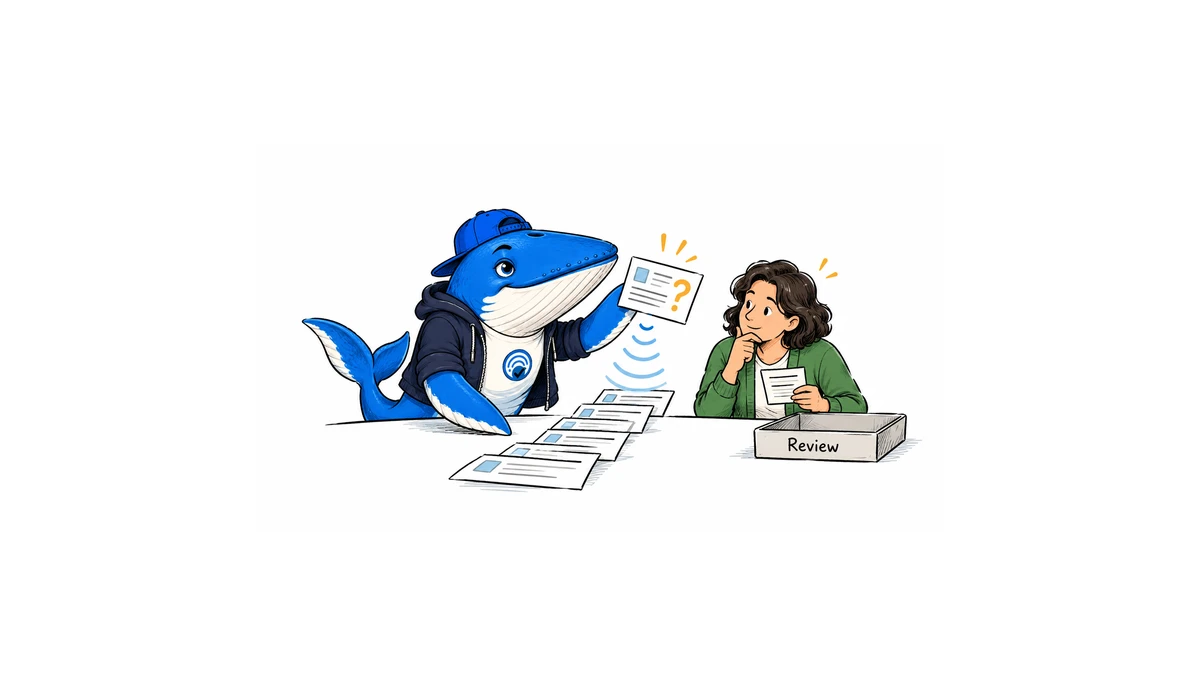
Search results can look plausible while missing the relationship a reader needs. Target researchers describe MOSS, a monitoring framework that uses language-model relevance checks to find cases worth investigating. Its contribution is a recurring route from a sampled result to a human review, rather than a claim that a model can settle search quality alone.
A production report with bounded evidence
The October 16 preprint, led by Alina Nesen and colleagues at Target, describes Model Sanity Service. The authors report production use across recommendation, search, and offer surfaces. The manuscript is under review; when interpreting its findings, keep the company affiliation and operational setting in mind.
The paper combines targeted sampling, prompts adapted to the retrieval strategy, structured alerts and diagnostic follow-up. A low score starts an investigation. A generated explanation can help organize that work, but it is not itself a confirmed root cause.
Read each evaluation on its own terms
| Surface | Reported evaluation | Interpretation limit |
|---|---|---|
| Recommendations | 498 human-labeled pairs | The comparison is within the reported benchmark and task definitions. |
| Search | 466 query–result pairs across 21 queries | Per-query variation matters; the aggregate is not every search task. |
| Offers | Alert-enriched adjudication | This sample cannot be compared directly with the other surfaces. |
The authors describe confirmed serving defects and an offline estimate of the effect of a proposed fix. An alert-rate change is not a measured revenue gain, ranking improvement, or universal error-reduction rate. This article does not independently verify Target’s production system or reproduce its benchmarks.
Keep a human confirmation step
A publisher testing on-site search can borrow the investigation structure without adopting the paper’s thresholds. Select real reader questions, preserve the result set, and record what a reviewer needs to decide. If the query asks for an installation guide, a product overview may share the terminology while failing the task.
- Retain the query, result, sampling rule, and version of the judging prompt.
- Record the model’s score and proposed explanation as an alert.
- Ask a reviewer to confirm the mismatch against the intended reader task.
- Investigate logs or configuration before naming a cause.
- Recheck the same task after a fix and preserve new failures as well as successes.
This is a proposed adaptation, not a SearchEngineAnswer deployment. Avoid sending private queries or unpublished content to a judging service without the organization’s approved data controls. A useful record can identify a case without copying sensitive material into an alert feed.
Calibration remains work for the operator
The paper notes that prompt calibration and thresholds were evaluated retrospectively, with a prospective frozen-prompt test still future work. It also identifies a mismatch between title-only inputs used by deployed scoring prompts and richer metadata available to human annotators. That can create alerts caused by missing context rather than a serving defect.
Start with reviewer agreement and manageable alert volume before deciding whether a threshold is useful. The search completeness comparison explains why benchmarks measure different tasks, while the citation-failure guide separates retrieval and answer-validation evidence.
Keep learning
Continue this topic
Earlier in this topic
A new QA study tests why supported answers can still miss the question
Research
Ask a question or join the discussion