Google Site-Reputation Enforcement in the EEA
Beginning August 30, Google says site-reputation manual actions will have different effects inside and outside the EEA. The policy remains in force, and third-party sections can still be separated to rank independently.
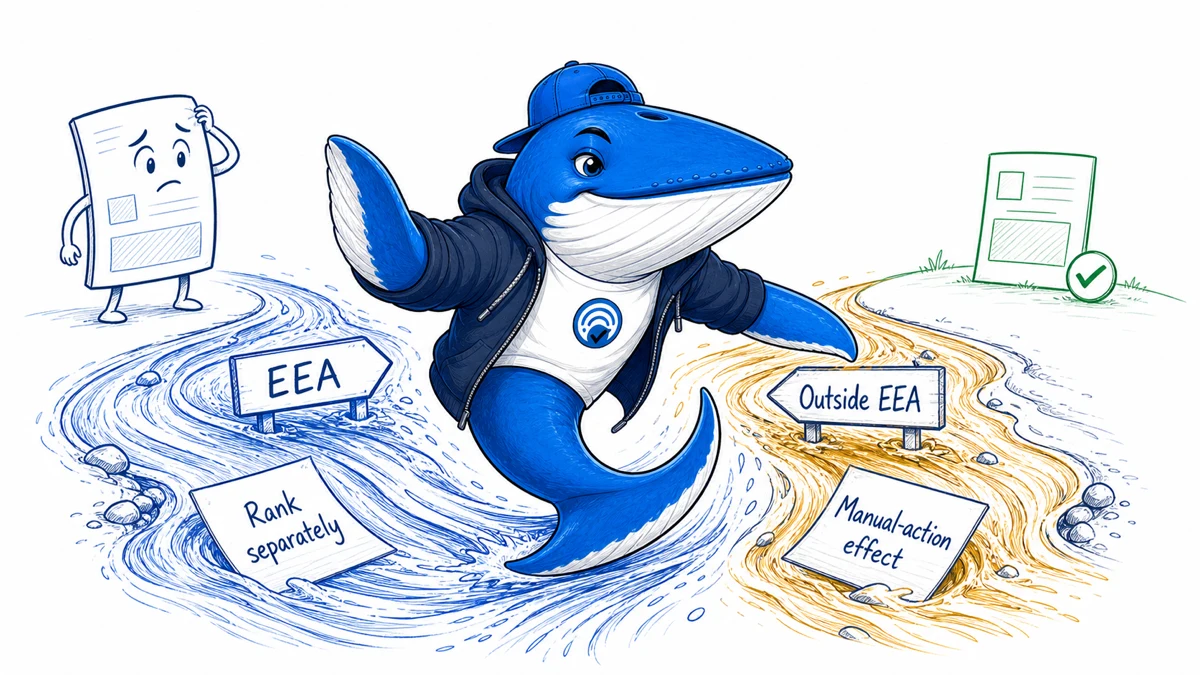
Direct answer: Google has not withdrawn its site reputation abuse policy in the European Economic Area. Beginning August 30, 2026, a site-reputation manual action will no longer directly demote the affected third-party section for searchers inside the EEA. Google says it may instead treat that section as a separate site and rank it independently. Outside the EEA, the manual action continues to affect the section directly.
For publishers, the practical question is no longer only “Will this section receive a manual action?” It is also “Would this section deserve its position without the host site’s established ranking signals?”
What Google announced
On August 28, Google published an update to site reputation abuse enforcement in the EEA. The change begins August 30 and applies to sites with a site-reputation-abuse manual action.
Google’s underlying spam policy still describes site reputation abuse as third-party pages published with little or no first-party oversight or involvement where the purpose is to manipulate rankings by exploiting the host site’s ranking signals. The policy is not limited to coupons, reviews, affiliate commerce, or any single business model.
Google says affected site owners will receive a Search Console message. Sites can still submit a reconsideration request, and eligible disputes can use the Digital Services Act mediation process. Nothing in the announcement restores an automatic right for a third-party section to inherit the host’s search reputation.
| Searcher location | Effect described by Google | Publisher implication |
|---|---|---|
| Outside the EEA | The manual action directly affects the abusive section | Visibility can fall because of the action itself |
| Inside the EEA | The direct manual-action effect does not apply | The section may still lose inherited ranking benefit |
| Inside the EEA over time | Google may treat the section as a separate site | Rankings can be recalculated from the section’s own signals |
What “rank independently” changes
Independent treatment is not the same as immunity. A third-party section can remain indexed while losing some of the host-level signals that previously helped it compete. Google warns that the change may develop gradually because its systems need time to understand the section as a separate site.
That creates two possible causes for a traffic change. Outside the EEA, a manual action can directly suppress the affected area. Inside the EEA, a section can decline because Google recalculates it without the same relationship to the host. The resulting graph may look similar, but the diagnosis and remedy are different.
Google has not published a formula, a list of separated signals, or a timetable for the recalculation. It has also not said that every third-party section will be separated. Treat separation as a possible system outcome, not a guaranteed status that can be checked with one operator or crawl.
A four-part integration audit
A logo, shared header, or contractual approval does not by itself demonstrate first-party involvement. Review the operating relationship behind the pages.
- Editorial control: Who chooses subjects, claims, product rankings, inclusion rules, sources, and update frequency? Record the named editor and the review evidence.
- Operational involvement: Can the host correct, reject, remove, or materially change the pages? Is that authority used in practice?
- User continuity: Does the section serve an expected need of the host’s audience, or is it primarily a separate acquisition business placed on a stronger domain?
- Independent value: Would the section still be useful and competitive on a new domain without the host’s reputation? Examine original testing, author expertise, sourcing, customer support, and external references.
Save the answers, contracts, reviewer names, correction logs, and page samples. A defensible integration claim needs evidence of actual participation, not only visual consistency.
How to measure the August change
Annotate August 30 in reporting, then segment by affected directory, country, page type, query group, and device. Keep EEA and non-EEA searchers separate. A sitewide average can conceal opposite movements.
- Export the Search Console manual-action message and record the affected scope.
- Build a fixed page set for the third-party section and a first-party control set with similar demand.
- Compare clicks, impressions, average position, indexed-page counts, crawl activity, and conversions.
- Track brand and non-brand queries separately; brand demand can mask a loss of generic visibility.
- Preserve the original daily data because Search Console retains a limited history.
Do not infer recovery from one EEA ranking check. Google explicitly says the system-level separation can take time. A stable weekly cohort and regional comparison will provide a more credible answer.
What publishers should not conclude
The announcement does not say that “parasite SEO is back,” that EEA traffic is protected, or that hosting third-party content is automatically abusive. It does not turn an affiliate relationship into a violation. The policy concerns the combination of third-party content, limited host involvement, and exploitation of ranking signals.
It also does not promise that moving a section, adding bylines, or placing it under editorial-policy language will resolve a manual action. Those changes matter only when they reflect a real operating model and useful content.
The safest response is to make the section capable of standing on its own: clear ownership, accountable authors, direct editorial participation, original evidence, transparent commercial relationships, and a correction process that readers can use.
Sources, method, and limits
Sources: Google Search Central’s August 28 enforcement announcement and Google’s current spam-policy documentation. Both primary sources are linked beside the claims they support.
Method: We compared the policy definition with the new location-specific enforcement effect, then translated the difference into an operational audit and a regional measurement plan.
Limits: Google has not disclosed the signals, weights, exact boundary tests, or timing used to treat a third-party section as a separate site. Any claim about which host signals are removed remains an inference until Google documents it or a controlled study isolates the effect.
Keep learning
Continue this topic
Next in this topic
Claude Text Watermark: Not Hidden Characters or SEO
Earlier in this topic
Product.category and Sale Dates: Feed-to-Schema Map
SEO
Ask a question or join the discussion