Generative Search Ads Split Relevance, CTR and Revenue
A Meituan paper reports a seven-day test of objective-specific generative ad retrieval, with separate relevance, click and commercial policies.
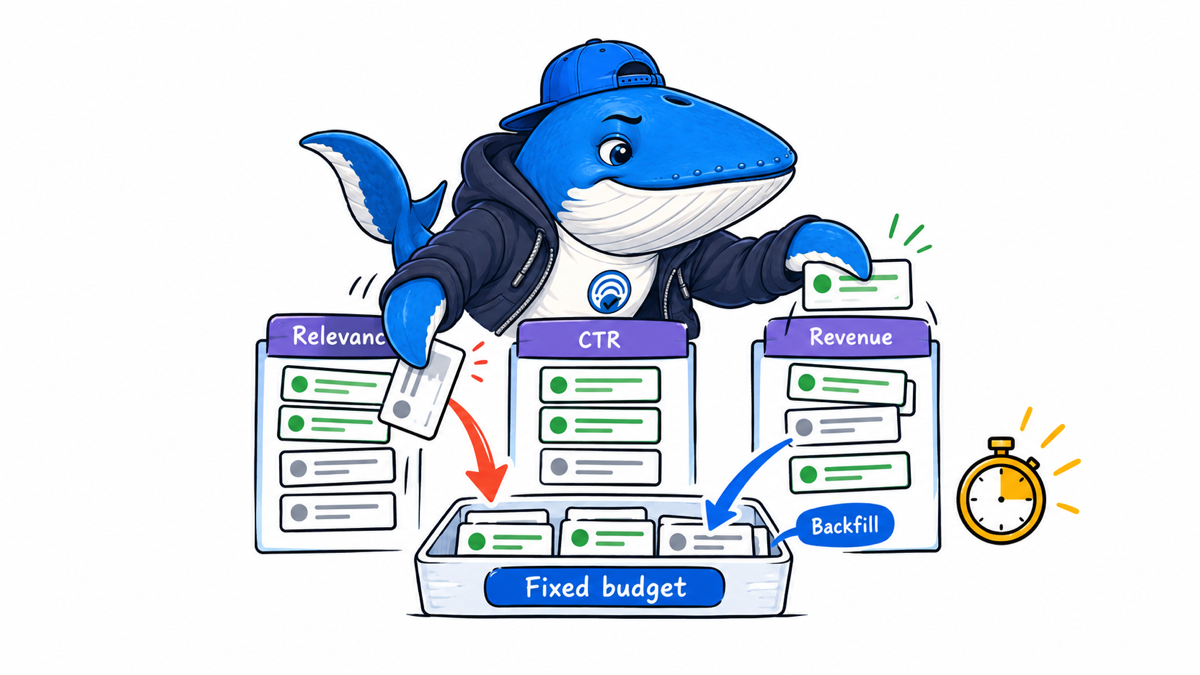
A Meituan research team reports that separating relevance, click propensity and commercial value into objective-specific generative retrieval policies improved click-through rate by 0.71%, revenue per search by 1.58% and advertising revenue by 1.32% in a seven-day online test.
One ranking policy is asked to satisfy three different jobs
A useful search ad should match the query, attract a legitimate click and create business value. Optimizing one reward can damage another. A relevance-only policy can leave commercially useful candidates unused. A revenue-only policy can surface ads that do not serve the user’s intent. A fused reward can hide which tradeoff the system learned.
UniPolicy’s design gives each objective a named token and a partly separate parameter pathway inside a shared decoder backbone. The paper uses <eCPM>, <CTR> and <Relevance> prefixes, twelve LoRA branches with three activated by the router, and objective-specific residual feed-forward networks.
The interesting mechanism is the fixed candidate budget
At inference time, the system runs the three policies in parallel and assigns each a candidate quota. Duplicate candidates are merged. If the merged set is too large, the top candidates are retained. If it is too small, cached reserve candidates backfill the open slots without another model forward pass.
This turns the business decision into an allocation problem. A team can choose how much of the candidate budget each objective receives instead of relying on one opaque reward sum.
An illustrative ten-slot allocation
This is my example, not a result from the paper. Suppose a retrieval stage has ten slots. Relevance receives four, CTR receives three and revenue receives three. Two policies generate the same ad, reducing the deduplicated set to eight. The system then backfills two reserve candidates using the calibrated within-policy merge score.
| Policy | Main quota | Unique main candidates | Reserve used | Review question |
|---|---|---|---|---|
| Relevance | 4 | 3 | 1 | Did the reserve still meet the online relevance floor? |
| CTR | 3 | 3 | 0 | Is the click model calibrated for this traffic segment? |
| Revenue | 3 | 2 | 1 | Did value rise without concentrating exposure? |
The example makes the operational question visible: who chooses the quota, which candidates are considered duplicates, and what floor prevents a weak tail candidate from filling the budget?
What the authors report
The offline dataset contains hundreds of millions of samples, a large user population and millions of advertisements. Each sample includes the query, user history and profile, plus clicked, exposed and unexposed candidates. The train and test sets were split chronologically.
In offline tests, UniPolicy reached NDCG@10 of 0.4218, compared with 0.4128 for the multi-objective MOPD baseline and 0.4044 for reward-sum GRPO. The objective tokens also behaved differently: each single-objective token produced its strongest normalized score on the corresponding business measure.
| Metric | Relative change | How to read it |
|---|---|---|
| CTR | +0.71% | More clicks per measured impression under the platform’s definition |
| Revenue per search | +1.58% | Higher ad value normalized by search volume |
| Advertising revenue | +1.32% | Business outcome reported for the test window |
| P99 latency | +2.5% | A modest tail-latency cost, not “unchanged latency” |
The percentages need missing context
The paper does not disclose the traffic allocation, absolute number of searches, geography, absolute metric baselines, confidence intervals or statistical-significance test for the online experiment. The authors describe a real industrial system, but the platform and ad market are not fully characterized.
That means the result supports “the authors report a lift in their seven-day test.” It does not support a forecast that another ad platform will gain the same amount.
What an ad-search team should audit before copying the design
- Objective definitions: write the exact denominator and attribution window for relevance, CTR, eCPM, revenue per search and revenue.
- Quota ownership: record who can change policy allocation and whether it differs by market or query class.
- Deduplication: define whether variants, merchants and destinations count as the same candidate.
- Quality floors: prevent backfill from admitting a candidate that violates relevance or policy constraints.
- Exposure distribution: check whether gains concentrate impressions among fewer advertisers.
- Latency: preserve median and tail measurements, not one average.
Download the objective-allocation review sheet
The sheet records policy quotas, duplicates, reserves, quality floors and outcomes. Example values are labeled EXAMPLE-REMOVE.
Download the search-ad allocation review sheet
My judgment
The paper’s transferable idea is not the exact lift. It is the separation of objectives at both training and inference. That makes tradeoffs easier to inspect and change. The main risk is moving the opacity one level higher: a system can expose three policies while leaving quota selection, thresholds and advertiser effects unexplained.
This work is relevant to generative retrieval and paid-search infrastructure. It does not show that consumer answer engines rank organic pages the same way, and it says nothing about Google Search ranking. For a publisher-side measurement model that keeps ad impressions, clicks, agent starts and business outcomes separate, use the ChatGPT Ads delivery audit.
Primary source
Kun Yao and colleagues, UniPolicy: Unified Objective-Specific Policies for Generative Search Advertising, arXiv preprint, September 17, 2026.
Keep learning
Continue this topic
Next in this topic
CITECHOICE Finds Structure Shifted Citation Credit, Not Source Admission
Earlier in this topic
Same AI Question, Different Language: A 67,200-Response Audit
Research
Ask a question or join the discussion