Claude Managed Agents Budgets: A Research Run-Control Method
Control Claude Managed Agents research with session budgets, authoritative event records, unfinished-work manifests, observable advisor interventions and versioned resume decisions.
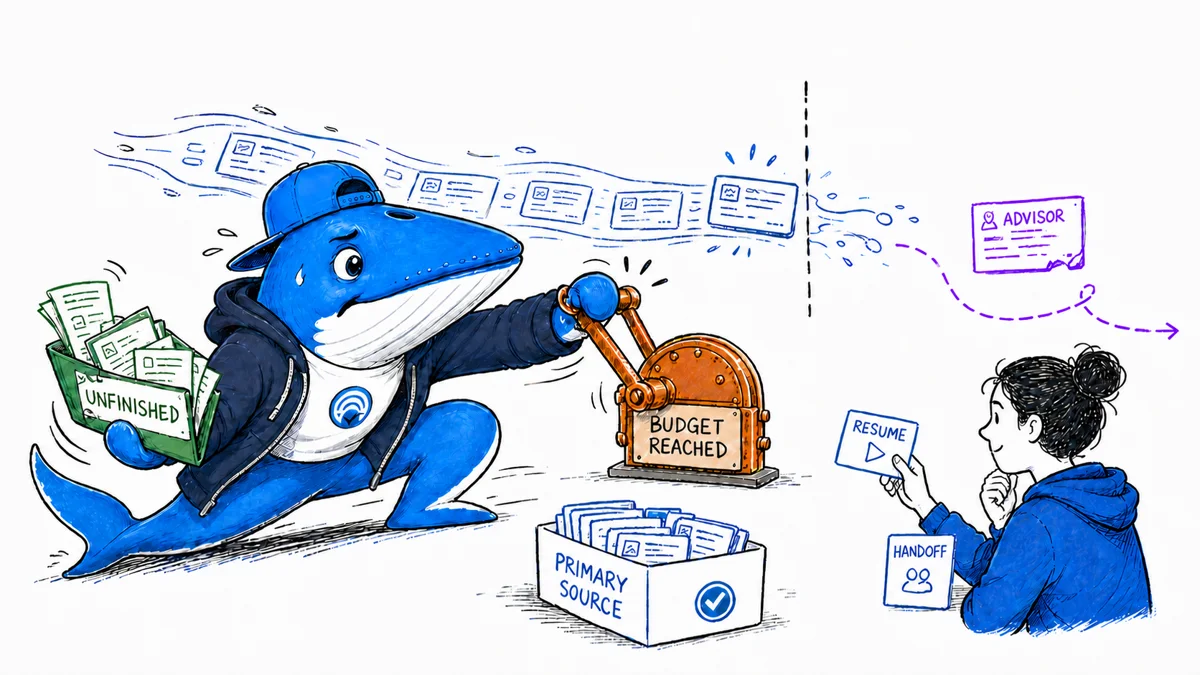
Direct answer: use a Claude Managed Agents session budget as an enforced run control, not as a promise that cost will stop at an exact cent or that the research is complete. Record the session-level stop reason, cumulative list cost, unfinished claims and any advisor consultation before deciding to resume, narrow or hand the work to a person.
Anthropic’s current documentation says a session pauses before its next model request after the tracked list cost reaches the cap. The request that crosses the cap finishes, so final cost can land fractionally above it. An advisor can influence the primary thread mid-turn, but that advice is not an independent source or a fact-checking certificate.
Define the research run before setting dollars
Write the reader job, required primary sources, expected artifact, acceptance rule, stopping conditions and human owner first. A narrow release-note verification should not receive the same budget as a patent-family review or a multi-market citation study.
Version the scope. If you change the model, tools, repository, required sources or output contract, create a new run version. Otherwise cost and completion records from different methods become impossible to compare.
Understand what the budget enforces
The session documentation defines a budget as a hard ceiling on tracked list cost and represents max_list_cost as a string containing whole US cents. A budget can be set when the session is created, then changed or removed later.
Enforcement happens between model requests. The in-flight request that carries cost over the configured amount can complete, which means a ledger must store both the configured budget and the final session-level list cost. “$25 budget” is not evidence of “exactly $25 spent.”
Key on the session event, not a thread guess
Anthropic’s event-stream documentation says a budget pause emits thread-idle events, a session usage snapshot and then a session-idle event with budget_reached. A final thread request can report end_turn while the overall session reports the budget stop.
| Question | Authoritative record | Common mistake |
|---|---|---|
| Why did the run pause? | Session-level stop reason | Reading one thread’s final status |
| What did the session cost? | Session usage list cost | Summing rounded thread totals |
| What remains unsettled? | Tool asks plus open-claim manifest | Assuming idle means complete |
| What resumes work? | Budget update above consumed cost or removal | Sending a new user message at the cap |
Make unfinished work a first-class output
When the cap pauses a session, save completed steps, open claims, missing sources, contradictions, failed tools, partial artifacts and the next safe action. Do not publish a fluent partial draft merely because it appeared before the stop.
- Check every material claim against the source ledger.
- Mark missing evidence and unresolved contradictions.
- Validate the artifact independently of the prose.
- Estimate the remaining task rather than only more tokens.
- Choose resume, narrow, human handoff or reject.
Treat advisor use as a recorded intervention
Anthropic’s multiagent documentation describes an advisor as a configured model the primary thread can consult for strategic guidance. The consultation runs in a platform-spawned anthropic.advisor thread and delivers advice through an event to the primary thread.
Record the advisor model, consultation reason, advisor thread ID, result visibility, advice received when visible, action taken and human review. Some advisor results are redacted on client surfaces even though the agent reads the full advice. A missing plaintext result therefore does not prove that no consultation influenced the run.
Keep model advice outside the evidence column
| Record | Classification | Publication use |
|---|---|---|
| Official document | Primary evidence | Supports the bounded product claim |
| Observed session event | Direct observation | Supports what occurred in this run |
| Advisor guidance | Model-generated intervention | Explains a planning influence, not the external fact |
| Human decision | Attributed judgment | Explains why the run resumed, narrowed or stopped |
Two models can share incomplete context or reinforce the same plausible mistake. When both models disagree with a current primary document, the document controls the factual claim.
Measure cost and completion separately
Report spend, elapsed time, source coverage, verified claims, rejected claims, unresolved claims, artifact status, tool failures, advisor interventions, human review time and rework as separate fields. A cheaper run can be incomplete; a more expensive run can still be wrong.
| Decision | Use when | Required note |
|---|---|---|
| Resume | Remaining work is specific and evidence-bearing | New cap, approver and expected artifact |
| Narrow | The original scope exceeds evidence or value | Revised reader job and removed claims |
| Human handoff | Judgment, access or verification is the constraint | Owner, missing authority and safe next step |
| Reject | Artifact or source requirements cannot be met | Failure reason and preserved evidence |
Version every resume decision
Raising or removing the cap resumes work automatically, according to Anthropic’s current event-stream documentation. Treat that change as a new controlled phase even when it happens inside the same session. Record the prior cap, consumed list cost, new cap, approver, unresolved task and time of change.
Keep the original budget event immutable so later cost reviews can reconstruct the decision.
Do not top up solely because the draft looks unfinished. First identify whether another model request can produce the missing evidence. A blocked login, unavailable primary document, ambiguous editorial judgment or broken external tool may require human authority rather than more session spend.
When resuming after advisor input, preserve the ordering of events. The record should show whether the advisor affected the plan before or after the budget pause and which primary evidence was collected afterward. That sequence prevents a later reviewer from mistaking model guidance for a sourced conclusion.
Download the research run manifest
Download the Claude Managed Agents research run manifest (CSV). Delete the EXAMPLE-REMOVE example row and replace it with observed session data. Keep API keys, credentials, private prompts and raw personal data out of the shared ledger.
Prepare source requirements with the source-bounded AI brief workflow, then use the publication gate after the run.
Limits of this method
SearchEngineAnswer has not run a Managed Agents research benchmark for this article. The manifest is a control design, not evidence that a budget, advisor or model improved completion quality. Product behavior, event schemas, model compatibility and pricing can change; reopen the current documentation when implementing the workflow.
Primary documentation
Keep learning
Continue this topic
Next in this topic
OpenAI API Usage by Key: Reconcile Research Spend Without Exposing Secrets
Earlier in this topic
Claude Inference Hooks: A Shadow-to-Enforce Release Gate
Tools & Workflows
Ask a question or join the discussion