SEO Automation With n8n: Build a Human-Reviewed Publishing Workflow
Automate research handoffs and repetitive checks while requiring evidence validation, named approval, least-privilege access and rollback before WordPress publication.
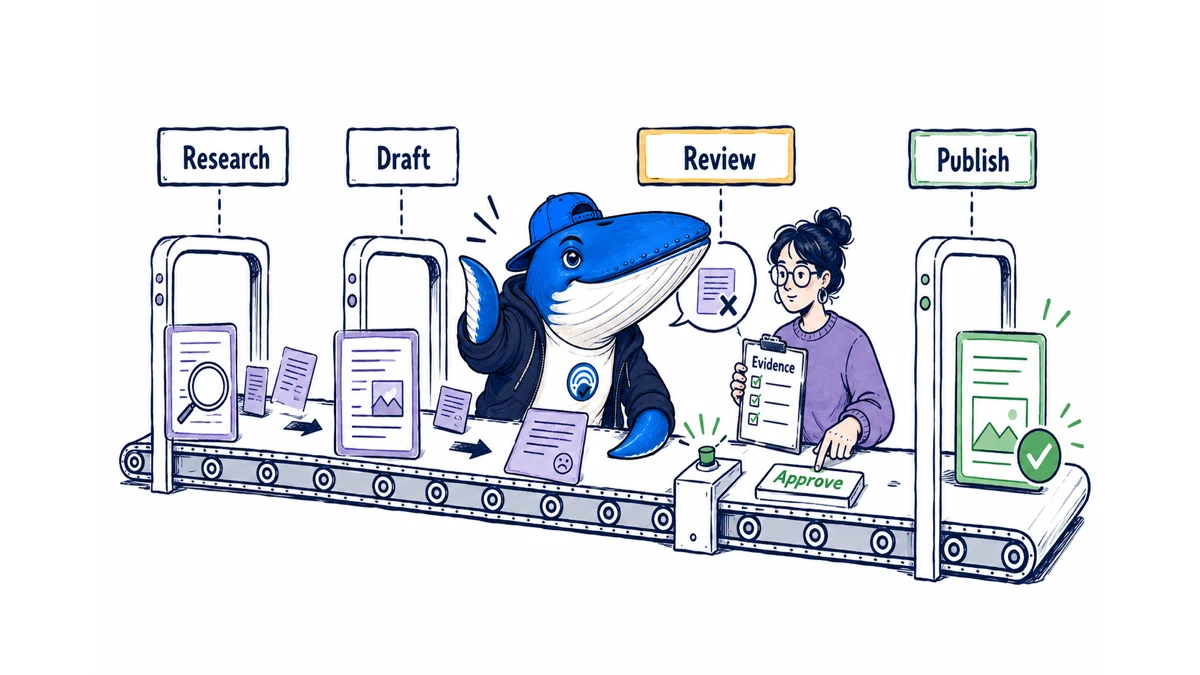
A safe n8n SEO workflow automates collection, formatting and handoffs while keeping evidence checks and publication approval human-owned. The dangerous design is a conveyor that turns a keyword row into a live WordPress post without verifying sources, overlap, claims or rollback state.
Choose tasks that benefit from automation
Good candidates are repetitive and observable: pulling approved feeds, normalizing URLs, checking status codes, flagging stale dates, assembling briefs from a source ledger, creating review tickets and recording publication outcomes. Keep strategy, claim interpretation, legal judgment and final approval with named people.
n8n’s workflow library includes community examples that connect SERP research, language models and WordPress, such as its SEO content workflow example. Treat templates as starting points, not proof that unattended publishing is safe.
Design four explicit stages
- Research: collect approved sources and store retrieval dates.
- Draft: generate structured sections with claim-source IDs.
- Review: validate facts, originality, intent and site overlap.
- Publish: create a backup, apply approved content and run public checks.
Give every stage an input schema, output schema and failure route. A node that returns data is not necessarily a successful editorial stage.
Build an evidence contract
Each factual claim should carry a source URL, source type, retrieved date, supporting passage or note, scope and reviewer status. Reject drafts containing unknown source IDs or inaccessible URLs. Do not let the model create citations that were absent from the research input.
Use official documentation for product behavior and primary records for announcements. Our evidence-led publishing workflow provides the hierarchy.
Add human approval that cannot be skipped
The review node should require a named reviewer, timestamp and explicit decision. Validate title promise, direct answer, source support, conflicts with existing pages, internal links, image rights, disclosure and any promised download. If rejected, return a reason code; do not loop silently until the draft passes a superficial score.
Separate technical validation from editorial approval. A page can contain valid HTML and still be generic or misleading.
Protect WordPress and external services
Use least-privilege credentials, environment-specific endpoints, secret storage and allowlisted operations. Draft by default. Set request limits, timeouts and idempotency keys. Record the WordPress post ID and previous state before updating it. Never include credentials in prompts, logs or exported workflow JSON.
Google warns that scaled content produced primarily to manipulate rankings can violate spam policies regardless of whether automation or humans created it. Review the scaled content abuse policy before increasing volume.
Test failure paths before enabling publish
| Failure | Expected behavior | Proof |
|---|---|---|
| Source times out | Stop or mark incomplete | Failed-run record |
| Duplicate slug | Route to review | No overwrite |
| Reviewer rejects | Remain draft | Decision log |
| WordPress 500 | Capped retry | No duplicate post |
| Public check fails | Rollback or unpublish | Snapshot restored |
Measure quality, not throughput
Track source-validation pass rate, reviewer rewrite rate, duplicate-intent blocks, rollback events, indexing, relevant queries, citations and qualified outcomes. “Articles per day” is a capacity metric, not a success metric. If volume rises while reviewer corrections and weak pages rise, the workflow is amplifying waste.
Download the n8n SEO human-review gate. Replace the example rows, test every failure state in a staging environment, and enable live publishing only after the evidence and rollback paths work.
Place automation inside the wider governance model in the AI SEO guide and task hub; throughput never replaces page intent, source verification, or outcome measurement.
Keep learning
Continue this topic
Next in this topic
How to Choose an AI SEO Agency Without Paying for Vanity Metrics
Earlier in this topic
Claude Managed Agents Controls: Domain Rules and Per-Call Permissions
Tools & Workflows
Ask a question or join the discussion