Dreambeans vs Google Discover: Publisher Guide
Dreambeans, Discover, Preferred Sources, and Google News audio use different inputs and offer different publisher opportunities. Here is the current product boundary.
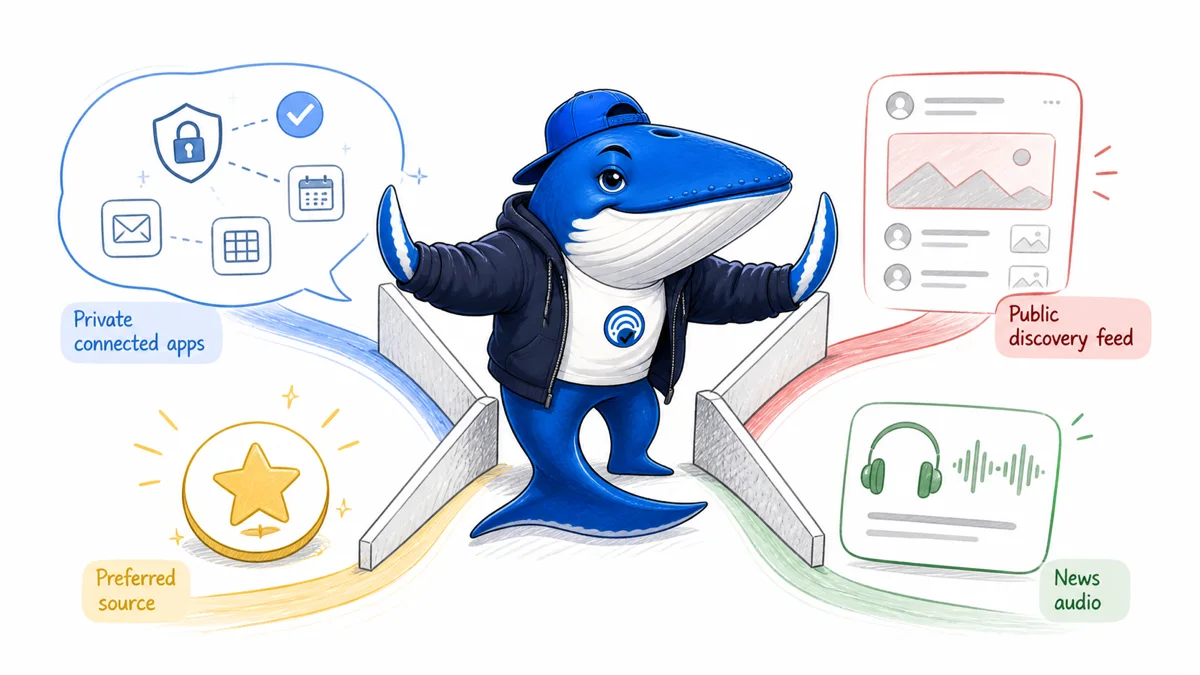
Dreambeans is not a new name for Google Discover
Dreambeans is a Google Labs experiment that creates daily stories from information in a user’s connected apps. Discover remains Google’s personalized content feed, and Google separately announced natural-language tuning for Discover, Preferred Sources controls in Search, and personalized News audio briefings. Publishers should not combine these surfaces into one “Google feed” metric.
They may share a broader personalization direction, but Google has not announced that Dreambeans will merge with Discover or become a publisher traffic channel.
The surfaces have different inputs and publisher opportunities
| Surface | Primary input and experience | Publisher action | Traffic expectation |
|---|---|---|---|
| Dreambeans | Google Labs app that builds daily stories from connected-app context. | No documented publisher submission or optimization program. | No documented Discover-style referral promise. |
| Discover | Personalized feed of content and interests; Google announced natural-language tuning. | Publish eligible, useful, timely content; readers can tune interests. | Can produce Discover traffic, but eligibility does not guarantee appearance. |
| Preferred Sources | A Search control that lets people choose sources they want to see more often. | Use Google’s embeddable button or link and explain the choice honestly. | A preference signal, not guaranteed ranking or distribution. |
| Google News audio briefing | Customized audio summary based on interests and followed topics. | Maintain accurate, attributable news coverage. | Attribution can occur, but reporting and referral behavior require observation. |
Why the comparison appeared now
SEO analyst Glenn Gabe asked on X whether Dreambeans might become “the next Discover.” That is a useful product question, but it is speculation. Google’s own Dreambeans page describes a connected-app story experiment, while Google’s August 20 Search, Discover, and News announcement treats Discover and News as separate active products.
Google says people had selected more than 600,000 unique Preferred Sources at the time of that announcement. The number shows adoption of a user control; it does not tell us how much incremental traffic a selected publisher receives.
What publishers can do now
Add a clear Preferred Sources action
Google now provides a publisher-facing button that can open the source-preference flow. Place it near a newsletter or follow action, describe what it does, and avoid promising that selection guarantees rankings. SearchEngineAnswer already includes an “Add us as a preferred source on Google” control in article navigation.
Treat Discover as editorial distribution, not a keyword slot
Use large, relevant images, accurate titles, transparent authorship, visible dates, and timely original reporting. Avoid curiosity gaps that the article cannot satisfy. Discover visibility is variable and may be personalized; save URL, date, traffic, and content-change records.
Make news easy to attribute
Use a stable publication identity, named authors, corrections, primary-source links, and clear separation between verified facts and analysis. An audio briefing may summarize a story without behaving like a conventional blue link, so monitor citations, mentions, and referrals separately.
Observe Dreambeans without inventing an optimization playbook
Document its current eligibility, connected apps, source attribution, user controls, and external-link behavior if you have access. Do not produce “Dreambeans SEO” tactics until Google exposes a publisher surface or repeatable evidence shows one.
Use a surface-specific ledger
| Field | Record | Avoid |
|---|---|---|
| Surface | Discover, Search Preferred Sources, News audio, Dreambeans | Labeling all activity “AI traffic” |
| Exposure | Screenshot, date, account state, country, language | Assuming one user view represents distribution |
| Attribution | Publisher name, linked URL, spoken or visible source | Calling a mention a click or citation |
| Referral | Landing URL, source/medium where available, session and outcome | Filling unassigned traffic with guesses |
| Content state | Title, image, author, dates, and meaningful updates | Changing several variables without a release note |
What convergence would look like
A meaningful convergence would require observable product changes: Dreambeans using public publisher content as a named source, outbound publisher links, publisher controls or eligibility, traffic attribution, or the experience appearing within Discover. Until Google documents or tests those elements, “next Discover” is a hypothesis—not a roadmap.
Sources and evidence limits
We checked Google’s Dreambeans page and August 20 personalization announcement on August 29, 2026. Google sources establish current product descriptions. The X post is attributed as analyst speculation. Features, availability, and interfaces can change; we will update the comparison when Google publishes a new boundary.
Keep learning
Continue this topic
Next in this topic
Google AI Overviews Can Expand Before You Scroll
Earlier in this topic
Category Entry Points for AI Search: Test Protocol
AEO & AI Search
Ask a question or join the discussion