Google’s New /goto SERP Links: What Changed—and What Did Not
Google is routing some result clicks through opaque /goto URLs. The change affects the clickable SERP link layer, not publishers’ canonical or indexed URLs.
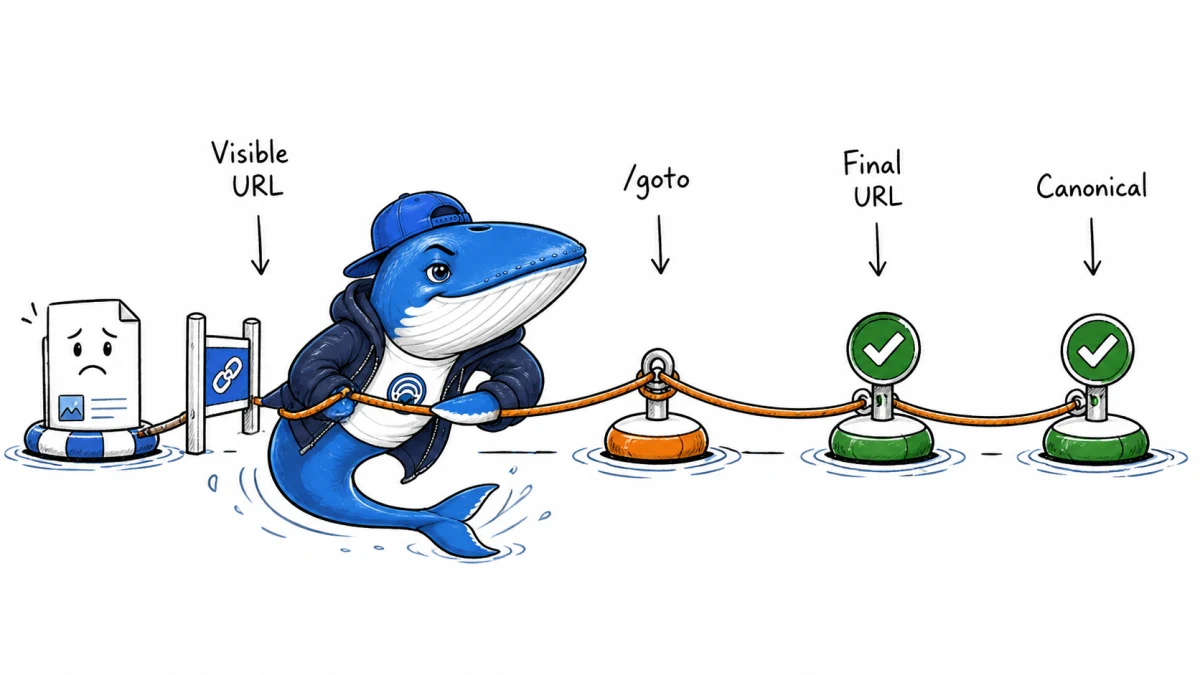
Direct answer: Google is routing some organic-result clicks through opaque google.com/goto URLs before sending the visitor to the publisher. This changes a link inside the search-results page. It does not change the publisher’s canonical URL, indexed URL, redirect map, or page address.
The distinction matters because a SERP collector can see an unreadable Google URL where it previously saw the destination. A publisher, however, should not respond with a site migration or canonical change. The first job is to check whether click attribution, browser extensions, rank tracking, and monitoring still work through the extra hop.
What Google confirmed
On August 26, 2026, Search Engine Land reported that Google confirmed it was deploying the new result-link behavior. The publication showed a result whose anchor pointed to an opaque google.com/goto?url=... address, followed by a server-side redirect to the publisher.
Google described the change as part of its long-running technical measures against evolving abuse. It did not name scraping as the specific reason for this implementation. The anti-scraping explanation is plausible context, especially because opaque redirect URLs make direct extraction harder, but it remains an interpretation rather than Google’s stated mechanism.
Search Engine Roundtable documented earlier testing and cited Nozzle observations across residential-IP samples. Those measurements are useful evidence of rollout, not a census of every country, query, account, device, or result type.
The four URL layers that should not be confused
| Layer | What it represents | What the new behavior can change |
|---|---|---|
| Visible domain or breadcrumb | The address text shown to the searcher | Nothing established by the /goto reports |
| Raw anchor target | The link in the result-page HTML | It can point to an opaque Google /goto URL |
| Redirect hop | The Google response that forwards the click | An additional server-side hop can appear |
| Publisher final and canonical URL | The destination page and its declared canonical | No publisher-side change has been documented |
This is also different from Google’s 2025 mobile visible-URL simplification, which removed breadcrumbs from mobile results and retained the domain. One concerns what the user sees. The other concerns the destination stored in the clickable anchor.
What the SearchEngineAnswer result showed
We ran one bounded check on August 29 at 13:19 UTC. The environment was Google desktop Search, a signed-in account, an English-Morocco interface, and the query searchengineanswer. Google corrected the query to “search engine answer.”
The SearchEngineAnswer result displayed https://searchengineanswer.com, and its clickable target was the direct homepage URL, https://searchengineanswer.com/. That result did not use a /goto wrapper.
This observation does not measure rollout share. It shows why the article should not claim that Google changed every result link. Account experiments, interface, locale, query class, result type, and rollout timing can all affect a live SERP sample.
How to test the redirect without confusing the layers
- Freeze the environment. Record the query, date and time, country, language, device, viewport, signed-in state, and result position.
- Capture the display layer. Save the visible domain or breadcrumb separately from the raw anchor target.
- Classify the anchor. Mark it as a direct publisher URL, Google
/url, Google/goto, or another wrapper. - Follow a small manual sample. Record the redirect status,
Locationvalue, final URL, and whether parameters survive. Do not build an aggressive automated redirect follower. - Check publisher measurement. Compare server logs, analytics landing pages, referrers, and campaign parameters before and after the observation. Preserve raw data.
Rank-tracking and SERP-data vendors need a separate engineering check. If a pipeline treated the raw anchor as the publisher URL, opaque hashes can break destination extraction even while a normal browser click still reaches the publisher.
What publishers should do now
Keep canonical tags, redirects, sitemaps, and internal links aligned with the real publisher URLs. There is no evidence here that those controls need to change. Instead, add a dated annotation to SEO operations, test representative Google clicks, and ask any SERP-data vendor how it resolves the new redirect layer.
If a reporting change appears, split the diagnosis into landing-page attribution, referrer preservation, click counting, and rank-tracker extraction. These are separate systems. The Search Console and analytics reconciliation guide provides the same discipline for AI-search measurement, while the site-migration checks in the priority-first SEO audit is relevant only when the publisher actually changes URLs.
The safest conclusion is narrow: Google has deployed a new link wrapper in some result sets, and current evidence does not establish a publisher-side URL or ranking change.
A rank-tracker drop can be a collection outage
On September 18, Search Engine Watch reported another disruption affecting automated Google result collection. SISTRIX’s public status page showed slower data collection, while a Nozzle representative said its retrievable Google data had fallen by about 80% during the disruption.
That does not establish that Google’s /goto/ link layer caused the later event, nor that any measured site lost rankings. It establishes a separate operational risk: a third-party visibility chart can collapse when the provider cannot collect a normal sample.
| Observation | First check | Do not conclude yet |
|---|---|---|
| Rank tracker shows a broad drop | Provider status, completion rate and missing rows | The site lost rankings |
| Search Console impressions fall on the same pages | Countries, devices, query families and dates | The redirect format caused it |
| Manual result still resolves correctly | Visible target, redirect hop and final canonical | Every automated collector can parse it |
Preserve the provider’s status incident and the raw export before backfilling. Compare Search Console and a small manual panel. If first-party impressions remain stable while the tracker loses rows across unrelated domains, investigate collection before editing pages. Sources: Search Engine Watch and SISTRIX status.
AI Mode citations are a separate measurement problem
A September 23 Evertune analysis adds a related but distinct observation. The measurement vendor says it tracked roughly 180,000 Google AI Mode responses from August 11 to September 3, 2026. In its sample, a typical mid-August response had 19.7 citation URLs and five plain links. By early September, direct citation URLs were nearly absent; 3.5 of the 3.8 remaining sources per response were google.com/goto links. Responses with any plain website link fell from 84% to 6%.
Those figures describe Evertune’s AI Mode captures, not the ordinary organic-result anchors discussed above. The published article does not provide the full prompt panel, account and country mix, raw response export or a controlled test of why the change occurred. Its timing alone cannot establish that the redirect wrapper caused the citation decline, that publisher traffic fell by the same percentage, or that every AI Mode user saw the same interface.
For measurement, record a displayed citation, its raw Google wrapper, the resolved publisher destination and the answer surface as separate fields. Count unique destinations after resolving redirects, but preserve the raw URL for auditing. Compare like-for-like prompts over time and keep Search Console and referral sessions as separate outcome series. This catches a link-format change without treating it as a canonical-URL change or a proven ranking loss.
Sources, method, and limits
Sources: Search Engine Land’s report containing Google’s confirmation, Search Engine Roundtable’s rollout report, Google’s official visible-URL documentation, and a dated SearchEngineAnswer SERP observation.
Method: We separated display, anchor, redirect, destination, and canonical layers, then recorded one live result under explicit conditions.
Limits: Google has not published rollout coverage, a trigger rule, redirect-retention guarantees, or Search Console counting changes. One SearchEngineAnswer query cannot represent the wider result set.
Keep learning
Continue this topic
Next in this topic
Google Now Unescapes JSON-LD Once: Find Double-Escaped Schema
Earlier in this topic
Google Ads vs Maps: Local Lead Attribution
SEO
Ask a question or join the discussion