Claude Text Watermark: Not Hidden Characters or SEO
Anthropic’s proposed Claude watermark uses statistical word-choice patterns in future models, not hidden Unicode characters, metadata, or an AI-detector score.
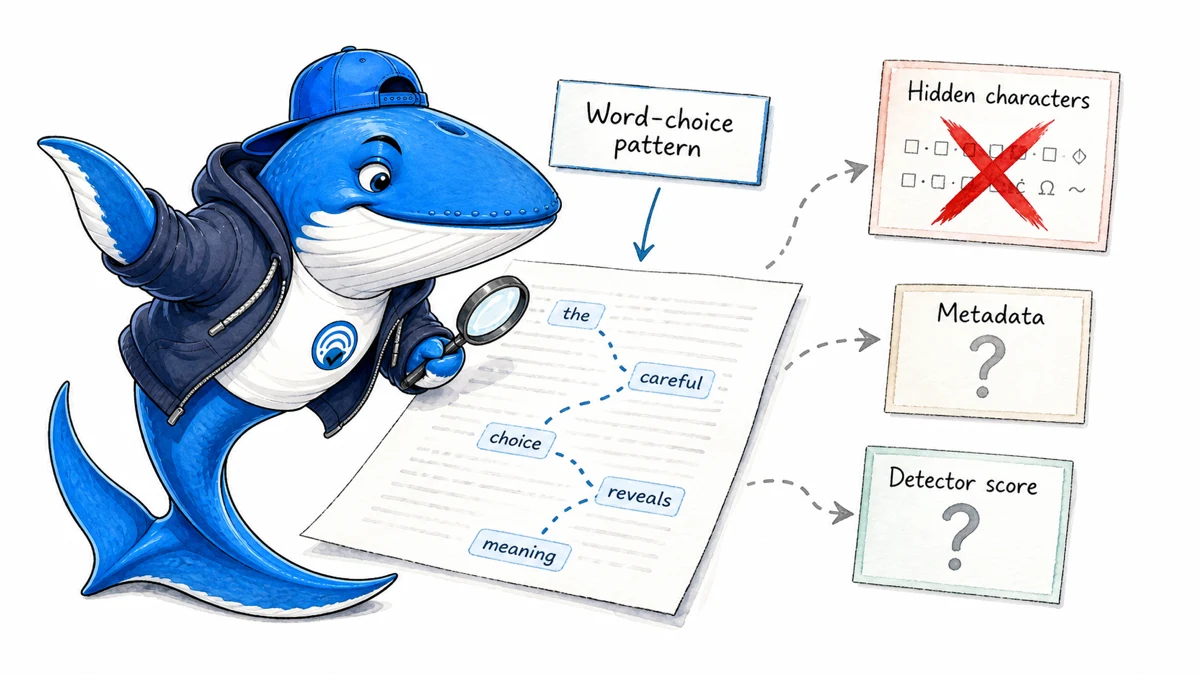
Direct answer: Anthropic’s announced Claude text watermark is not a string of hidden Unicode characters. It is a proposed statistical signal created through subtle word-choice patterns in future Claude models. Anthropic says the method adds no hidden characters, extra tokens, or identifying information. It is not a Google Search signal, and it is not the same as an AI-detector score.
What Anthropic announced
Anthropic published its text-watermark proposal on August 14, 2026. The company says future Claude models can be trained to prefer certain equally plausible word choices. Across enough text, those choices form a statistical pattern that a compatible detector can evaluate.
Anthropic says the watermark uses no invisible characters, no metadata, no extra tokens, and no identifying information about a person or conversation. The company also says its evaluations found no practical quality impact. That quality statement is first-party test evidence, not an independent guarantee for every language, genre, or editing workflow.
The announcement describes future Claude models. It should not be used to claim that every current or historical Claude output carries the signal.
Four things people call a watermark
| Mechanism | Where the signal lives | Anthropic announcement? |
|---|---|---|
| Statistical word-choice watermark | A pattern across generated word choices | Yes |
| Hidden Unicode characters | Invisible or unusual characters in the text string | No |
| Provenance metadata | A file, document, or delivery wrapper | No |
| AI-detector score | A model’s prediction based on text features | No |
This matters because the remedies are different. Removing zero-width characters cannot erase a word-choice distribution. Copying text into a plain-text editor does not necessarily change it. A detector score can fluctuate even when no designed watermark exists.
What the signal can and cannot establish
A statistical watermark is most useful across sufficient text generated under supported conditions. Short passages, heavy editing, translation, quotation, mixed authorship, and model changes can affect detectability. Anthropic’s announcement does not turn a positive signal into proof of who prompted the text, whether a human verified it, or whether its claims are correct.
A negative result is also bounded. It can mean the text was not watermarked, the sample was too short, the signal was altered, the detector was incompatible, or the model was outside the supported set.
Publishers should therefore avoid using one detector output as the sole basis for rejecting a freelancer, accusing an author, or labeling a page. Preserve drafts, sources, revision history, and editorial communications when provenance matters.
There is no announced Google ranking signal
Google’s current spam policy addresses scaled content created primarily to manipulate rankings, regardless of whether humans, automation, or both produced it. Google has not announced an organic ranking boost or penalty based on Anthropic’s text watermark.
The useful SEO questions remain visible: Does the page satisfy a real need? Are consequential claims sourced? Is first-hand work identifiable? Are authors and commercial relationships clear? Was the page produced at a scale that sacrifices accuracy or usefulness?
A watermark could support platform governance or provenance research. It does not replace a content-quality review, and it does not make a factual error safer to publish.
A publisher policy that survives the hype
- Require disclosure by workflow. Define where assistants may be used: research organization, transcription, outlining, editing, translation, or drafting.
- Verify claims independently. The accountable author should open the primary sources and confirm names, dates, numbers, limitations, and quotations.
- Keep evidence. Save source notes, test files, data, interview records, and material revisions for consequential work.
- Review the result, not a detector alone. Use editorial judgment and documented evidence before making employment or publication decisions.
- Correct publicly. A visible correction process protects readers whether an error originated with a person, a model, or a source.
Do not install “watermark stripping” scripts on the strength of a viral claim. Such tools can introduce security risks, damage text, and solve the wrong technical problem.
Sources, method, and limits
Sources: Anthropic’s August 14 announcement and Google’s current scaled-content spam policy.
Method: We separated four mechanisms commonly grouped under “AI watermark,” then mapped the announcement’s explicit claims and its unresolved conditions.
Limits: Anthropic has not yet published every deployment detail, model list, language result, detector threshold, or independent replication needed to judge performance across publishing workflows. Future implementations can differ from the announced approach.
Keep learning
Continue this topic
Next in this topic
How to Verify GPTBot and Other AI Crawlers
Earlier in this topic
Google Site-Reputation Enforcement in the EEA
SEO
Ask a question or join the discussion