ChatGPT Restaurant Reservations: Local Search Guide
ChatGPT now connects restaurant questions to reservation availability through OpenTable, Resy, and Yelp. Selection, inventory, and completed bookings remain separate outcomes.
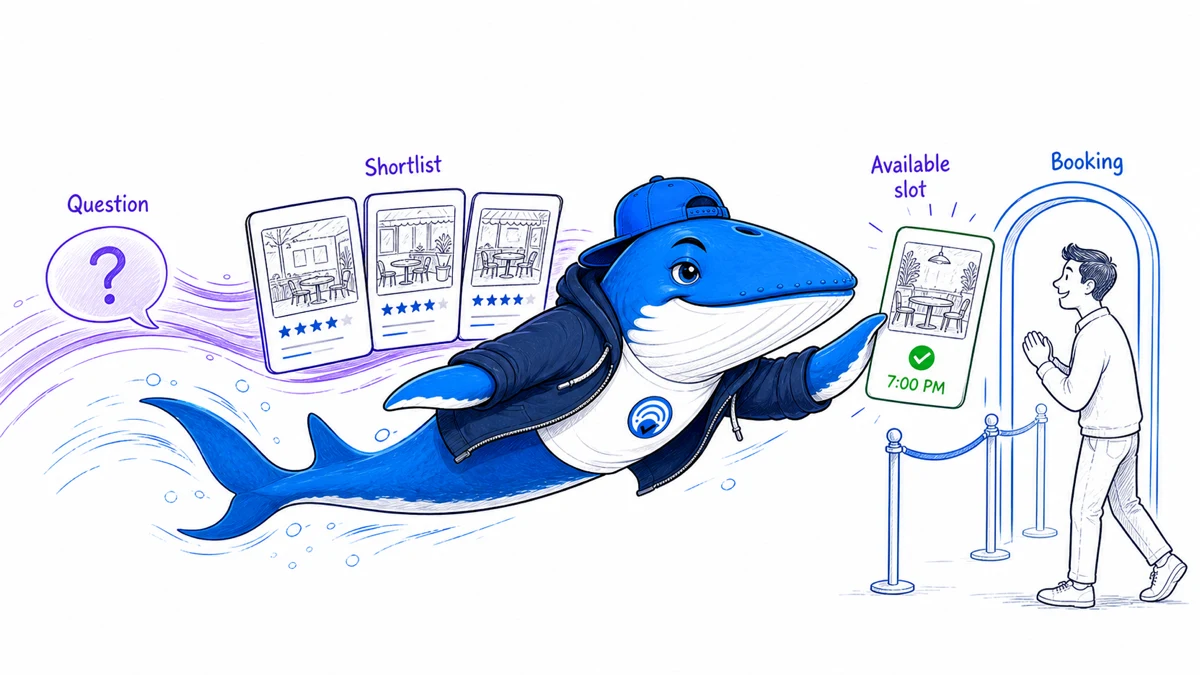
Direct answer: ChatGPT can now move from a restaurant question to a reservation flow through OpenTable globally, Resy in the United States, and Yelp in the United States and Canada. OpenAI says the experience is available across Free, Go, Plus, Pro, Business, and Enterprise plans on mobile, web, and desktop; ChatGPT Work is excluded. The announcement does not disclose how restaurants are selected or ordered.
What OpenAI launched
OpenAI added restaurant reservations to the ChatGPT release notes on August 10, 2026. A user can ask for a restaurant, review suggested options and available reservation times, then continue through a supported booking partner.
| Partner | Documented geography | Role |
|---|---|---|
| OpenTable | Global | Reservation availability and booking flow |
| Resy | United States | Reservation availability and booking flow |
| Yelp | United States and Canada | Restaurant information and booking flow |
The feature joins discovery, inventory, and transaction steps that were previously easier to measure separately. A restaurant can be known to ChatGPT yet have no visible slot. A slot can exist at a partner while the restaurant is absent from a particular shortlist.
Four states in the booking funnel
- Entity understood: ChatGPT can reconcile the restaurant’s name, location, cuisine, website, and listing records.
- Shortlist selected: The restaurant appears for a specific request and context.
- Slot available: A supported provider returns inventory for the requested party, date, and time.
- Booking completed: The user continues to the provider and finishes the reservation.
Measure each state. A single “AI visibility” score cannot reveal whether the constraint is entity data, recommendation relevance, inventory, or booking completion.
OpenAI has not published the selection formula, ordering factors, provider precedence, or attribution window. A prominent result is an observation for that prompt, user, place, and time—not proof of a general ranking position.
A local entity and inventory audit
- Identity: Keep the canonical name, address, phone, coordinates, cuisine, price range, and opening hours consistent across the website and major listings.
- Official page: Give each location a crawlable page with menu context, accessibility details, neighborhood, reservation link, and accurate temporary closures.
- Provider record: Verify the supported booking profile, time zone, party-size rules, inventory release, and cancellation policy.
- Structured data: Use valid Restaurant or LocalBusiness markup that agrees with visible page content. Markup does not guarantee selection.
- Evidence: Maintain recent menus, first-party photography, press references, and clearly attributed reviews or awards.
After a rebrand, relocation, or domain migration, test old and new names. Conflicting entity records can produce duplicate restaurants, stale addresses, or a recommendation that leads to the wrong booking profile.
A repeatable restaurant test
Create 20 prompts that represent real decisions: cuisine plus neighborhood, dietary need, group size, price ceiling, outdoor seating, accessibility, late availability, and a named-restaurant query. Run each in a fresh conversation three times at fixed local times.
Record the plan, model, account state, approximate location, precise-location permission, device, prompt, shortlist order, displayed facts, cited sources, provider, available slot, price or deposit, and final destination URL. Repeat from at least two markets if the business operates in both.
Use one control restaurant with similar location and inventory. If both disappear, the change may be provider or feature availability. If only one disappears, inspect entity and inventory differences before attributing the result to “ChatGPT SEO.”
Do not automate a booking or create inventory solely for testing unless the provider allows it. The useful endpoint is an available flow, not a false reservation that harms restaurant operations.
What this means for local search
The feature narrows the distance between an answer and a commercial action. Publishers and local businesses should expect the answer surface to combine descriptive content with live partner data. Owning the best article is not enough if the booking record is incomplete; having inventory is not enough if the entity cannot be reconciled.
The defensible strategy is coordinated data: accurate first-party pages, consistent listings, supported provider inventory, and measurement that preserves prompt context. Avoid claiming that schema, reviews, or a provider partnership guarantees placement. OpenAI has not made that promise.
Sources, method, and limits
Source: OpenAI’s official ChatGPT release notes, including the documented plans, clients, partners, and regions.
Method: We separated entity recognition, shortlist inclusion, live availability, and completed booking, then designed a test that records each state.
Limits: OpenAI has not disclosed ranking factors, provider coverage by city, result-order rules, attribution, or conversion reporting. Availability can vary by restaurant, time, party size, location, account, client, and rollout.
Keep learning
Continue this topic
Next in this topic
Category Entry Points for AI Search: Test Protocol
Earlier in this topic
Perplexity Source Labels Apply to Domains, Not Every Page or Claim
AEO & AI Search
Ask a question or join the discussion