Google AI Search Console Logging Error: Aug 13–17
Google says a Search Console logging error underreported Generative AI impressions from August 13 through August 17. It was a reporting issue, not an actual traffic decline.
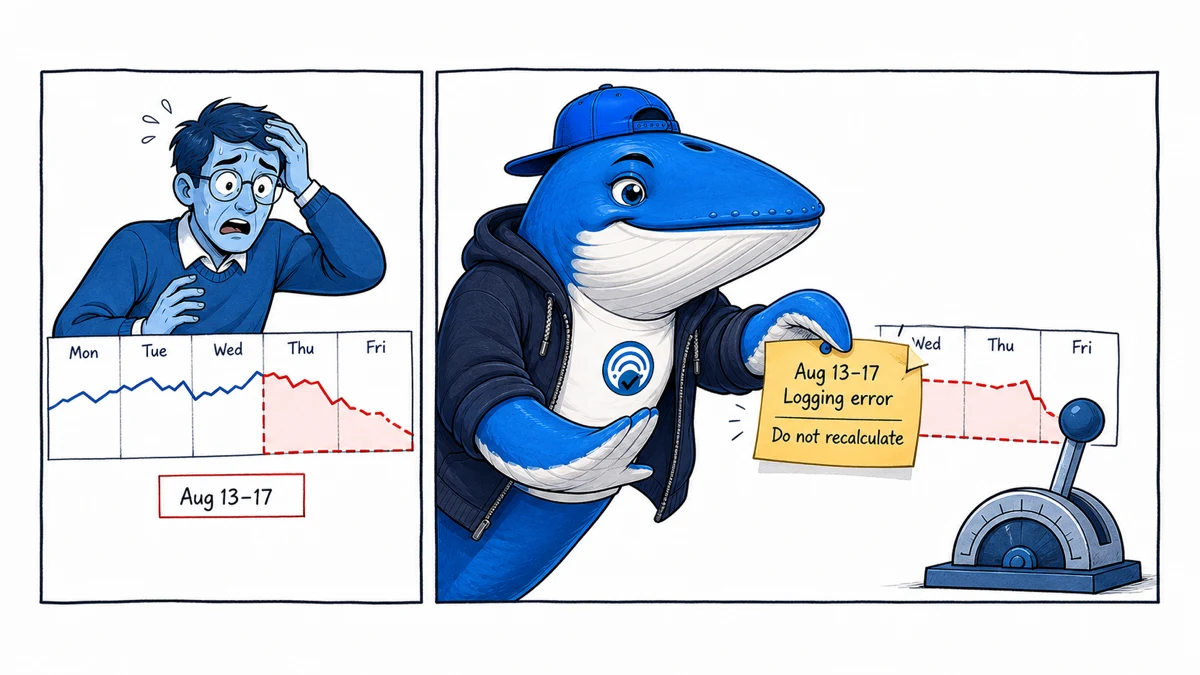
Direct answer: Google says a logging error caused Generative AI impressions in Search Console to be underreported from August 13 through August 17, 2026. The incident affected reporting, not actual search traffic. Google also lists a separate August 13 Discover reporting issue. Do not use those dates to calculate an AI-visibility loss or retroactively inflate the data.
What Google recorded
Google’s Search Console data anomalies page lists a Generative AI performance-report logging error from August 13 to August 17. Google says the error caused a decrease in reported impressions and did not reflect an actual change in search traffic.
The same page lists an August 13 Discover logging error that reduced reported clicks and impressions, including Generative AI impressions in Discover. Google does not provide the number of affected properties, the percentage missing, or a correction factor.
| Surface | Dates | Reported impact | What Google says did not change |
|---|---|---|---|
| Generative AI in Search | August 13–17 | Reported impressions decreased | Actual search traffic |
| Discover, including Generative AI | August 13 | Reported clicks and impressions decreased | The note describes a logging error |
What the note does not prove
The anomaly does not establish that every property lost data, that all five days are equally incomplete, or that clicks and impressions were affected by the same proportion. It does not reveal how Google assigns an impression to a generative surface.
It also does not explain a decline that starts before August 13 or continues after August 17. When a graph spans the incident boundary, compare the affected segment with adjacent dates and with unaffected dimensions rather than labeling the whole movement a reporting error.
Because Google supplied no denominator, multiplying the missing period by an average uplift would create false precision. Keep the recorded values and attach an anomaly label.
How to annotate the data
- Preserve the raw export. Save the unmodified daily Search Console data and the time of export.
- Mark August 13–17. Add a reporting-anomaly field rather than overwriting impressions.
- Keep surfaces separate. Search Generative AI and Discover have different incident ranges in Google’s note.
- Exclude the period from rate comparisons. Do not use it as a clean baseline for impression growth, click-through rate, or visibility-share changes.
- Retain independent observations. Referral sessions, server logs, rank captures, and saved answer citations can provide context, but they are not a substitute for the missing Search Console denominator.
If Google later republishes or backfills the data, store a second export and compare the files. Until then, “unknown because of logging” is more accurate than an estimated correction.
Why impressions and traffic must stay separate
An impression is a platform-defined exposure event; a click or referral is a visit event. They answer different questions. Our guide to Google AI impressions versus AI traffic explains why a visibility line can rise without matching referral growth.
This incident adds a third state: the exposure may have occurred, but the measurement was not logged correctly. A reliable report should distinguish a behavioral change, a measurement change, and an unknown cause.
For executive reporting, use one sentence: “Google underreported Generative AI impressions August 13–17; the period is excluded from trend conclusions.” That is more useful than smoothing the line and hiding the uncertainty.
Sources, method, and limits
Source: Google Search Console’s official data-anomalies record, accessed August 29, 2026.
Method: We preserved Google’s stated dates and affected metrics, then designed an annotation procedure that does not invent missing values.
Limits: Google has not published the scale, affected-property count, query distribution, correction status, or technical cause. The incident note supports a reporting caveat, not an estimate of lost impressions.
Keep learning
Continue this topic
Next in this topic
Perplexity Source Labels Apply to Domains, Not Every Page or Claim
Earlier in this topic
Reddit’s ChatGPT Citation Share Fell 86%
AEO & AI Search
Ask a question or join the discussion