EU DMA Google Search Data for AI Chatbots
Google has appealed the EU’s Search-data decision. The application route remains public, but eligibility, audits, licensing and the court process still separate interest from access.
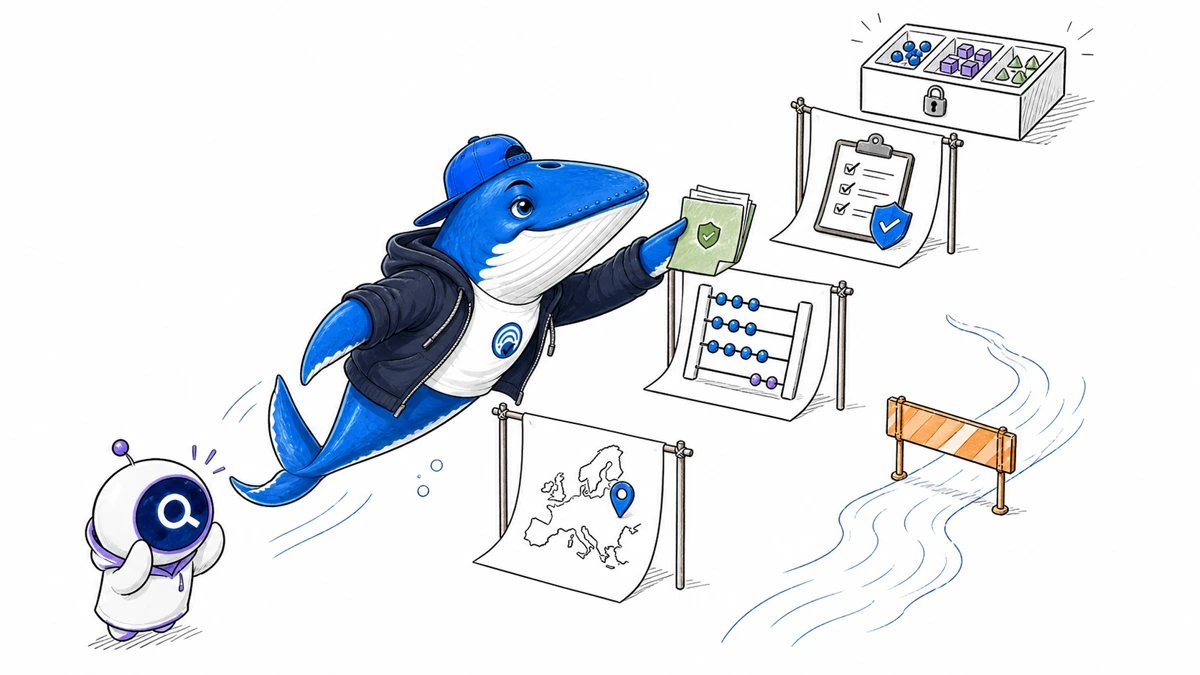
Direct answer: the European Commission’s July 2026 decision requires Google to prepare anonymized ranking, query, click, and view data for eligible rival search engines, including qualifying AI chatbots with online search functions. It does not require Google to hand over its algorithms, and the end-of-August milestone is an application page and eligibility form—not immediate access to a finished dataset.
The implementation is staged through January 2027. Eligibility, licensing, privacy safeguards, audits, latency, and price all sit between a company and production access.
Google’s September 29 appeals: what changed?
Reuters reported on September 29 that Google filed challenges at the EU General Court on September 28 against two July Digital Markets Act specification decisions. One concerns access to anonymized Google Search data for eligible rival search services. The other concerns interoperability for competing AI assistants on Android. They are separate measures, even though Google challenged both.
Google argues that the requirements could weaken privacy and Android security protections. The European Commission describes safeguards for both measures and says the search-data arrangement is designed to protect users while enabling competition. Those are the parties’ positions, not a finding that either side’s prediction has come true.
The distinction for publishers and AI-search teams: a filed appeal is not, by itself, evidence that the decisions have been suspended, that an applicant has received search data, or that a chatbot has changed its answers. We have not located a public court order staying either measure. Treat the implementation timetable below as the published plan unless an official decision changes it. The next useful evidence will be a court order, a revised Commission or Google program page, or a documented licence or dataset delivery, not a citation fluctuation attributed to the litigation.
September 1 update: the application route and samples are now specified
Google has published its European Search Dataset Licensing Program page and an expression-of-interest route. The page confirms that the dataset covers ranking, query, click, and view data from Google Search in the European Economic Area. It also turns several earlier milestones into concrete eligibility and sample requirements.
| Item | Current documented state | What it does not prove |
|---|---|---|
| Expression of interest | Application route is public; Google says it will respond within seven calendar days | Qualification, a signed licence, or dataset access |
| Sample A | Free 1,000-row dataset, available from November 16, 2026 | Production-scale coverage |
| Sample B | Paid synthetic dataset of up to 10 million queries, available from November 16 | Observed Google user records or live ranking behavior |
| Sample C | Paid 5% sample, available from November 16 | Access without eligibility and Level 1 assurance |
| Licensing agreement | Google says details will be provided to relevant applicants starting September 17, 2026 | That every term or final price is public today |
Use the eligibility test before budgeting for a sample
An applicant must qualify as an online search engine directed at EEA users. Google also lists control and sanctions restrictions, then applies two activity tests: the applicant must either have provided online-search-engine services in the EU for at least two consecutive years or be a newer entrant with more than €50 million in capital investment; and it must have at least 50,000 average monthly EU users of those search services during the past year.
The 50,000 threshold is not a site-traffic threshold, a chatbot-account total, or a global active-user figure. Document the OSE service, EU scope, period, monthly calculation, and denominator.
Download the Google Search Dataset eligibility checklist (CSV). Its ten EXAMPLE-REMOVE rows cover legal classification, EEA operation, control, sanctions, operating history or capital, users, independent assurance, monitoring, licence readiness, and sample selection.
Sample C and the full dataset require independent assurance
Google says a Level 1 reasonable assurance report from a qualified independent auditor is a mandatory prerequisite for Sample C and the full Search Dataset. Ongoing access also requires continuous monitoring and a Level 2 reasonable assurance report. Those are operational controls, not paperwork to schedule after access.
Before choosing Sample C, map data segregation, access control, logging, retention, incident response, audit evidence, and the people allowed to handle personal data. Sample A may answer an initial schema question without pretending the organization is ready for production access. Sample B can support pipeline testing but is synthetic; it cannot validate conclusions that depend on observed user behavior.
The schedule is now a decision tree
- Now: determine whether the product is an EEA-directed online search engine and compile eligibility evidence.
- From September 17: review the licensing agreement and the precise technical, audit, liability, and use restrictions.
- Before November 16: choose the smallest sample that answers the research question; complete Level 1 assurance before requesting Sample C.
- From November 16: preserve sample type, cost, schema, date range, latency, and restrictions with every analysis.
- For ongoing access: maintain continuous controls and Level 2 assurance rather than treating the initial audit as permanent approval.
No public page currently establishes that ChatGPT, Perplexity, or another named chatbot has qualified, purchased a sample, passed assurance, or integrated the dataset. Keep those states separate in reporting.
Update method and limit
Method: We compared Google’s September 1 program page with the milestones already recorded in this article, converted the newly specified eligibility rules into a decision checklist, and separated the three sample types from full access.
Limit: The licensing agreement is scheduled for relevant applicants from September 17 and the samples for November 16. This update does not claim access, approval, price, schema, or results for any applicant.
What data is in scope
Article 6(11) of the Digital Markets Act requires anonymized search data to be shared under fair, reasonable, and non-discriminatory terms. The Commission says the covered data concerns free and paid search activity generated by end users.
| Area | Examples described by the Commission | Not included or altered |
|---|---|---|
| Query | Query text plus generalized metadata such as language and device type | No user account, search history, precise timestamp; rare or long queries may be suppressed |
| View and click | URLs viewed and actions on search results | Paid-result URLs are removed; interaction durations may become ranges |
| Ranking | Information about where a result appeared on the results page | No Google ranking algorithm or search technology |
| Location and identity | Generalized location and grouped user attributes | Direct identifiers and precise location are removed |
The Commission describes a privacy process that removes direct identifiers, suppresses risky records, and groups users through a k-anonymity threshold. Contractual controls also restrict re-identification, onward disclosure, retention, data linking, and use outside search-service improvement.
This is not an advertising dataset. The Commission says beneficiaries cannot use it to train general-purpose AI models, build unrelated consumer profiles, improve advertising services, or systematically copy Google’s results.
The four implementation milestones
| Deadline | Required milestone | What it does not yet establish |
|---|---|---|
| End of August 2026 | Submit the eligibility application form to the Commission; publish a webpage explaining rights and how to apply | No completed dataset or applicant access |
| September 2026 | Provide template licences, test samples, cost items, and estimates | No final anonymized production dataset or final price |
| November 2026 | Finalize the anonymized dataset; provide technical detail on latency and personal-data detectors | No guarantee that an applicant has passed eligibility and audit checks |
| January 2027 | Finalize and communicate the pricing offer | No automatic entitlement for every AI chatbot |
The Commission says data latency should be at least seven days and, to the greatest technically feasible extent, no longer than the latency Google uses internally. A beneficiary may choose an access duration up to five years. Those conditions matter for retrieval and ranking research: historical behavioral data can improve a system without becoming a real-time feed.
Which AI chatbots may qualify?
The decision covers a category, not a list of approved products. An AI chatbot must provide an online search service and satisfy eligibility, security, data-transfer, and audit conditions. The Commission says an applicant generally needs genuine search activity in the EU or credible-new-entrant status, at least 50,000 average monthly EU users during the previous year, and the capacity to handle sensitive search data.
A newer entrant can satisfy part of the economic-activity test if it was founded less than two years ago and has received more than €50 million in capital investment. Applicants must also meet sanctions, cybersecurity, GDPR-transfer, and independent-audit requirements.
That means it is inaccurate to write that ChatGPT, Perplexity, or another named service already receives Google’s data. The official page says AI chatbots with online search functions are eligible in principle. It does not publish a list of approved beneficiaries or completed licences.
Why this matters to publishers and measurement tools
If qualified competitors receive a useful behavioral dataset, they may improve query understanding, indexing priorities, retrieval, and result ordering. The effect on any publisher is still indirect. The measure does not create a reporting portal showing where a site appears in every chatbot, and it does not make the shared data public.
For AI-visibility vendors, the decision creates several claims worth auditing:
- Does the product claim access to the DMA dataset, or merely anticipate it?
- Is a sample, licence, audit, or production access actually documented?
- What date range, country coverage, latency, and anonymization apply?
- Does the tool separate Google behavioral data from its own prompts, crawls, and citation observations?
- Can the vendor show which conclusion depends on which source?
Our AI visibility tools buyer guide uses the same evidence principle: a useful dashboard must preserve the observation unit and provenance, not simply present one visibility score.
What to verify next
- Monitor the EU General Court for a public order that changes the effect or timing of either challenged decision.
- Check the Commission and Google program pages for revised licence terms, sample availability, or implementation dates.
- In November, record the finalized fields, suppressions, latency, detectors, and delivery method if the published schedule still applies.
- In January 2027, compare the published pricing components with the cost of eligibility and independent assurance.
- Do not attribute an AI-search ranking or citation change to this measure without evidence that a named service obtained and used the data.
Source, method, and limits
Primary source: European Commission: Alphabet specification proceedings—Sharing of Google Search data, decision adopted July 16, 2026 and checked August 24, 2026.
Method: We mapped each official milestone to the access state it actually proves and separated included behavioral data from algorithms, personal identifiers, paid-result URLs, and restricted uses.
Limits: The implementation is in progress. This article does not establish that any named AI company has applied, qualified, signed a licence, passed an audit, paid for access, or used the dataset.
Keep learning
Continue this topic
Next in this topic
ChatGPT Search-Call Syntax: Evidence Review
Earlier in this topic
ChatGPT Ads Europe: 31-Market Access Guide
AEO & AI Search
Ask a question or join the discussion