How to Compare YouTube Citations With Google Search Results
Normalize watch, Shorts, embed, and short links to one video ID, then compare AI citations with a separately captured Google result set without mistaking absence for a universal ranking rule.
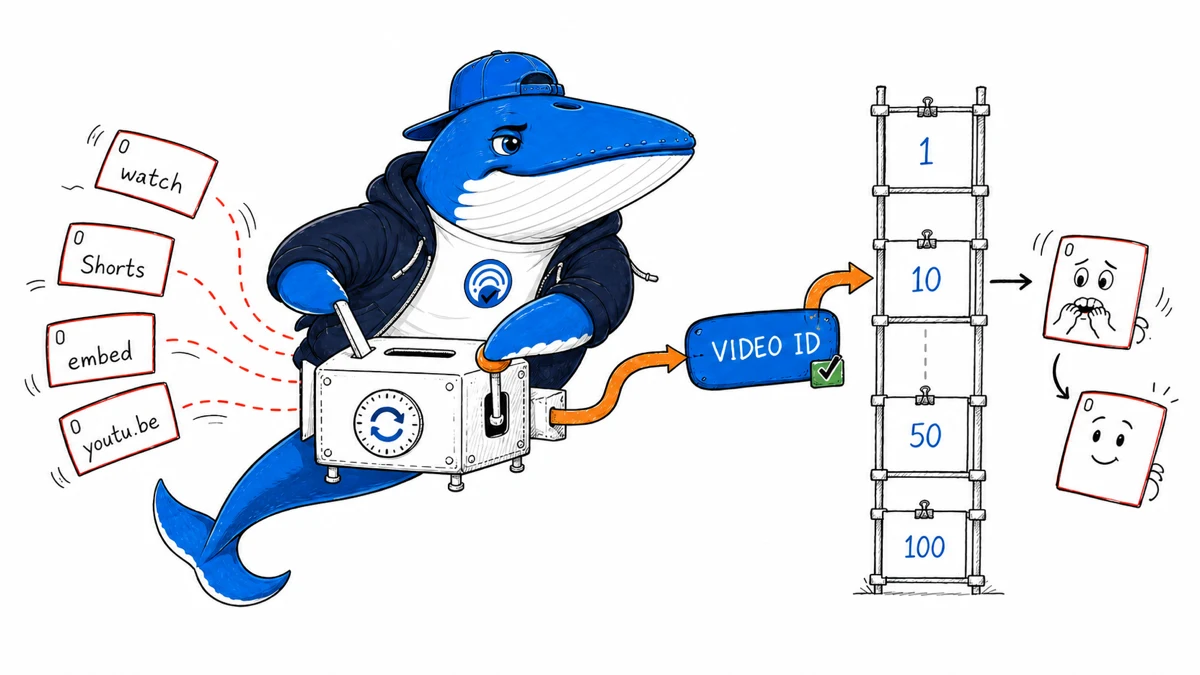
A YouTube citation in an AI answer and a YouTube result in Google are two different observations. To compare them without creating a false finding, normalize every citation to its video ID, capture the Google result set separately under a recorded environment, and classify only what those two captures support. The browser-local tool and CSV below make that process repeatable.
What this guide does and does not do: it replaces an unfinished test proposal with a usable audit method. It reports no fabricated experiment results and makes no claim that a cited video is universally inside or outside Google’s top 100.
The short answer
Yes, an AI answer can cite a YouTube URL that you do not observe in a separately captured Google result set. But “not observed” is narrower than “does not rank.” The captures may differ by time, location, language, login state, result type, query wording, or collection depth. An AI product may also expose a citation while consulting more sources than it cites inline.
The defensible unit of comparison is the normalized video ID within two documented result sets. The defensible conclusion is “inside our observed set,” “outside our observed set,” “ambiguous,” or “not comparable.” Anything stronger requires additional evidence.
Capture the two evidence sets separately
Do not treat an AI citation list as a copy of Google rankings. OpenAI’s official web-search documentation, for example, distinguishes visible inline URL citations from a broader sources list of URLs consulted by the model. That product-specific distinction is a useful warning: the links shown to a reader and the resources involved in retrieval are not necessarily the same set.
Your comparison therefore needs two ledgers. Ledger A records the citation exactly as the AI surface displayed it. Ledger B records the YouTube videos observed in the selected Google result capture. Join the ledgers only after collection.
| Evidence set | Record | Do not infer |
|---|---|---|
| AI citation capture | Query, surface, timestamp, cited URL, cited passage or claim | That every consulted source was cited |
| Google result capture | Query, environment, timestamp, observed position, video URL | That every user sees the same ordering |
| Joined audit | Normalized video ID, observed-set outcome, passage support | Why either system selected the video |
Freeze an environment card before collecting
Google says result ordering can depend on the query, relevance and usability signals, source expertise, location, and settings. Its help pages also explain that results can vary with language, context, and personalization, and that location can affect what appears. Record the environment before the first query so you can distinguish a different result from a different test.
| Field | Minimum record | Why it matters |
|---|---|---|
| Query | Exact characters, punctuation, and language | Near-duplicate wording can return a different set. |
| Surface | Product, feature, and signed-in state | “AI answer” is not one stable interface. |
| Locale | Country, language, and reported location | Localized results may reorder or change. |
| Time | UTC timestamp for each capture | Indexes and answers change. |
| Depth | Number of results actually captured | A partial set cannot support a top-100 conclusion. |
Match video IDs, not raw URLs
The same video can appear as a standard watch URL, a youtu.be short link, a Shorts path, an embed URL, or a privacy-enhanced embed. Tracking parameters and timestamps can make two links look different even when they identify the same video. Comparing raw strings will create false mismatches.
Extract the video identifier first. YouTube’s official Videos API documentation likewise accepts video IDs when retrieving video resources. The audit does not need to call that API; it borrows the stable identifier as the join key.
| Observed shape | Normalization action |
|---|---|
youtube.com/watch?v=VIDEO_ID | Read the v parameter. |
youtu.be/VIDEO_ID | Read the first path segment. |
youtube.com/shorts/VIDEO_ID | Read the segment after shorts. |
youtube.com/embed/VIDEO_ID | Read the segment after embed. |
| Playlist, channel, search, or malformed URL | Mark it unresolved; do not force a video match. |
Use the browser-local row builder
Open the YouTube citation audit row builder. Paste the citation URL and fill in the query, surface, timestamps, observed Google rank, outcome, passage-support decision, and notes. The tool recognizes common YouTube URL shapes, displays the extracted ID, and exports a CSV row.
The tool has no analytics, network request, account connection, or storage service. Your entries remain in the current browser tab until you download them or clear the page. If you need a sheet before collecting, download the audit CSV template and delete every row marked EXAMPLE-REMOVE.
Collect the Google comparison set without changing the question
Use the exact frozen query. Capture the result order and URL you actually observe, including video modules or other result types that your protocol includes. Decide the inclusion rule before collection: for example, “all YouTube video results in the first 100 organic positions” is not the same test as “all videos shown anywhere on the results page.”
Do not silently substitute a different search product. Google’s Programmable Search JSON API uses an API key and a configured Programmable Search Engine and can return up to the first 100 results. That makes it useful for its own reproducible study, but it is not evidence of what the consumer Google Search interface displayed. If you use it, name that surface in the dataset and title.
Classify the join conservatively
After normalizing both ledgers, join them by video ID and apply one outcome. Blank ranks must stay blank; zero is not a rank. “Outside” means no matching ID appeared within the completed, documented capture, not that the video can never rank.
| Outcome | Use when | Safe wording |
|---|---|---|
| Inside observed set | The same video ID appears in the captured Google set. | “Observed at position 37 in this capture.” |
| Outside observed set | The capture reached its declared depth and no ID matched. | “Not observed in the first 100 captured positions.” |
| Ambiguous | The capture is incomplete, the result is a playlist/channel, or the URL cannot be normalized. | “The available capture cannot resolve this row.” |
| Not comparable | Query, locale, time window, or inclusion rule changed materially. | “Excluded because the evidence sets are not comparable.” |
Passage support is a second decision
A matching video ID answers only the ranking-overlap question. It does not show that the video supports the claim made in the AI answer. Open the cited video, locate the relevant section, and record whether the passage supports, partly supports, contradicts, or does not clearly address the claim.
Keep this field separate from result-set presence. A video can be inside the captured Google set but fail to support the cited claim. Another can sit outside the observed set yet support it directly. Combining these judgments into one score hides the distinction readers need.
Report the denominator and missingness
Percentages are meaningless without a denominator. If an AI answer contains five YouTube citations, two normalize successfully, one is a playlist, and two were not checked because collection failed, the denominator for a completed overlap rate is two, not five. Report the unresolved and excluded rows beside the calculation.
A concise result statement can follow this pattern: “Of N normalized citation rows with complete paired captures, x appeared inside the observed result set and y did not. a additional rows were ambiguous and b were not comparable.” This language preserves the boundary between the sample and the broader web.
Use stopping rules instead of rescuing a result
Stop and mark the row when consent screens, throttling, unavailable pages, login prompts, age restrictions, deleted videos, or an incomplete result capture prevent the declared procedure. Do not change the query, location, browser state, or collection method just to obtain a clean-looking answer.
- Retry only under a predeclared rule, such as one retry after ten minutes.
- Preserve the first timestamp and record the retry separately.
- Never infer a rank from a third-party snippet or a different query.
- Keep unavailable videos in the ledger; missingness is part of the result.
A reproducible 10-step workflow
- Write the exact question and inclusion rule.
- Freeze query, surface, locale, signed-in state, device, and capture depth.
- Capture the AI answer and every visible citation with a UTC timestamp.
- Separate citations from any broader retrieval-source list the product exposes.
- Normalize YouTube video URLs to their video IDs.
- Capture the selected Google result surface without changing the query.
- Normalize every observed YouTube result to the same identifier.
- Join the ledgers and assign one conservative outcome per row.
- Assess passage support independently.
- Report denominators, missing rows, exclusions, and environment limits.
The publication quality gate
A study is ready to publish when another person can reconstruct what was compared without guessing. The package should include the frozen query list, environment card, raw citation URLs, normalized IDs, capture timestamps, observed positions, inclusion rules, exclusions, failure log, passage-support decisions, and the calculation used for any summary number.
It is not ready if it labels an incomplete capture “top 100,” mixes API and consumer results without disclosure, compares URL strings instead of IDs, or converts “not observed” into “does not rank.” Those errors create a stronger headline by weakening the evidence.
A September cross-check found a platform-level video split
Two recent datasets add a time-sensitive warning to this method: a video’s absence from one answer engine should not be treated as evidence that video disappeared from AI search generally.
| Study and surface | Observation | Boundary |
|---|---|---|
| Epovest, Perplexity | Video-citing sourced answers fell from 61.5% on August 10 to 0.7% on August 17. Nine travel trackers moved from 39 of 54 answers to 0 of 54. | Same questions repeated over time, but this is the vendor’s tracker set and API-based collection. |
| Epovest, Gemini | 46.5% of sourced answers cited a video in the reported current-model sample. | The denominator is sourced answers, not all requested answers. |
| Prefer, Perplexity | YouTube appeared in 0 of 240 answers on September 13. | One-day snapshot of 80 AI-search questions repeated three times. |
| Prefer, Gemini | YouTube appeared in 113 of 240 answers, or 47.1%. | All answers are in the denominator, including 27 that did not search. |
The studies should not be pooled because their prompts and denominators differ. Their direction agrees: Perplexity moved to near-zero video citations after mid-August, while Gemini remained much higher. The broader 960-answer source-market comparison explains why this is an engine-specific retrieval observation, not a universal verdict on YouTube.
Use the result in a broader measurement system
Citation overlap is one measurement, not an AI-visibility score. Place it beside the AI visibility measurement crosswalk when you need to compare citations, mentions, referral visits, and business outcomes. For the separate question of which sources deserve trust, use the AI search source-credibility comparison.
Method, sources, and update note
This guide was rebuilt on September 1, 2026, from an earlier protocol-only page. It adds a working local normalizer, an example-marked CSV schema, explicit classification rules, stopping rules, and a passage-support check. Product behavior claims are limited to the linked official documentation from OpenAI, Google Search Help, Google Programmable Search, and the YouTube Data API. The article contains no test-result claim.
Update trigger: recheck the method when a cited product changes how it exposes citations or sources, when Google changes the selected result surface, or when YouTube changes supported URL structures.
Comparison design
A YouTube citation is not equivalent to a Google video ranking
The two surfaces can select content for different reasons, so the comparison needs a fixed query set and separate observations.
- Search result
- Video rank, result type and visible publisher.
- AI answer
- Whether the video is cited, linked or merely mentioned.
- Content match
- Which claim or step the video supports.
- Stability
- Whether the result repeats across dates and clean sessions.
My takeaway: The useful finding is the overlap and the disagreement. A simple top-100 count hides why a video was selected and whether it supported the answer.
Keep learning
Continue this topic
Next in this topic
Perplexity DeepSeek V4 Flash: Verify Routing and Fallbacks
Earlier in this topic
How to Measure AI Citations and Recommendations Separately
AEO & AI Search
Ask a question or join the discussion