Claude inference_geo: Separate Inference Location from Data at Rest
Claude inference_geo can control eligible inference processing, but it does not replace workspace data-residency settings. Verify both layers and provider-specific limits.
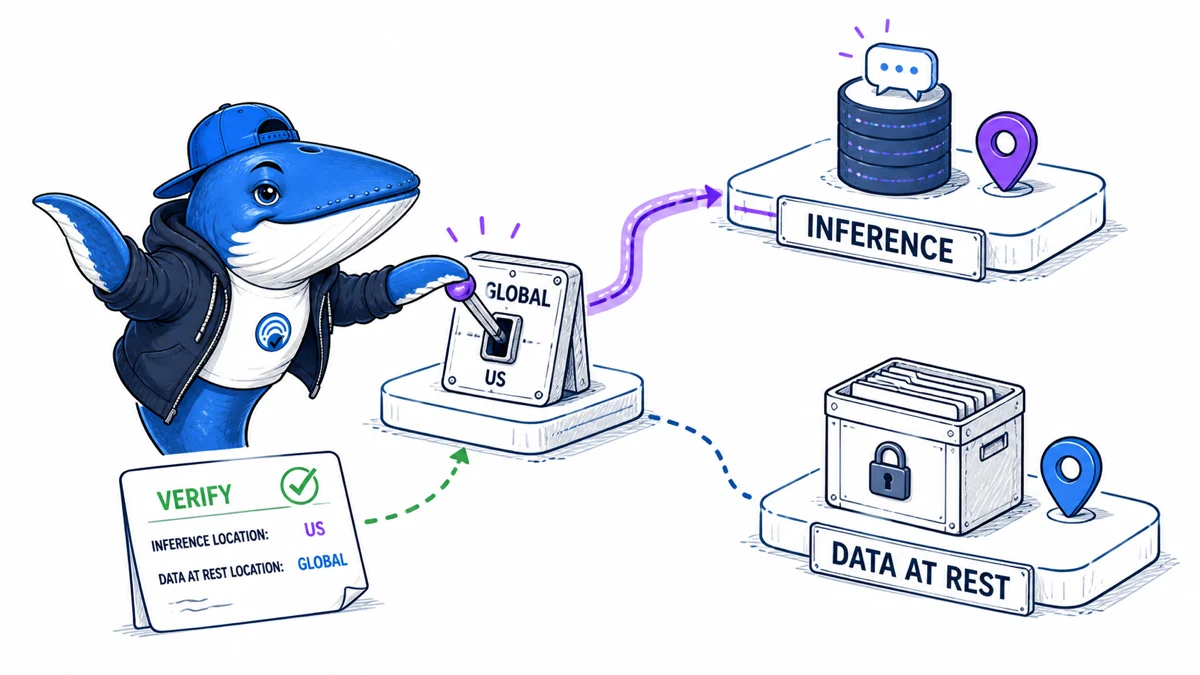
Direct answer: Anthropic’s inference_geo option controls the region used for eligible model inference; it does not by itself set the storage location for workspace or application data. Treat inference processing and data at rest as two distinct policy layers, then verify the product path, model support, response evidence, and price before claiming a residency outcome.
Anthropic currently documents global and us inference geography for Claude 4.6 and later models. The same documentation says United States-only inference has a pricing multiplier. These are current product facts, not permanent platform guarantees.
Draw the two-layer boundary
| Layer | Control | Evidence |
|---|---|---|
| Inference processing | Per-request or workspace inference geography | Request configuration and response usage |
| Data at rest | Workspace or provider residency setting | Organization configuration and contract |
| Transit and integrations | Application, logs, tools, and providers | Architecture and data-flow record |
A request can be processed in one geography while prompts, outputs, telemetry, backups, or application logs follow different storage and transfer rules. Write the claim at the layer supported by the evidence.
Verify model and product support
Check the exact model string, API path, SDK version, account type, and provider before setting the option. Anthropic’s direct API documentation is not automatically a statement about Amazon Bedrock, Google Vertex AI, or another hosted path. Managed Agents also have their own documented limitation for per-request inference geography.
- Save the intended processing geography and policy owner.
- Confirm the model is inside the supported family.
- Send a non-sensitive fixture through the real application path.
- Record the request, response,
usage.inference_geo, error state, and timestamp. - Test the fallback path and decide whether an unsupported or unavailable geography fails open or closed.
Do not infer the location from latency, IP observations, or account billing region when the product exposes a direct evidence field.
Include cost and failure behavior
Anthropic’s pricing documentation currently applies a 1.1× multiplier to United States-only inference. Model the full request mix rather than applying the multiplier to an average bill without checking which models and calls actually use the setting.
Define behavior when the requested geography is unavailable, unsupported, or rejected. For regulated or contractual workloads, silently retrying through a global route can be worse than returning a clear error. For lower-risk workloads, a documented fallback may be acceptable. The decision belongs to the data owner, not to an undocumented SDK default.
Log safe request identifiers and geography outcomes without copying sensitive prompt content into a monitoring system that has a different residency policy.
Publish a precise residency statement
A defensible statement names the product, model, control, layer, evidence, and date. For example: an eligible request was configured for United States inference and returned us in the usage record on a stated date. That does not prove where every related log, backup, tool call, or application record is stored.
Review the statement after model migrations, provider changes, workspace configuration changes, or new tools. Keep legal and contractual interpretations with qualified counsel and the governing agreement.
Use the Claude inference controls guide to keep security decisions separate from editorial approval.
Ask a question or join the discussion