DuckDuckGo Expanded Result Previews: What Publishers Can Verify
DuckDuckGo announced playable video previews and expanded text summaries. Here is what publishers can verify without inventing selection or markup rules.
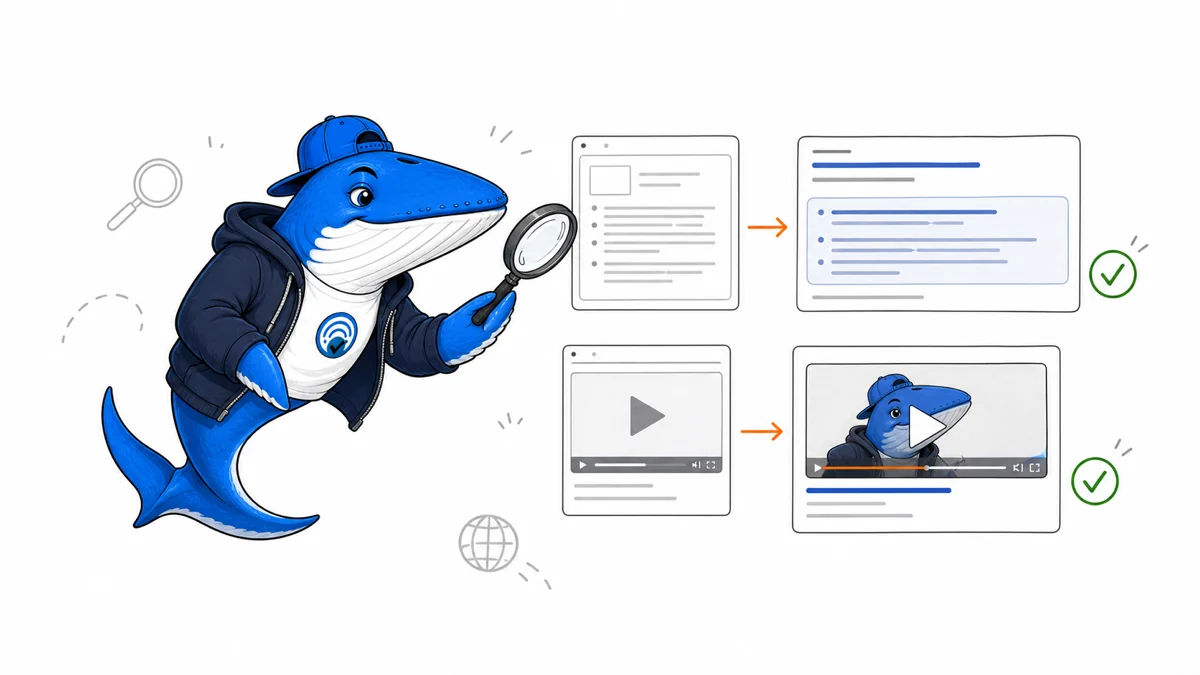
Published August 9, 2026: DuckDuckGo says its Q2 2026 Search updates added more informative previews, including playable video previews and expanded text summaries. The announcement describes the user-facing result, but it does not publish a dedicated publisher markup, selection formula, or guaranteed eligibility path.
This article separates the confirmed product change from the checks publishers can run. SearchEngineAnswer has not completed a controlled query sample measuring which pages receive expanded previews, so no inclusion rate or causal optimization claim is made.
What DuckDuckGo announced
DuckDuckGo’s public update page says Search results now give users more information before they click. The examples named in the announcement are playable video previews and expanded text summaries. That is enough to confirm a presentation change, but not enough to identify a new schema requirement or ranking factor.
The page groups the change with Q2 2026 product updates. It does not say that every video result is playable, that every text result receives a longer summary, or that one field controls the preview. Publishers should avoid turning a short release note into implementation folklore.
| Question | Current evidence | Safe conclusion |
|---|---|---|
| Do playable video previews exist? | DuckDuckGo Q2 update | Yes, in some results |
| Do expanded text summaries exist? | DuckDuckGo Q2 update | Yes, in some results |
| Is special schema required? | Not stated in the announcement | Do not invent a requirement |
| Is inclusion guaranteed? | No guarantee stated | Treat selection as variable |
| Which source field is used? | Not specified | Audit visible evidence |
Prepare text pages for a longer preview
Write the direct answer near the relevant heading and keep its subject, boundary, evidence, and limitation together. An expanded summary creates more room, but it also exposes vague introductions, unsupported claims, and qualifications placed far from the sentence they constrain.
Use a descriptive title, concise meta description, visible publication or update date, clear authorship, stable canonical URL, and crawlable main content. These are defensible page-quality practices even when the engine chooses a different passage for the preview.
Do not duplicate the same summary in the title, description, opening paragraph, and every heading. Repetition reduces information density and does not establish which field DuckDuckGo will select.
Prepare video pages for preview
Give the video a stable watch page with a unique title, useful surrounding text, accurate thumbnail, duration, upload date, and a playable source that is not hidden behind an avoidable interstitial. Use appropriate video structured data where it accurately represents the visible page, but do not claim DuckDuckGo’s release note requires it.
Check consent and regional variants. A preview may fail when the public page shows a poster but the player source requires a session, when robots controls block the media, or when an embed is unavailable in the result’s market.
Captions and transcripts improve accessibility and give search systems text that describes the actual video. They must match the media; generated transcripts should be reviewed for names, numbers, and technical terms.
Run a bounded preview study
- Choose a fixed query set that includes your brand, informational pages, and video pages.
- Record country, browser, privacy settings, device, date, and signed-in state.
- Capture the result title, displayed URL, summary length, highlighted terms, media preview, and destination.
- Map displayed text to the title, meta description, visible passage, transcript, or another source.
- Repeat on a schedule without changing the pages during the first observation window.
- Only then make one bounded content or technical change and define the recheck date.
A study can report prevalence in its own sample. It cannot claim a universal DuckDuckGo rule unless the engine publishes that rule. Preserve absent previews as data instead of discarding them.
What publishers can do now
Audit whether the preview represents the page accurately, whether media playback works, and whether the destination satisfies the promise made in the result. Fix mismatched titles, stale summaries, blocked media, missing transcripts, and wrong canonicals at their source.
Keep the announcement in perspective. More informative previews may improve a searcher’s decision before clicking, but the release does not promise more impressions, clicks, or traffic. Measure those outcomes separately and record the query environment.
Use the citation-ready passage test for the core answer: it improves the integrity of any extracted passage without pretending to control the engine’s presentation.
Ask a question or join the discussion