How to Evaluate an SEO or GEO Tool Without Accepting Its Score as Google Data
Evaluate SEO and GEO scores by their inputs, collection method, freshness, weighting, coverage, validation, and the decision they actually change.
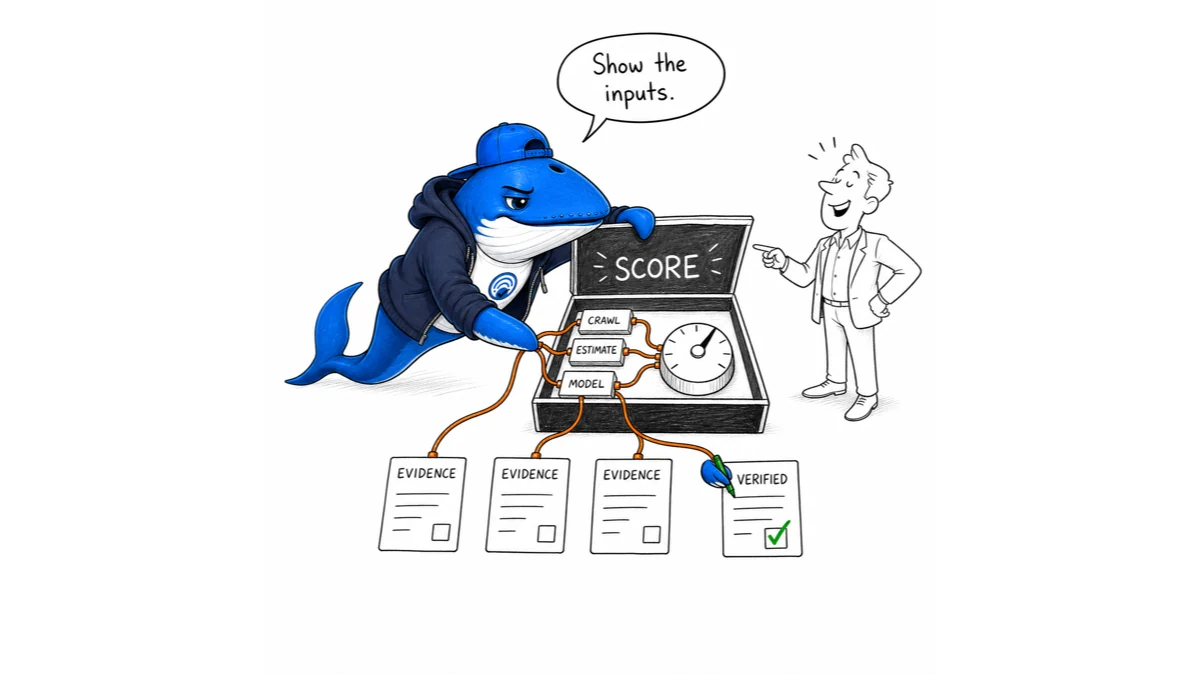
Published August 9, 2026: This evaluation framework follows Google’s June 2026 guidance for using third-party SEO tools.
An SEO or GEO tool score is the output of that vendor’s model. It is not Google’s internal ranking data, a promise of AI citation, or proof that fixing the highest number will improve business results. The score can still be useful when the tool exposes its inputs, method, scope, and uncertainty.
The right question is not “Is this score accurate?” in the abstract. Ask: accurate for which decision, against which evidence, under which conditions?
What Google warns about
Google says third-party tools do not have access to its internal ranking systems or complete Search data. Tool providers make their own predictions and estimates, and Google does not guarantee their accuracy. Google recommends understanding how a tool collects and interprets data before using it for decisions.
That warning is especially relevant to composite “health,” “authority,” “AI visibility,” or “GEO” scores. A single number can combine crawl observations, estimated search demand, sampled results, prompt sets, links, or proprietary weights. Two tools can score the same page differently without either number being a Google metric.
The seven-question scorecard
| Question | Evidence to request | Failure sign |
|---|---|---|
| What is measured? | Fields, definitions, scope, and unit | A label with no operational definition |
| Where does data come from? | Crawl, API, panel, prompt set, or estimate | “Live data” without provenance |
| How fresh is it? | Collection date and refresh cadence | No timestamp |
| How is it weighted? | Formula or meaningful methodology | A precise score from secret inputs |
| What is missing? | Coverage, row limits, sampling, and exclusions | No limitations section |
| Can it be validated? | Exportable observations and reproducible checks | Only the final number is visible |
| Which decision changes? | Action, threshold, owner, and expected outcome | “Improve the score” is the whole plan |
Separate observations, estimates, and advice
- Observation: the crawler received a 404 response from this URL at this time.
- Estimate: this keyword may receive a modeled amount of demand.
- Classification: the tool assigned the page to a topic or intent.
- Recommendation: the vendor believes a change is worth making.
- Composite score: the vendor combined several inputs using its own weights.
These can coexist in one product, but they should not inherit the same confidence. Verify direct technical observations on the site. Compare estimates with first-party data where possible. Treat recommendations as hypotheses with mechanisms, tradeoffs, and stopping rules.
Run a bounded evaluation
- Choose one decision, such as finding broken canonicals or monitoring named-page citations.
- Create a small verified truth set that includes normal cases and failure cases.
- Run the tool with saved settings, date, property, plan limits, and export.
- Measure false positives, false negatives, missing coverage, and time saved.
- Compare the recommendation with the mechanism and your first-party evidence.
- Adopt, limit, or reject the tool for that decision—not for every possible use.
A tool that catches 95% of broken canonical tags may be valuable for that audit even if its overall site score is unhelpful. A citation monitor can be useful for observation while remaining unsuitable for causal claims. Match the evidence layer to the decision using the AI visibility crosswalk.
A safe reporting template
Write: “Tool X reported 74/100 on August 9 using its documented crawl and weighting model. The underlying export found 18 URLs with missing descriptions; our direct check confirmed 15. We will fix the confirmed template issue and re-crawl, but we will not treat the composite score as a Google metric.”
This preserves the tool’s useful observation, exposes the validation, and keeps the conclusion within the evidence. It also gives a future reviewer enough detail to reproduce the decision.
Ask a question or join the discussion