Bing AI Performance: Audit Citation Share With a 29-Field Ledger
Interpret Bing Citation Share as a sampled grounding-query ratio, preserve filters and limits, and connect citations to search, referrals, and outcomes.
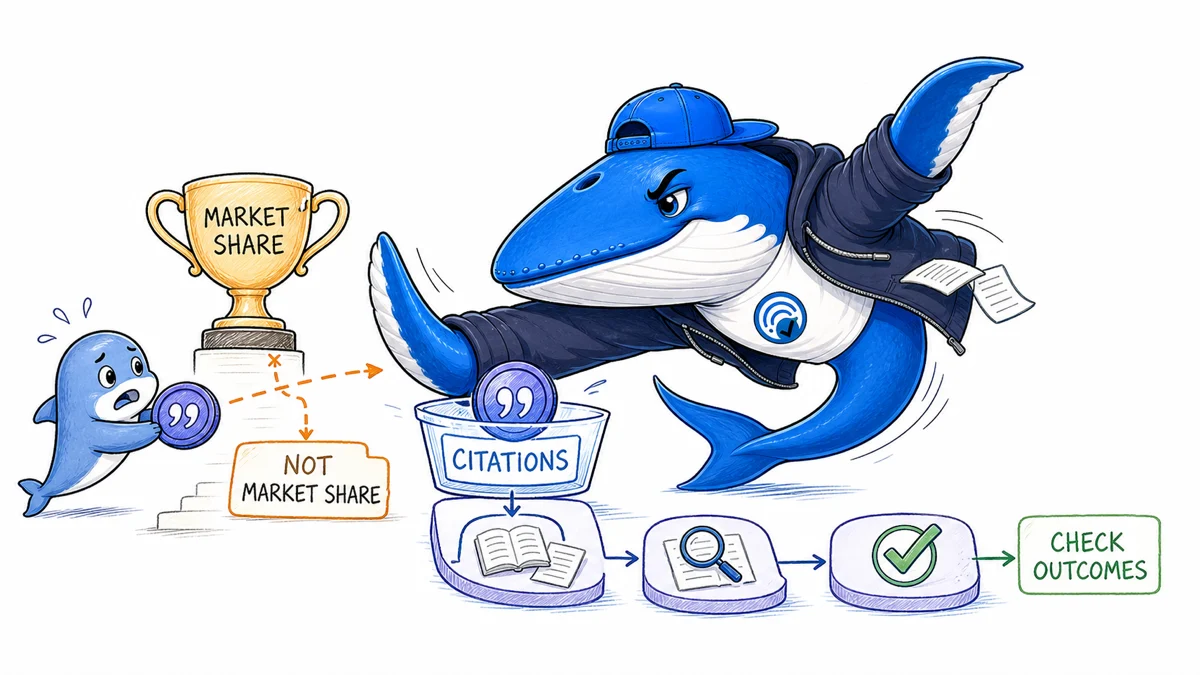
Direct answer: Bing Citation Share is the percentage of citations attributed to your site out of all citations shown for one grounding query. It is not market share, a ranking position, traffic share, authority, or a content-quality score. Use it to find a change worth investigating, then check the filtered export, cited page, search performance, referrals, and business outcome before choosing an editorial action.
This rebuilt guide includes a 29-field Bing AI Performance ledger. Its example rows are marked EXAMPLE-REMOVE. The worksheet preserves filters, sample limits, search and referral evidence, alternative explanations, and the decision that follows.
Start with Bing’s actual Citation Share denominator
Bing’s current AI Performance documentation defines Citation Share at the grounding-query level. The numerator is the citations attributed to your site; the denominator is all citations shown for that query. The remaining share does not expose competitor domain names.
A 20% share can describe different environments. It could represent one site citation in a five-citation set, two in ten, or twenty in one hundred. Do not invent counts when the interface or export does not expose them. Preserve the reported percentage, query group, page, filter, period, retrieval time, and any raw counts that are actually available.
| Recorded result | Supported reading | Unsupported leap |
|---|---|---|
| 20% for one grounding query | The site received one fifth of the shown citation space for that query | The site has 20% AI-search market share |
| Share increased | Relative citation presence changed in the reported sample | The page rewrite caused the increase |
| High total citations | The site was visibly referenced often in covered experiences | Every citation produced a visit or influenced the answer equally |
Record the covered AI surfaces and preview state
AI Performance aggregates citation activity from Microsoft Copilot, AI-generated summaries in Bing, and select partner integrations. That product scope is broader than a single Bing results page and narrower than every AI answer on the web. The Intents, Topics, Citation Share, and Compare capabilities are documented as preview features, so labels, sampling, and fields can change.
Write the supported-surface scope beside each export. If an executive asks whether a movement came from Copilot, Bing summaries, or a partner integration, the report does not promise that split. State that the aggregate cannot answer the question rather than assigning the change to the most familiar product.
Freeze filters before comparing two periods
Bing says exports reflect the active filter. A grounding-query filter and a page filter cannot be applied at the same time in the mapping view, so save each view as a separate record and give it a stable ID. Capture the property, date range, comparison period, filter type, filter value, export time, and report version.
The documentation also warns that page and grounding-query filters can show different counts for the same apparent pair because they may use slightly different sampled windows. Do not force those values to reconcile as if they came from a complete event ledger. Keep the records together, note the sampling boundary, and use them to prioritize review.
- Export the unfiltered baseline for the selected period.
- Filter one important grounding query and export its cited pages.
- Filter the relevant page separately and export its query groups.
- Repeat the same procedure for the comparison period.
- Store the files and filter manifest before interpreting the movement.
Keep citations, search, referrals, and outcomes separate
A visible citation is not a click. A click is not a qualified session. A qualified session is not a sale, lead, subscription, or retained customer. Join the layers for investigation, but do not rename one as another.
| Evidence | Question it answers | Important limit |
|---|---|---|
| Bing AI Performance | Where was the site visibly cited in covered AI experiences? | Sampled aggregate; not a click or rank log |
| Bing Search Performance | How did eligible pages perform in traditional Bing search? | Does not measure answer citations |
| Analytics and server logs | Which measured visits reached the site? | Cannot see citations that did not produce a visit |
| CRM or declared outcome | What did an attributed visitor do? | Attribution does not prove the citation caused the decision |
Use the AI visibility measurement crosswalk for the broader signal map and the GA4 referral guide for measured sessions. Both are companions to Citation Share, not replacements for it.
Treat Intents and Topics as review labels
Intents classify grounding queries into broad jobs such as informational, commercial, navigational, local, research, creation, or learn-and-solve. Topics group related query activity. These labels can help an editorial team organize a queue, but they do not reveal an individual user’s full prompt or prove that Bing understood the page correctly.
Compare the label with the page’s declared reader job. A troubleshooting guide grouped under a commercial topic may deserve inspection, but the label alone is not a reason to rewrite it. Look at the cited page, title, opening answer, evidence, update date, and nearby internal links. Correct an actual mismatch; do not stuff the label into headings.
Write at least three explanations for every movement
Bing states that citation trends are observational and cannot be attributed to one content edit or model event. A share can rise because your site gained citations, because the wider citation set contracted, because user demand changed, because another source changed, because a partner refreshed, or because sampling and classification changed.
| Pattern | Evidence to add | Bounded decision |
|---|---|---|
| Share down; citations stable | Total citations, topic demand, sampled filter notes | Hold or inspect the expanded citation environment |
| Share and citations down | Cited pages, crawl/index state, freshness, competing evidence | Review the affected page and delivery |
| Share up; referrals flat | Referral sessions, landing pages, call-to-action fit | Report citation gain without claiming traffic gain |
| Share up after rewrite | Release date, comparison periods, confounders | Continue observing; do not claim causality yet |
Use the 29-field citation-share ledger
Download the Bing AI Performance Citation Share ledger. Remove the EXAMPLE-REMOVE rows and use one row per filtered observation. The worksheet includes the period, filter, query group, page, labels, citations, share, sampling notes, search clicks, referrals, outcomes, release annotations, alternative explanations, owner, and next review date.
Leave numerator and denominator blank when Bing does not expose them. Blank means “not available in this observation”; it does not mean zero. Store the exported source file beside the ledger so a reviewer can trace the row back to the report state that produced it.
Change the page only when the evidence names a page problem
Useful reasons to revise include stale facts, a weak direct answer, missing primary evidence, an unclear page job, inaccessible tables, conflicting canonicals, or a cited passage that no longer supports its claim. A falling percentage by itself is not a content defect.
If you make a material edit, record the release date and keep the pre-change export. Use the small SEO experiment method to define the primary metric, guardrails, observation window, and stopping rule. Preserve demand shifts, model updates, site migrations, and other concurrent changes as confounders.
Sources and method
- Bing Webmaster Tools: AI Performance
- Bing Webmaster Tools: Search Performance
- SearchEngineAnswer editorial policy
The official documentation was rechecked on August 29, 2026. This article interprets Bing’s documented fields and provides an example-led operational ledger. It does not access a reader’s Bing Webmaster Tools property, report SearchEngineAnswer Citation Share results, identify competitor domains, or establish that a content change caused a citation movement.
Keep learning
Continue this topic
Next in this topic
Should You Block AI Crawlers? A Founder’s Decision Guide
Earlier in this topic
ChatGPT Product Feeds: Separate Discovery, Ads, and Checkout
AEO & AI Search
Ask a question or join the discussion