Gemini Deep Research’s legacy agent has an October 23 shutdown deadline
Google scheduled the legacy Deep Research API agent’s shutdown. Choose a replacement by job, then verify the complete research handoff.
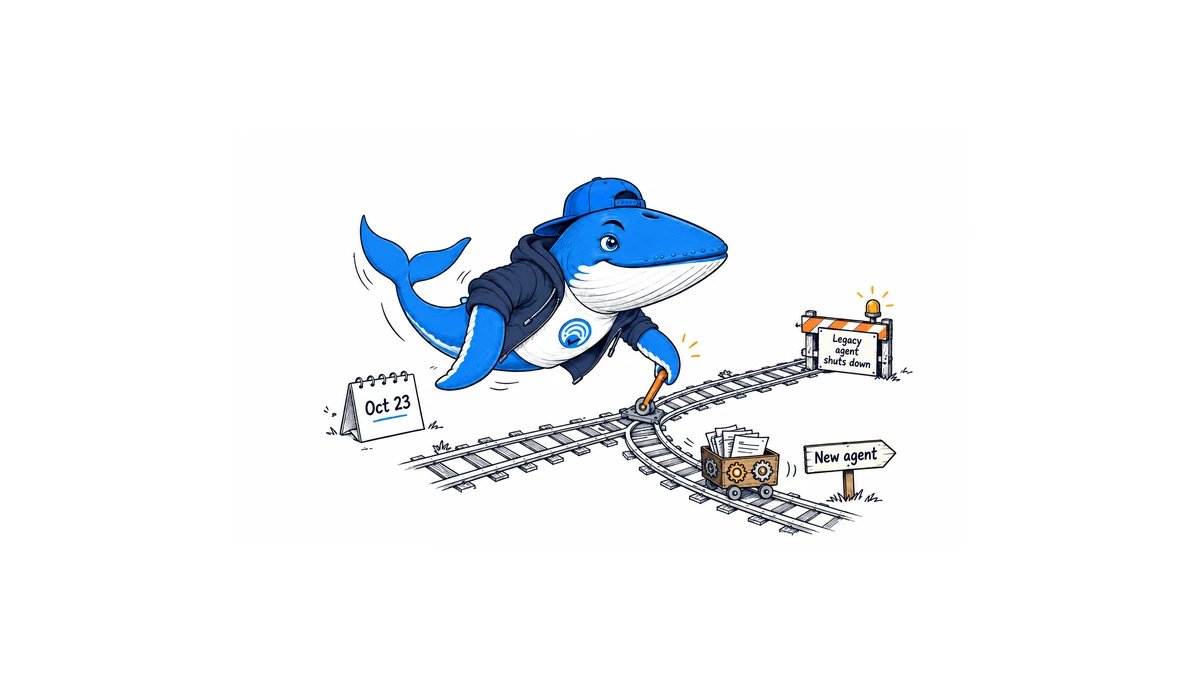
A scheduled research job can keep an obsolete agent identifier long after the person who built it has moved on. Google’s October 8 Gemini API notice schedules deep-research-pro-preview-12-2025 for shutdown on October 23. Teams using that identifier should find the affected jobs before their next automated run.
Google names two preview replacements: deep-research-preview-04-2026 for speed and client streaming, and deep-research-max-preview-04-2026 for more comprehensive research. The documented change is to the agent parameter in interactions.create. This concerns the Gemini API, not a shutdown of consumer Gemini research or Google AI Mode.
A deadline for one agent, not for every Gemini workflow
The deprecation schedule lists October 23 for the legacy agent and notes that these are the earliest possible shutdown dates. The specific release notice says the agent will shut down that day. Plan against the stated date, and recheck official notices before a production change; neither document is evidence that the shutdown has already happened.
Start with jobs that explicitly name the legacy agent. A general mention of “Gemini” in a prompt does not identify the runtime dependency. Search deployment configuration, saved request definitions, and scheduled-job settings, then connect each match to an owner and the next expected execution. Keep unrelated model migrations out of this change.
Choose by the handoff the reader needs
A research view someone waits to read
Consider an illustrative application that prepares a short competitor brief while a user watches. Its acceptance check should include whether progress reaches the interface, whether completion is recognized, and whether the final sources remain clickable. A response that eventually finishes can still fail the reader’s job if the interface never leaves its loading state.
The speed-oriented agent is a documented option to evaluate here, not a measured winner. Keep the original question, source requirements, and output contract constant. Save failed and incomplete runs alongside successful ones instead of selecting the cleanest demonstration.
A background brief consumed by another system
Now consider an illustrative overnight research job whose output feeds an editor’s queue. Its priority is a complete, reviewable brief. Check that the consumer recognizes the finished output, retains the source destinations, and separates supported facts from open questions. A more comprehensive answer can create extra review work if it adds unsupported detail.
Evaluate the comprehensive agent against that contract. Record actual time, retries, usage, and reviewer acceptance before changing the production route. These examples are proposed acceptance checks, not API experiments performed by Search Engine Answer.
The identifier is only the first check
Google’s Deep Research agent documentation is the reference for the current integration. After selecting an available replacement, test the whole route from scheduled start to the destination an editor or reader sees. Inspect timeouts, error handling, and a successful answer. Keep a fallback available or a safe pause mode; a soon-to-retire identifier is not a durable rollback option.
The migration is ready when the affected job completes under its normal execution identity, and its consumer accepts the result. Our SEO automation guide helps identify workflow dependencies, while the Gemini citation-span guide explains why preserving a source list differs from checking the claims it supports.
Keep learning
Continue this topic
Next in this topic
Shopify policy automation can replace your custom text and translations
Earlier in this topic
Haiku 5.5 Lowers Token Costs, but SEO Automation Still Needs a Review Budget
Tools & Workflows
Ask a question or join the discussion