ChatGPT Adds Virtual Try-On, but Our Anonymous Test Did Not Surface It
OpenAI documented virtual try-on for clothing and accessories. In three anonymous web prompts, ChatGPT returned text recommendations and one sponsored placement, but no Try on control.
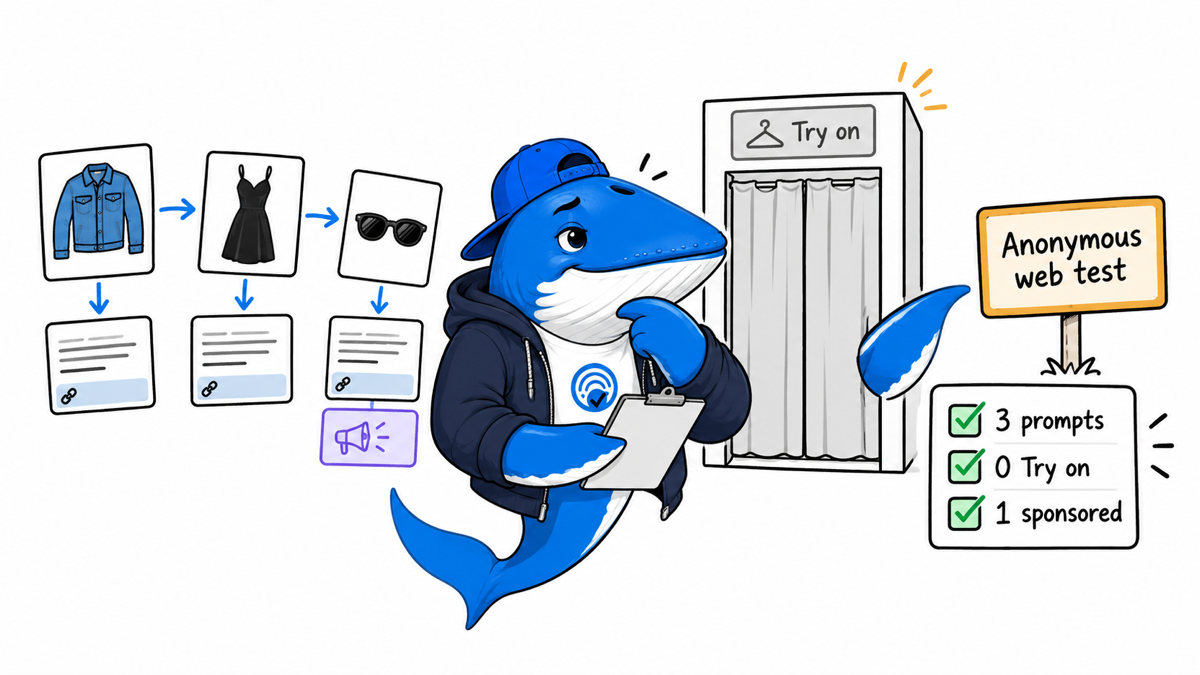
Direct answer: OpenAI documented a new Try on control for clothing and accessory listings in ChatGPT on October 1, 2026. In a three-prompt anonymous web check on October 3, ChatGPT returned nine product recommendations and one sponsored placement, but it did not show a product card or Try on control.
That result is a narrow availability observation, not evidence that virtual try-on failed everywhere. The test was signed out, used the web client, and did not cover a saved reference photo, a mobile app, a paid plan, another market, or a merchant feed.
What OpenAI documented
The ChatGPT release notes say a Try on button can appear on product listings for clothing and accessories. A user can take or upload a selfie, generate a virtual try-on with ChatGPT Images, and retain a reference photo for later sessions. The reference photo can be changed or deleted under Settings, Personalization, Reference photos.
The same release added Favorites and folders for saved products. OpenAI says the shopping changes are available on mobile and web. The note does not specify eligible countries, plans, merchants, catalog requirements, ranking inputs, or the share of product listings that receive the control.
| Control | Documented behavior | Still unspecified |
|---|---|---|
| Try on | Can appear on clothing and accessory product listings | Country, plan, merchant and listing eligibility |
| Reference photo | Saved for later try-ons and managed in Personalization settings | Retention and workspace differences beyond the linked controls |
| Favorites | Saves products to Favorites or a folder in the library | Merchant attribution and measurement fields |
A three-query anonymous observation
I ran the check in the unsigned ChatGPT web client on October 3, 2026. Each prompt asked for three products under a price ceiling. I recorded the response structure, source presentation, product-card presence, Try on control and sponsored content. I did not upload a photo, create an account, open a merchant destination or attempt a purchase.
| Prompt scope | Response observed | Try on | Sponsored placement |
|---|---|---|---|
| Men’s blue denim jackets under $150 | Three text recommendations with source buttons | Not observed | Not observed |
| Women’s black cocktail dresses under $200 | Three text recommendations with one source domain | Not observed | Not observed |
| Women’s sunglasses under $100 | Three text recommendations, a source group and a separate sponsored card | Not observed | Observed |
The unit here is a prompt-response observation, not a unique product listing audit. Nine named recommendations appeared across the three answers. None appeared as the product-listing interface described in the release note.
What the missing control means
The observation supports one limited statement: the anonymous web surface used for these three prompts did not expose Try on. It does not show whether the product was ineligible, whether the user state was ineligible, whether the interface was still rolling out, or whether a different query would have triggered a product card.
It also shows why a merchant should not treat a release note as proof of distribution. A capability can be documented while individual sessions still receive text recommendations, source links or ads without the new interface.
| Observed fact | Supported conclusion | Unsupported conclusion |
|---|---|---|
| No Try on control in three prompts | The control was absent in this signed-out web check | The feature is unavailable to all users |
| Text recommendations appeared | ChatGPT could answer with products without product cards | The named merchants were accepted into a specific feed program |
| One sponsored card appeared | Paid content was present beside one answer | The recommendation list itself was paid or ranked by ad status |
Audit the surface before changing product content
Merchants should first establish whether the feature appears for their audience. Use a small prompt set that includes a branded query, a non-branded category query, an accessory query and a product with strong image coverage. Record the country, language, device, client, account state, plan, prompt, result type, Try on state, source domain, ad state and time.
Then separate four questions:
- Did a product recommendation appear?
- Did the answer use a product card rather than plain text?
- Did the product card expose Try on?
- Did the interaction produce a measurable merchant visit or conversion?
One positive answer does not imply the next. Product visibility, interface eligibility, image generation and merchant outcomes are different layers.
The next useful test
A stronger follow-up needs matched prompts across signed-out, signed-in web and mobile sessions, with country and plan held constant where possible. If the control appears, record the product-card fields and the transition from listing to image generation. If it does not, keep the negative result tied to the exact environment instead of turning it into a platform-wide claim.
For the wider measurement boundary, use the ChatGPT product feeds, organic shopping and ads explainer. It keeps organic product results, sponsored placements and merchant feed programs separate. The AI visibility measurement crosswalk provides the same separation for citations, referrals and business outcomes.
Keep learning
Continue this topic
Earlier in this topic
Cloudflare Web Search API Makes Crawler Rules Part of the Contract
AEO & AI Search
Ask a question or join the discussion