Kagi Can Hide Paywalled Search Results: What Publishers Should Measure
Kagi added a preference to remove paywalled links from results. Publishers need a matched on/off test before blaming crawling, indexing, ranking, or the filter.
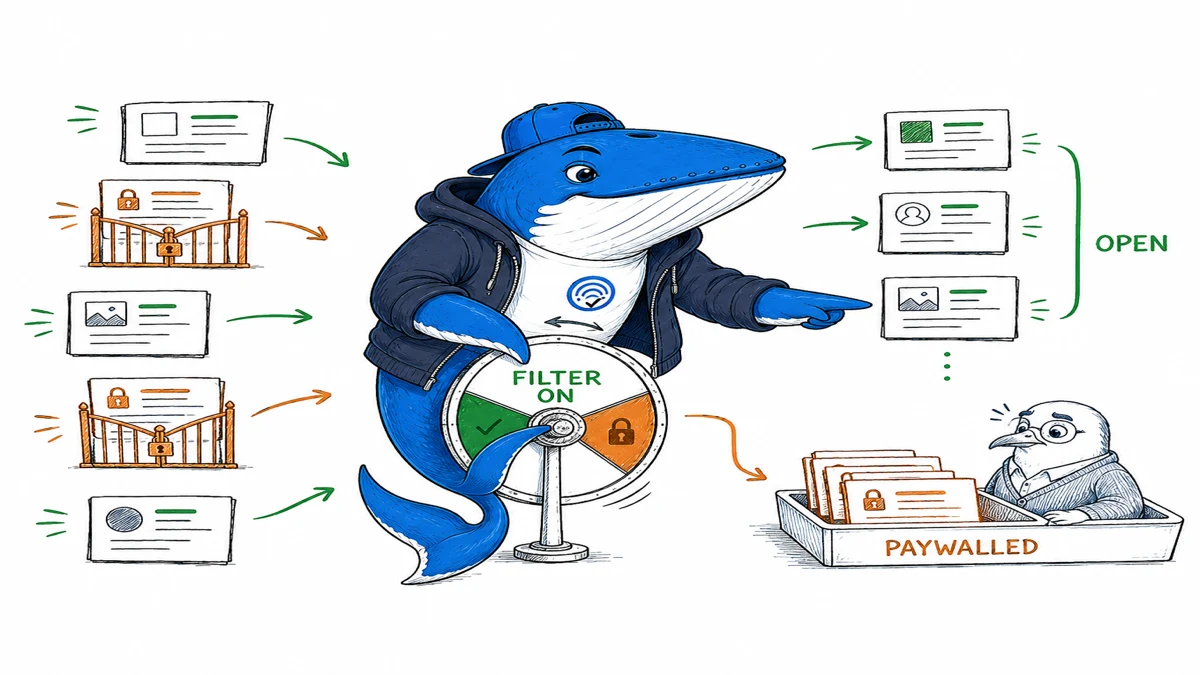
Kagi added a setting that can automatically remove paywalled links from a user’s search results. The August 21, 2026 changelog entry is short, but its measurement consequence is important: a paid article can be absent because of a user preference, not because the engine failed to crawl or rank it.
What Kagi announced
Kagi’s public changelog says it added a setting to automatically remove paywalled links from search results on August 21, 2026. The entry establishes the existence of a user-controlled filter. It does not publish a complete classifier specification, a list of affected publishers, adoption data, or a promise that every paywall will be detected.
That limited claim is the right starting point. “Can be hidden by a setting” is not the same as “Kagi has removed paywalled journalism.” Publishers should verify the preference state before attributing a missing result to indexation or ranking.
Add filter eligibility to the search funnel
A conventional diagnostic asks whether a URL was discovered, crawled, indexed, ranked, displayed, and clicked. Kagi’s preference adds another gate between ranking eligibility and display: was the result removed for this user because the paywall filter was on?
This matters because the corrective action changes by stage. Crawl and index problems call for technical work. Weak ranking calls for relevance or authority work. A preference-based removal calls for audience and product analysis; changing canonicals or resubmitting a sitemap will not override a user’s choice.
A matched on/off test publishers can run
- Choose 20 to 30 queries where your paid article and at least one open alternative are plausibly relevant.
- Record the URL, query, market, language, device, signed-in account, test time, and paywall type.
- Run each query with the paywall filter off, then on, changing no other setting.
- Save result position, result presence, title, snippet, host, and whether a paywall label or other marker appears.
- Repeat a sample in fresh sessions to distinguish stable filtering from ordinary result variation.
- Classify each pair as unchanged, paid result removed, different URL from the same publisher substituted, or inconclusive.
Do not automate at a rate that violates service terms. A small, reviewed comparison is more useful than a large scrape with uncertain settings.
Segment paywalls before interpreting results
Use separate labels for hard paywalls, metered access, registration walls, subscriber-only pages, and pages with a complete open article plus a paid offer. Detection and user expectations may differ. Also record whether structured data such as isAccessibleForFree and hasPart accurately describes the visible page, but do not assume those fields alone control Kagi’s classifier.
If an open explainer and a subscriber investigation serve different intents, compare them separately. Turning every paid page into a thin free summary can create duplication and weaken the product. The goal is to understand display paths, not to disguise access conditions.
What publishers should do with the results
First, quantify the exposed query set rather than extrapolating from one screenshot. Then decide whether an open service page, newsletter landing page, public abstract, or separate explainer genuinely helps the reader. Make its value complete enough to stand alone and link transparently to the paid work.
Track Kagi referrals, conversions, subscriptions, and assisted discovery separately from Google or AI-answer traffic. A low referral count does not prove the filter caused the decline. Use the same denominator discipline described in our AI visibility versus referral-traffic test and retain the preference state with every observation.
What not to conclude
- A missing paid URL does not prove deindexing.
- A visible URL with the filter off does not prove all users see it.
- A substituted free page does not prove Kagi selected it because it was free.
- A correct paywall label does not establish the classifier’s full input set.
- A handful of queries cannot establish platform-wide publisher impact.
These boundaries keep a useful product change from turning into an unsupported traffic narrative.
Source, method, and limit
Primary source: Kagi’s product changelog, checked September 4, 2026.
Information gain: the article adds filter eligibility to the diagnostic funnel and provides a matched on/off protocol with paywall-type segmentation.
Limit: Kagi has not published enough detail in the cited entry to infer classifier logic, adoption, accuracy, or traffic impact. Those questions require documented product detail or observed data.
Keep learning
Ask a question or join the discussion