Perplexity Source Labels Apply to Domains, Not Every Page or Claim
Perplexity’s Government, Academic, and Trusted labels provide domain-level context. They do not endorse every page, verify every claim, or promise citation visibility.
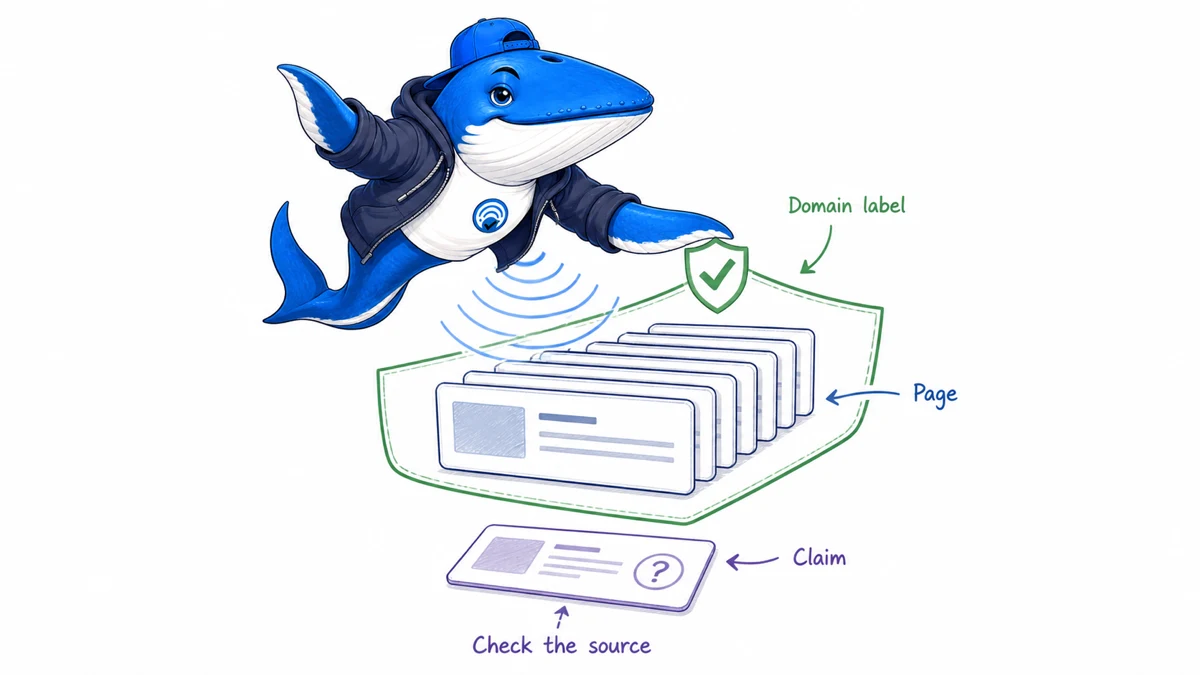
Direct answer: Perplexity’s Government, Academic, and Trusted labels describe a source domain, not the accuracy of an individual page or claim. A label is a context cue, not an endorsement, ranking guarantee, or citation signal. Publishers should audit whether their domain-level disclosures make the label understandable without assuming it changes visibility.
How Perplexity defines the labels
Perplexity’s source-label documentation, updated August 7, describes three labels:
- Government: an official government organization or agency.
- Academic: an educational institution or academic organization.
- Trusted: a domain that meets Perplexity’s stated publication-quality criteria.
For the Trusted label, Perplexity says it asks whether the publication discloses corrections, identifies authors, and separates news from advertising or opinion. The label applies at domain level. Perplexity explicitly warns that the label does not validate every page or claim on that domain.
The documentation also says partnerships and payments do not determine labels. A source without a label is not necessarily low quality, and a labeled source is not endorsed by Perplexity.
Domain, page, and claim are different levels
| Level | What can be evaluated | What the label establishes |
|---|---|---|
| Domain | Ownership, corrections, authorship, editorial separation | The label’s stated scope |
| Page | Date, author, evidence, conflicts, method, updates | Nothing automatically |
| Claim | Whether the cited source supports the exact statement | Nothing automatically |
A government domain can publish an outdated PDF. An academic institution can host a student page. A newsroom with sound corrections can publish opinion, sponsored content, or a mistake. Readers and answer systems still need to inspect the cited page.
This distinction matters in AI answers because a compact label can look like a quality score. Perplexity’s own wording is narrower: it gives context about a source domain.
A publisher disclosure audit
Whether or not Perplexity assigns a label, these checks improve reader accountability:
- Ownership: Name the legal or operating entity, the editorial leadership, and a working contact route.
- Corrections: Publish a visible policy and show how meaningful corrections are dated on the affected page.
- Authors: Use stable author pages with relevant expertise, recent work, and contact or profile links.
- Commercial separation: Mark advertising, affiliate relationships, sponsored material, and opinion in language a reader can understand.
- Evidence: Link important claims to primary material and describe tests, sample sizes, dates, and limitations.
- Freshness: Preserve publication dates, add meaningful update dates, and remove claims that can no longer be verified.
Run the audit on the mobile page, not only the policy documents. Disclosures that are technically present but hidden behind unclear labels or obstructive overlays do not help a reader evaluate a claim.
How to test whether labels affect visibility
Perplexity does not state in the help article that a source label changes ranking, retrieval, or citation probability. A correlation study should therefore avoid turning the label into the assumed cause.
Build a fixed prompt set and record every cited domain, label, citation position, answer claim, source type, query intent, date, account state, and model. Compare labeled and unlabeled domains only after controlling for authority, topical relevance, page freshness, content type, and the number of eligible pages.
A before-and-after comparison is difficult because labels can be added at the same time that Perplexity changes retrieval or the web changes. The stronger experiment uses matched domains and repeated prompts. Even then, the result shows association unless the system’s treatment can be isolated.
Do not redesign a publication solely to obtain a badge. Improve disclosures because they reduce ambiguity and help readers; measure any visibility effect separately.
Questions the current documentation leaves open
- How frequently are domains re-evaluated?
- Can a publisher request review or correct an inaccurate label?
- How are mixed platforms, user-generated sections, and hosted subdomains handled?
- Does the label appear on every product surface and in every region?
- Is label status used anywhere in retrieval or ranking?
These are unresolved based on the published help article. Absence of documentation is not evidence that the feature has no internal use, but it is also not permission to advertise an SEO benefit.
Sources, method, and limits
Source: Perplexity’s official “Understanding Source Labels” help article, updated August 7, 2026.
Method: We mapped every documented label claim to its stated domain-level scope, then built a publisher audit that can be completed without assuming a ranking benefit.
Limits: Perplexity does not publish the complete classification process, review cadence, domain inventory, or any label-to-citation experiment. Label presentation and coverage can change by product surface.
Keep learning
Continue this topic
Next in this topic
ChatGPT Restaurant Reservations: Local Search Guide
Earlier in this topic
Google AI Search Console Logging Error: Aug 13–17
AEO & AI Search
Ask a question or join the discussion