Gemini Imagen Shutdown: Migrate Image Tools Before August 17
Google is shutting three Imagen 4 API model IDs on August 17, 2026. Migrate production image workflows to Gemini image generation with a measured cutover and rollback.
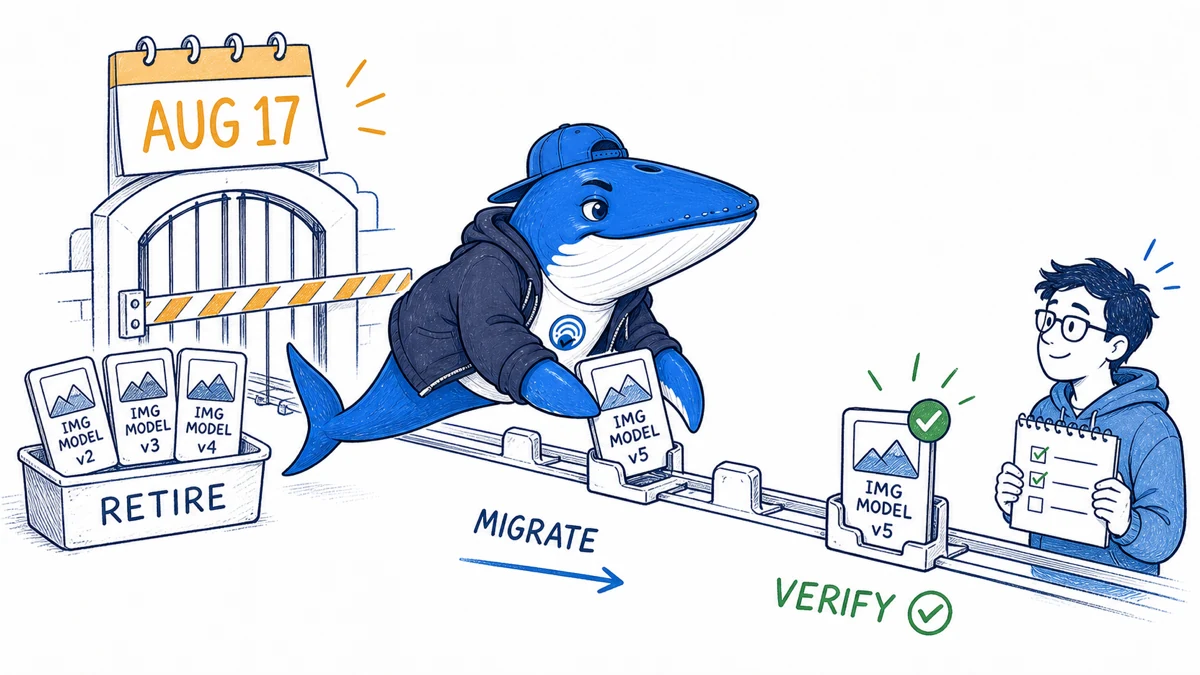
Direct answer: Google’s Gemini API deprecation table lists imagen-4.0-generate-001, imagen-4.0-ultra-generate-001, and imagen-4.0-fast-generate-001 for shutdown on August 17, 2026. A production workflow that still calls one of those model IDs needs a tested replacement before that date.
This is not a model-string swap. Google’s current image-generation documentation moves the recommended workflow toward Gemini image models through generate_content. That can change request construction, response handling, supported controls, output review, latency, cost, and safety behavior. Treat it as an application migration.
Inventory every image-generation path
Search application code, serverless functions, WordPress plugins, scheduled jobs, notebooks, internal tools, browser BYOK flows, deployment variables, and saved prompt templates for the retiring IDs. Record the owner, environment, caller, SDK version, endpoint, model string, authentication method, prompt source, output destination, and current fallback.
| Field | Why it matters | Evidence |
|---|---|---|
| Model and endpoint | Identifies the retiring call | Code reference and request log |
| Request controls | May not map one-to-one | Saved fixture and expected behavior |
| Output consumer | Defines file and metadata constraints | Upload, crop, moderation, or publishing path |
| Fallback | Controls outage behavior | Runbook and owner |
Do not limit the search to the main repository. The highest-risk caller is often an old automation that runs rarely and is not covered by the primary test suite.
Build a visual regression set
Select fixtures that represent the work the system actually performs: people, products, editorial illustrations, text inside images, aspect-ratio variants, reference-image inputs, sensitive prompts, long prompts, and prompts expected to fail. Preserve the exact request, model, date, response metadata, raw file, and human review notes.
- Run the old and replacement paths while the old model remains available.
- Check whether each required control is accepted, ignored, translated, or rejected.
- Compare dimensions, file type, transparency assumptions, text accuracy, subject fidelity, safety result, latency, and cost.
- Test downstream crops, compression, uploads, alternative text, and publication templates.
- Classify differences as acceptable, blocking, or requiring product approval.
A prettier sample does not prove migration readiness. A workflow passes when the replacement satisfies declared operational and editorial requirements across the fixture set.
Change the request and response contract deliberately
Follow the current Gemini image-generation examples for the supported model and SDK rather than copying an old Imagen request into a new model string. Validate response parts before assuming an image is present. Preserve text responses, blocked outputs, safety events, partial failures, and empty results as first-class states.
Pin the replacement model when reproducibility matters. A moving alias can be useful for current product behavior, but it is a poor regression instrument unless the resolved model and date are recorded. Keep the prompt transformation layer versioned as well; small automatic rewrites can create apparent model differences.
Never expose a shared server credential in a browser to imitate BYOK. A browser flow should store only the user’s own key locally, disclose where it is sent, and provide a clear removal path.
Release before the shutdown
Deploy a canary to a bounded share of real work. Monitor request success, blocked outputs, empty responses, latency, cost, downstream upload errors, crop failures, and human rejection reasons. Set a rollback trigger before the first production request and keep the old path available only within the documented shutdown window.
Complete the cutover early enough to observe recurring jobs. After verification, remove the retiring model IDs from code, secrets, configuration, documentation, and examples. Add an alert or test that fails when a retired ID reappears.
The evidence-led publishing guide provides the claim ledger and release review used here, while the technical launch checklist supplies the canary and rollback discipline.
Ask a question or join the discussion