ChatGPT Shopping Labels and Review Summaries: What Merchants Can Control
Separate merchant-controlled product facts from ChatGPT-generated titles, feature labels, review summaries, and merchant ordering.
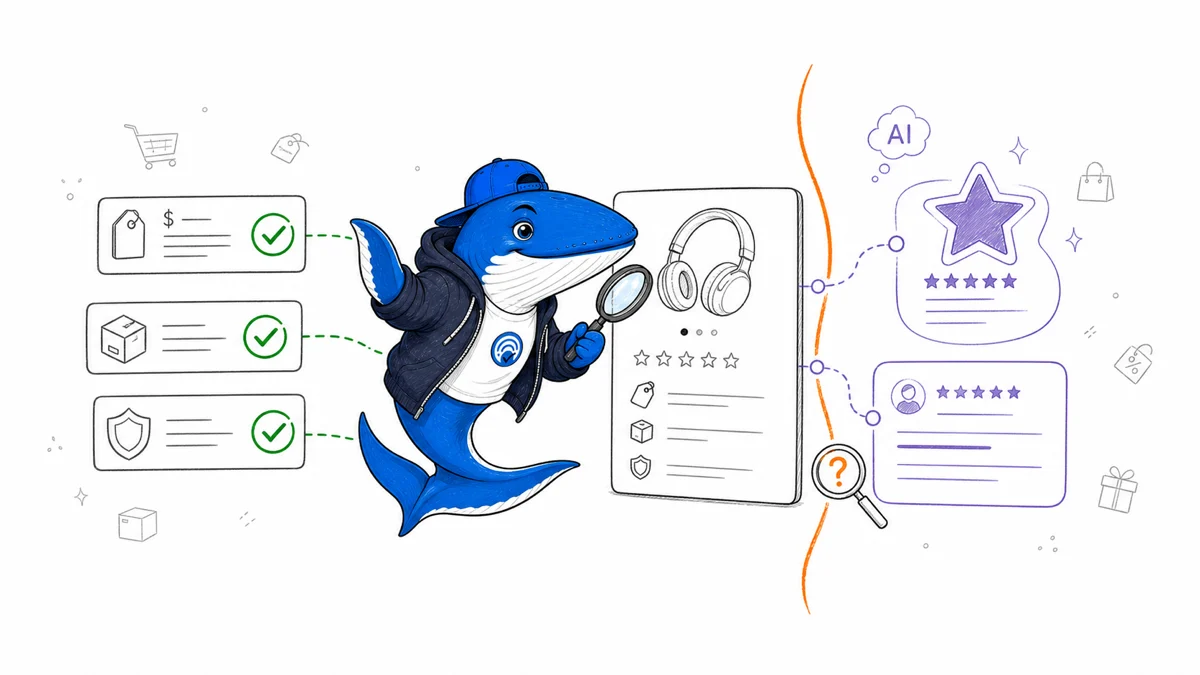
Published August 9, 2026: ChatGPT can generate simplified product titles, descriptions, feature labels, and review summaries for shopping results. OpenAI says labels such as “Budget-friendly” or “Most popular” are generated from available information, are not guarantees, and may not reflect all market data. Reviews and ratings are not verified by OpenAI.
This guide maps which shopping fields a merchant can control, which are generated, and which depend on external providers. It is based on OpenAI’s current documentation; SearchEngineAnswer did not run a statistically controlled shopping-result test for this article.
Separate source data from generated presentation
| Displayed element | Likely source layer | Merchant action |
|---|---|---|
| Price and availability | Merchant or third-party metadata | Keep feeds and product pages current |
| Simplified title or description | Generated by ChatGPT from provider information | Supply unambiguous canonical facts |
| “Budget-friendly” or “Most popular” | Generated label | Do not treat as a verified award |
| Review summary | Model summary of public reviews | Monitor underlying review accuracy and themes |
| Rating or review count | Public or provider data | Do not claim OpenAI verified it |
| Merchant order | Generated from availability, price, quality, seller relationship, and other factors | Verify first-party metadata and commercial facts |
The distinction matters when support teams investigate an incorrect phrase. Editing the page title may not directly change a generated label; fixing an inaccurate price requires a different path from disputing a review summary.
What OpenAI documents about product selection
OpenAI says product results are selected independently by ChatGPT and are not ads or influenced by OpenAI partnerships. Ads are separate. A product may appear when ChatGPT considers it relevant to the user’s intent, query context, Memory, or custom instructions. The system may consider price, reviews, ease of use, structured metadata, third-party content, model responses, safety standards, and product policies.
Not every available product is shown. This means a single prompt capture cannot establish a permanent rank. Results can vary with wording, user context, location, available data, product state, and later system changes. Track prompt and context if you monitor visibility, but do not present that capture as a universal position.
For Shopify merchants, OpenAI says product data is integrated through Shopify Catalog and individual merchants do not need extra work for that integration. Other merchants can review OpenAI’s product-feed documentation and direct-feed access process.
Audit the fields you can control
- Choose one canonical product identifier and use it consistently across the product page, feed, variants, and merchant systems.
- Keep price, currency, availability, shipping terms, and seller identity current.
- Write factual titles and descriptions that distinguish the item without keyword repetition.
- Map variants accurately so reviews, images, sizes, and prices do not attach to the wrong product.
- Expose clear return, warranty, and support information where applicable.
- Record the last successful feed update and the public page state before reporting an error.
OpenAI warns there may be delay after merchants update pricing or shipping. A discrepancy therefore needs a timestamped source-of-truth check before it is labeled a model error.
Review generated labels as interpretations
A “Budget-friendly” label may reflect reviewers discussing value rather than the lowest available price. “Most popular” may be inferred from available signals rather than a complete market census. OpenAI explicitly says these labels are not guarantees or verified statements.
When a label appears inaccurate, capture the prompt, date, product card, merchant detail page, cited or linked sellers, and the current first-party facts. Then classify the issue:
- Source error: the merchant page or feed is wrong.
- Freshness lag: the source changed but the result has not caught up.
- Entity mismatch: the label or reviews attach to a different variant or product.
- Generated interpretation: source facts are correct but the summary overstates them.
- Coverage gap: the comparison omits relevant sellers or market data.
Use the product feedback controls OpenAI provides. Do not rewrite your product claims to imitate a generated badge that OpenAI does not verify.
Build a shopping observation record
For monitoring, save the exact user request, account context that can be disclosed, country, device, date, product shown, merchant order, price, labels, review summary, and destination URLs. Compare that record with the canonical merchant feed and page. Repeat only after defining what change would count as meaningful.
This is an observation method, not a ranking tracker. The ChatGPT product-feed guide explains why organic product results, direct feeds, Shopify catalogs, checkout, and ads must remain separate reporting layers.
Ask a question or join the discussion