Back Button Hijacking: Audit Third-Party Scripts Before Google Treats It as Spam
Reproduce browser-history manipulation across real entry, consent, ad, and device states, then isolate the first- or third-party script that causes it.
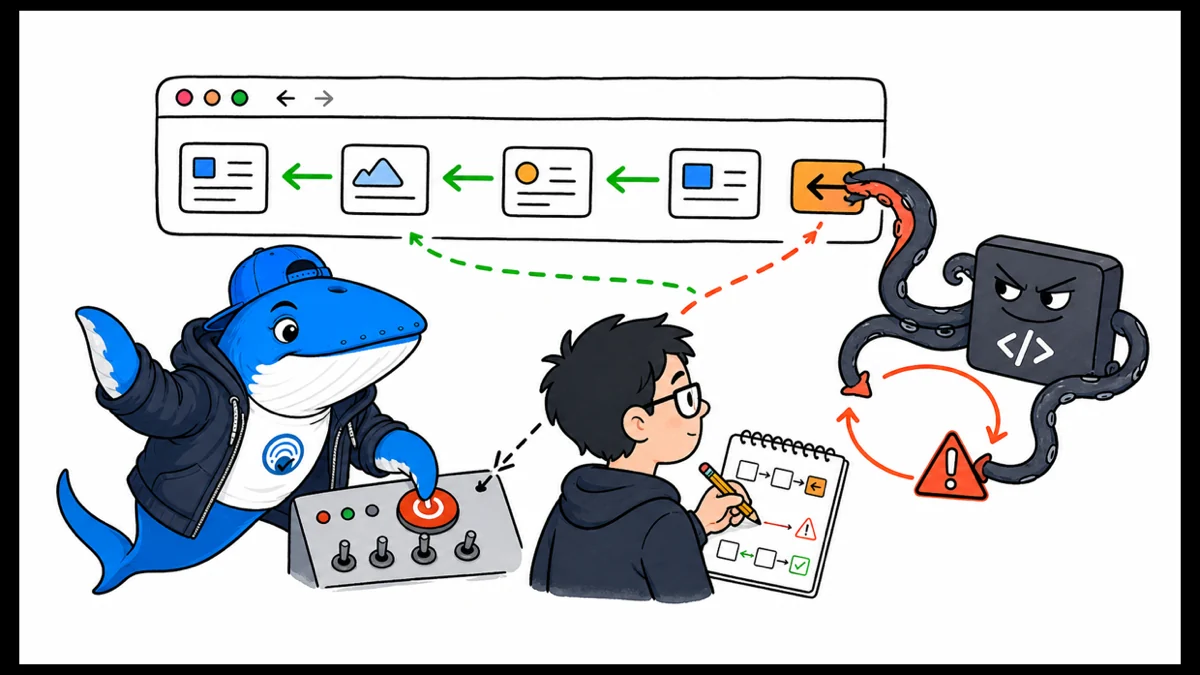
Published August 9, 2026: Google made back button hijacking an explicit malicious-practices violation and began enforcement on June 15, 2026. Pages that manipulate browser history so a visitor cannot immediately return to the page they came from can face manual spam actions or automated demotions.
The risk is not limited to code written by the site’s own team. Google notes that included libraries or advertising platforms can introduce the behavior. A meaningful audit therefore has to reproduce navigation with real third-party scripts, consent states, devices, and traffic sources—not only inspect the first-party repository.
What counts as back button hijacking
A normal page may use the History API for legitimate application navigation. The problem is deceptive manipulation: inserting or replacing browser-history entries so the Back button loops, returns to an interstitial, sends the visitor to an unexpected destination, or otherwise prevents an immediate return to the prior page.
The practical test is the user journey. Open a referring page, follow the link to the site, then press Back once. If the browser does not return as expected, preserve the exact route and investigate. Do not dismiss the result because the address bar appears normal or because a second press eventually escapes.
Run a reproduction matrix
| Dimension | Cases | Evidence to save |
|---|---|---|
| Entry | Search, social, email, direct, internal link | Referrer, landing URL, redirect chain |
| Consent | Before choice, accept, reject, returning visitor | Cookies, storage, scripts loaded |
| Device | Desktop, mobile, in-app browser | Browser version and screen recording |
| Monetization | Ads on/off, vendor and placement variants | Network log and script initiator |
| Navigation | One Back press, repeated Back, forward | History state and final destination |
Use a clean profile and a returning profile. Record the HTML, console, network requests, loaded bundles, pushState and replaceState calls, redirects, service-worker activity, and any script that runs on popstate. A video is useful for the symptom; a request and initiator log is needed to assign ownership.
Isolate the responsible script safely
Disable third-party tags in controlled groups: advertising, consent, analytics, personalization, push notifications, affiliate scripts, and optimization tools. Re-run the same path after each change. If a tag manager controls the release, compare its published versions and preserve the configuration that reproduces the issue.
Do not fix the symptom by adding another history manipulation layer. Remove or disable the responsible code or configuration. Then test the expected Back journey on the same devices and entry routes, including states in which the vendor previously behaved differently.
Make this a launch and vendor-review check. The technical launch checklist covers rollback and monitoring; the client-specific fetch study shows why one passing client cannot establish universal behavior.
After remediation or a manual action
Deploy the smallest change that removes the manipulation, record the affected URLs and vendor version, and watch logs and user reports for recurrence. If Search Console reports a manual action, review its scope, correct all affected templates, document the fix, and submit a reconsideration request only after the behavior is gone.
An automated demotion may not provide a message or a fixed recovery date. Do not promise that rankings will return on a schedule. The controllable outcome is a browser journey that matches user expectations across the tested states.
Contracts with ad and library vendors should require notification of navigation changes, a disable switch, version history, and a named escalation route. Back navigation is part of the product, even when a third party supplies the script.
Keep learning
Continue this topic
Next in this topic
Google “Read More” Deep Links: Preserve Section Anchors and Hash Fragments
Earlier in this topic
Google Site Moves: Domain-Variant Migration Matrix
SEO
Ask a question or join the discussion